[Editorial] Ill-Prepared Yellow Envelope Law Raises Serious Risk of Deepening Labor-Management Conflict
- Input
- 2026-02-10 18:30:06
- Updated
- 2026-02-10 18:30:06
The Yellow Envelope Law essentially expands the bargaining responsibility of principal employers and reduces unions’ liability for damages arising during strikes. The Ministry of Employment and Labor (MOEL) first released a draft revision of the enforcement decree last December, but after both labor and management objected, it revised the wording and reissued the draft on the 6th.
The reissued draft keeps "single bargaining channel" as the basic principle within a bargaining unit, but allows separate bargaining units for principal contractors and subcontractors in light of differing interests, representation issues, and the potential for conflict. As a result, companies that rely on many subcontractors may face repeated negotiations, significantly increasing their bargaining burden.
There is growing concern that the Yellow Envelope Law will impose substantial costs on the Korean economy. If uncertainty in labor-management relations increases, companies may delay or scale back investment, and some analyses warn that a one-percentage-point drop in the investment rate could lower gross domestic product (GDP) growth by 0.3 to 0.4 percentage points.
The law’s implementation could also give hesitant companies a pretext to cancel planned investments or shut down loss-making operations. In a survey of 100 foreign-invested firms operating in Korea conducted after the Yellow Envelope Law passed, more than 35 percent responded that they were considering reducing investment or even withdrawing their Korean operations.
Companies liken the current atmosphere ahead of the Yellow Envelope Law’s enforcement to the calm before a storm. Recalling how the introduction of the 52-hour maximum workweek regulation and the Serious Accidents Punishment Act initially triggered a series of disputes over interpretation and application, they are now reviewing their legal and labor-relations response manuals. Many say they are determined not to become the first high-profile test case that draws public attention.
To be sure, it is difficult to predict with certainty the outcome of the Yellow Envelope Law, which takes the country down an uncharted path. There is a possibility of positive effects, such as reduced damage-liability burdens on workers, more stable labor relations, and higher productivity. Some studies even suggest that the law could generate a certain level of economic benefits. Nevertheless, given today’s confrontational labor-management climate, it is hard to rule out the risk that, without meticulous preparation, the new system will actually intensify conflict rather than ease it.
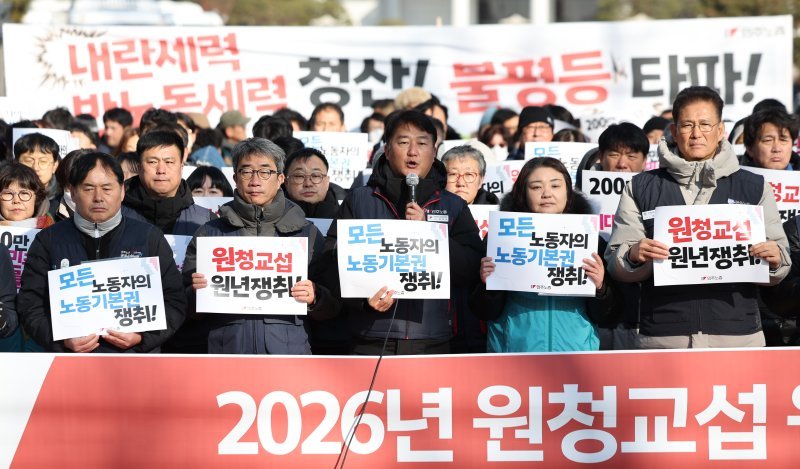
Labor groups have already declared this year the starting point for expanding direct bargaining with principal employers and have announced plans for collective action. They plan to send formal bargaining requests this month, followed by various rallies and mass meetings. The government says it will build up case examples consistent with the law’s intent through on-site guidance, but as long as labor and management remain far apart, it is far from clear whether the Yellow Envelope Law can take root smoothly.
We live in an era when artificial intelligence (AI) and humanoid robots are reshaping the entire structure of the labor market, and national competitiveness hinges on how quickly and effectively societies adopt new technologies. In such a world of relentless competition, prolonged and wasteful labor-management strife only weighs down the Korean economy. Rather than putting ideology first, the government must urgently establish realistic, detailed standards and clear guidelines, and use predictable complementary measures to ensure a soft landing for the new system so that both labor and management can adapt to the new environment.