[Editorial] Lawmakers must heed CCEJ’s warning on rushed administrative integration
- Input
- 2026-02-10 18:30:01
- Updated
- 2026-02-10 18:30:01
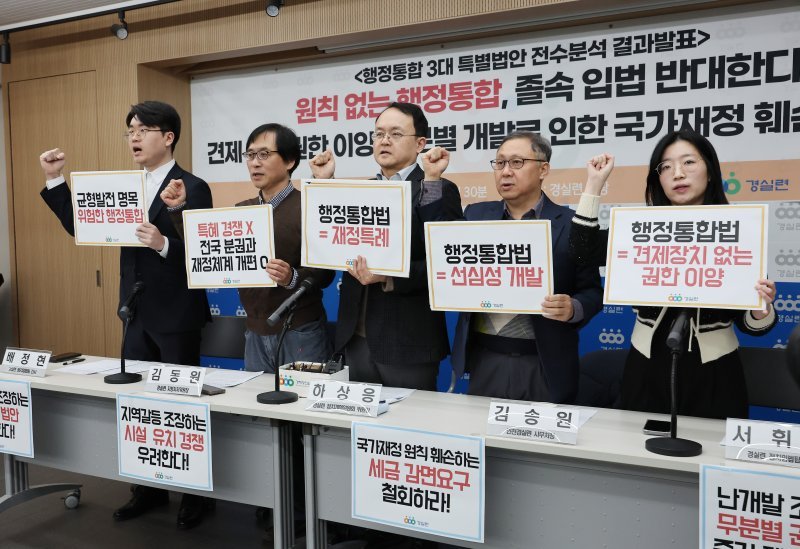
The stated rationale for administrative integration is that the concentration of population and resources in the capital area is accelerating the decline of the provinces, so local governments must be scaled up to enhance their competitiveness. The justification sounds reasonable. However, in the rush ahead of local elections, the process has become hasty, with insufficient efforts to gather public opinion, and that is a serious problem. CCEJ argued that the three special bills on administrative integration amount to "hasty legislation that institutionalizes development-related special favors and undermines constitutional principles," and called for their immediate withdrawal.
CCEJ says it conducted a clause-by-clause analysis of the special bills. It concluded that the legislation distorts the purpose of decentralization, destabilizes the national administrative system and could lead to reckless fiscal waste. Of the 1,035 provisions across the three bills, 869 clauses—83.96%—are said to focus on special benefits such as fiscal exceptions, transfers of authority and the incorporation of local demands. The bills also reportedly contain many provisions that would undermine fairness with other local governments, including preferential treatment for certain regions’ social overhead capital projects and guarantees to host national institutions.
Provisions that would convert national taxes such as capital gains tax and corporate tax into revenue sources for local governments, and that would require the central government to cover operating costs for local projects, were described as "extra-legal demands that shake the foundations of the national fiscal order and encourage moral hazard." In particular, CCEJ warned that clauses effectively neutralizing preliminary feasibility studies would "render toothless a key mechanism for preventing the waste of taxpayers’ money."
CCEJ also argued that provisions delegating licensing and permitting authority wholesale to local government heads, and demands for inheritance tax reductions for specific regions, violate the Constitution’s principles of taxation by law and equality. If the same entity both develops projects and exercises permitting power, checks and balances such as environmental impact assessments can be neutralized, making it difficult to prevent environmental damage and haphazard development, the group pointed out. It further criticized the exclusion of mandatory local referendums, saying that leaving out such procedures disregards the will of residents.
The points CCEJ raises one by one are largely persuasive. Above all, it is wrong in itself to rush through a restructuring of the national administrative system in this slapdash manner. Both the ruling and opposition parties have fallen into populism, chasing votes ahead of local elections. They must regain their composure, even at this late stage. Even if CCEJ’s criticisms are not correct in every detail, it is only proper to revisit the contentious issues, solicit further opinions and head off foreseeable problems before the bills are passed.
Many citizens are asking, "Why are they trying to merge local governments, and why are they in such a hurry?" They say they do not understand the reason for integration, nor the reason for the rush. Yet in situations like this, the ruling and opposition parties easily find common ground. That is what makes politics so troubling. There is ample reason to reflect carefully on CCEJ’s criticism that this is "a special law that circumvents the Constitution and a scramble for special favors" and nothing more than "political point-scoring."