Shipbuilding Stocks Enter Correction After Rally, Analysts Call It a Breather
- Input
- 2026-02-11 06:00:00
- Updated
- 2026-02-11 06:00:00
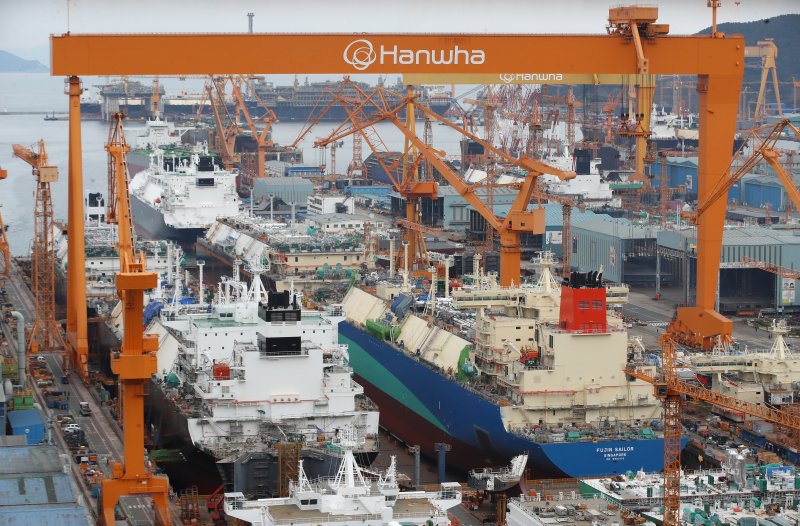
According to the Korea Exchange (KRX) on the 11th, from January 9 to February 10, HD Hyundai Heavy Industries fell from 609,000 won to 534,000 won, a decline of 12.3%. Over the same period, HD Korea Shipbuilding & Offshore Engineering (HDKSOE) dropped from 447,000 won to 382,000 won, down 14.5%. In contrast, Hanwha Ocean slipped only 2.6%, from 134,400 won to 130,900 won, while Samsung Heavy Industries also saw a pullback in the low 2% range, showing relatively stable performance.
Analysts note that the size of the correction broadly matches the magnitude of the earlier gains. For the HD Hyundai group, which drove the early-year strength in shipbuilding stocks, high-priced orders and clearer medium- to long-term earnings visibility beyond 2026 were quickly priced in, resulting in a steep short-term rise. As a result, the recent pullback has also been relatively larger.
Several factors are cited behind the increased share-price volatility, including the fact that higher prices for Liquefied Natural Gas carrier (LNG carrier) newbuilds have yet to clearly materialize and that fourth-quarter results are hard to compare on a simple year-on-year basis due to merger effects and bonus payments. By contrast, expectations were priced into Hanwha Ocean and Samsung Heavy Industries at a more gradual pace, so their share-price corrections over the past month have been relatively limited.
Bae Ki-yeon, an analyst at Meritz Securities, explained, "There are many concerns about the outlook for LNG carriers, which represent the commercial ship segment," adding, "Even though we confirmed final investment decisions on a number of U.S.-origin LNG carrier expansion projects last year, we have yet to see news of large-scale orders for Korean shipyards or of ship prices rising on the back of stronger demand."
Even as share prices correct, industry indicators remain solid. In January, global newbuilding orders declined year-on-year in terms of the number of vessels, but the share of large ships increased, so order volume actually rose when measured in compensated gross tonnage (CGT). With orders still centered on high value-added vessel types such as LNG carriers and tankers, the order mix continues to favor Korean shipbuilders.
Overall, the trend in newbuilding prices is also supportive. In dollar terms, prices for some vessel types have undergone a modest adjustment, but in won terms they remain stable thanks to the weaker currency. As a result, concerns about margin erosion for domestic shipbuilders are seen as limited.
From an earnings perspective, the medium- to long-term momentum remains intact. High-priced orders will start to be recognized in earnest from 2026, so revenue and profit leverage are likely to expand step by step. A solid backlog of orders for commercial and specialized vessels is also enhancing earnings visibility.
Eom Kyung-ah, an analyst at Shinyoung Securities, said, "For Korean shipbuilders, this year is a period when price growth outpaces growth in workload," and added, "Given that this is not a phase where variable costs are rising sharply within the overall cost structure, we expect operating leverage on sales to be maximized."
[email protected] Bae Han-geul Reporter