KOSPI ends flat as semiconductor rally pauses [Closing Market Report]
- Input
- 2026-02-10 16:20:56
- Updated
- 2026-02-10 16:20:56
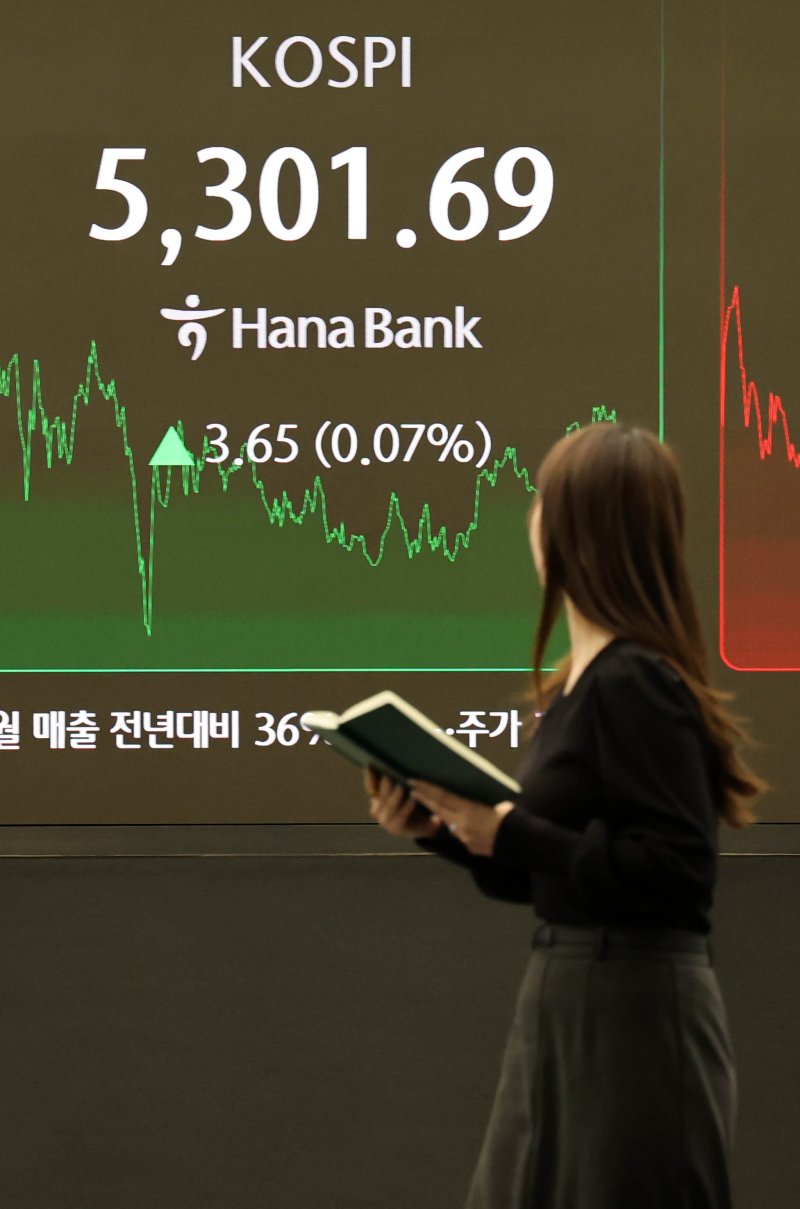
According to Financial News, the KOSPI finished nearly unchanged around the 5,300 level as semiconductor stocks took a breather.
According to the Korea Exchange (KRX) on the 10th, the KOSPI closed at 5,301.69, up 3.65 points (0.07%) from the previous day. During the session, the index climbed as much as 1.24% to 5,363.62 compared with the previous close, but it gave back most of its gains on selling by retail investors.
On the main KOSPI market, foreign investors and institutions were net buyers of 97.3 billion won and 637.8 billion won, respectively, while individuals were net sellers of 929.7 billion won.
By sector, paper and wood (8.26%), textiles and apparel (3.34%), and transportation and storage (3.11%) were strong. In contrast, electricity and gas (-2.40%), medical and precision instruments (-1.09%), and transportation equipment and parts (-0.91%) were weak.
Among large-cap stocks by market capitalization, Shinhan Financial Group (4.93%), KB Financial Group (3.17%), and Samsung Life Insurance (2.59%) advanced. Hanwha Aerospace (-4.36%), Doosan Enerbility (-1.57%), and Hanwha Ocean (-1.43%) declined.
The two leading semiconductor blue chips, Samsung Electronics (-0.30%) and SK hynix (-1.24%), were weak.
The KOSDAQ closed at 1,115.20, down 12.35 points (-1.10%) from the previous day. Retail investors were net buyers of 464 billion won, while foreign investors and institutions were net sellers of 341.5 billion won and 90.8 billion won, respectively.
Jungeun Lim, a researcher at KB Securities, explained, "In the domestic stock market, large-cap names such as Samsung Electronics and SK hynix paused in a tight range, while rotational buying moved into sectors with strong earnings expectations, leading to relative strength in domestic demand and consumer stocks." Lim added, "Financial holding companies continued to gain on expectations of improved earnings and stronger shareholder returns in line with changes in the policy environment."
[email protected] Bae Han-geul Reporter