BOK Governor Rhee Chang-yong Warns 'Compressed Aging Will Weaken Growth Potential'
- Input
- 2026-02-10 14:12:03
- Updated
- 2026-02-10 14:12:03
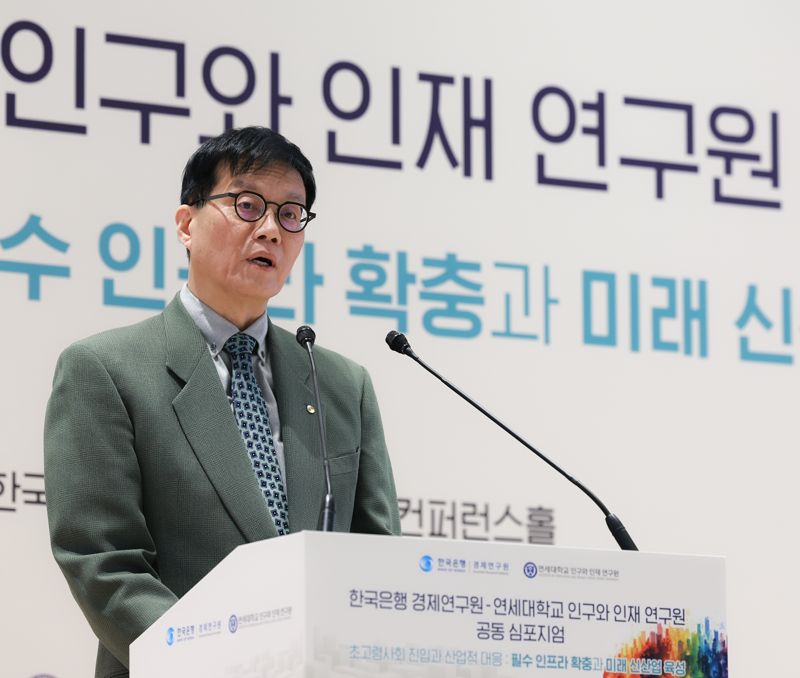
In his congratulatory address at the joint symposium of the BOK Economic Research Institute and the Yonsei Institute for Population and Talent, held on the 10th at the BOK annex in Jung District, Seoul, Rhee stated, "Compressed aging not only weakens growth potential but also rapidly increases the social burden of support," adding, "It is posing a serious challenge to the sustainability of our economy."
Rhee went on, "If the current pace of aging continues, by around 2050 we are expected to become the world’s oldest country, with roughly one out of every two people being elderly," noting, "The speed of change in our society is so unusual that overseas observers even refer to Korea as the 'canary in the coal mine' for aging risk."
Korea has already entered a super-aged society, with people aged 65 and older accounting for more than 20% of the total population as of last year.
Rhee continued, "Aging is also a structural change that creates new demand," and emphasized, "As demand for essential end-of-life services such as caregiving, medical care, and funerals is rising rapidly, there are limits to what can be supported with constrained public finances alone, so we must build a sustainable supply base from an industrial perspective."
However, he cautioned, "It is not as easy as it sounds to overhaul the institutions and regulations needed to support this," explaining, "This is because legal and institutional constraints and various interests are intertwined, and the adjustment process inevitably creates winners and losers."
In this context, the BOK has released a series of structural reform reports. Rhee also introduced these reports at the event.
The BOK Issue Note titled "Promoting Essential End-of-Life Industries in a Super-Aged Society," released that day, raises concerns about supply–demand imbalances in nursing homes and cremation facilities. Rhee explained, "Currently, nursing care fees are applied uniformly nationwide, even though real estate costs differ greatly by region," and proposed, "We suggest a system in which users partially bear the portion of costs corresponding to land and building rents."
Regarding cremation facilities discussed in the same report, he pointed out, "Because they are perceived as a typical NIMBY facility, expansion of such facilities has been delayed," and warned, "If this bottleneck is not resolved, the burden and inefficiency in the funeral process will inevitably grow." As an alternative, he proposed installing small, decentralized cremation facilities within large hospital funeral halls.
Another BOK Issue Note released the previous day, titled "Strategies to Foster the Advanced Biohealth Industry: Building a Foundation for the Use of Bio Data," addresses how to make better use of bio data.
Rhee remarked, "Korea’s healthcare data has enormous potential value, to the point that it is called the 'diamond of the AI era,'" but added, "In reality, the responsibility and burden of protecting personal information fall excessively on individuals and medical institutions, so data is not being fully utilized."
He then proposed, "For research recognized as being in the public interest, the state should approve the use of data, and for such approved research, we suggest a new framework that enhances predictability in procedures and activates the distribution of bio data under strict safeguards."
[email protected] Kim Tae-il Reporter