Heaviest Lunar New Year Traffic Expected on the Morning of the 15th for Departures and the Afternoon of the 17th for Returns
- Input
- 2026-02-10 11:00:00
- Updated
- 2026-02-10 11:00:00
The Ministry of Land, Infrastructure and Transport announced on the 10th that it will implement special transport measures for the Lunar New Year holiday for six days from the 13th to the 18th. During this period, it will pursue five key tasks: improving traffic flow, expanding travel convenience and services, ensuring traffic safety, increasing public transport capacity, and strengthening preparedness for adverse weather.
First, on 242 sections of expressways and national highways where congestion is expected, drivers will be guided to detour routes, and 69 shoulder lanes on expressways will be opened for use. On the Gyeongbu Line between Yangjae and Sintanjin, the operating hours of the bus-only lane will be extended by four hours compared with normal days, from 7 a.m. to 1 a.m. Traffic conditions, accidents, and other road information will be provided in real time through mobile apps, electronic road signs, and traffic broadcasts.
Measures to improve travel convenience and services will also be implemented. Fares will be discounted by 30–50% for Korea Train eXpress (KTX) and Super Rapid Train (SRT) passengers traveling from cities to hometowns or visiting regions with declining populations, and the number of new ticket vending machines accessible to passengers with reduced mobility has been expanded to 148 stations nationwide.
To ease congestion at airports, the opening time of international departure halls will be moved up by up to 30 minutes. Temporary parking lots will be secured, and parking fees will be waived for domestic flight passengers who are from multi-child families or are persons with disabilities.
Special safety inspections are also under way for transport facilities, vehicles, and passenger ships to ensure smooth operation of roads, railways, aviation, and maritime transport. Using AI technology, warning messages will be displayed on electronic road signs in high-risk accident zones, and systems will detect whether seat belts are fastened in all seats. Highway patrol footage will be analyzed with AI to strengthen public reporting of traffic law violations.
To accommodate the increase in public transport users, the number of bus, rail, air, and passenger ship services and seats will be increased by 12.7% (16,578 trips) and 9.7% (937,000 seats), respectively, compared with normal periods.
Additional measures include strengthening road patrols and pre-spreading and re-spreading de-icing agents in vulnerable areas to prepare for heavy snow and icy conditions.
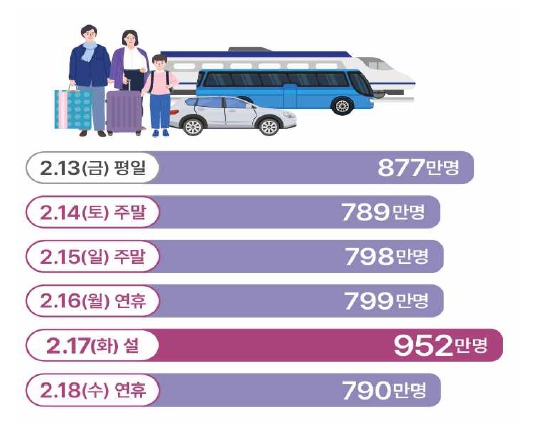
The Ministry of Land, Infrastructure and Transport expects a total of 27.8 million trips during the measures period, or an average of 8.34 million trips per day. Although the total number of trips is projected to decrease by 13.1% compared with last year’s Lunar New Year measures period, the shorter holiday means the daily average number of trips is expected to rise by 9.3%.
Most people are expected to travel by car (86%), and average daily traffic volume on major expressways is forecast to reach 5.25 million vehicles, up 14.1% from last year. The heaviest congestion is expected on outbound routes on the morning of the 15th and on inbound routes on the afternoon of the 17th.
[email protected] Choi Ga-young Reporter