Foreign investors dumped 10 trillion won in Korean stocks but snapped up quality names
- Input
- 2026-02-10 12:18:09
- Updated
- 2026-02-10 12:18:09
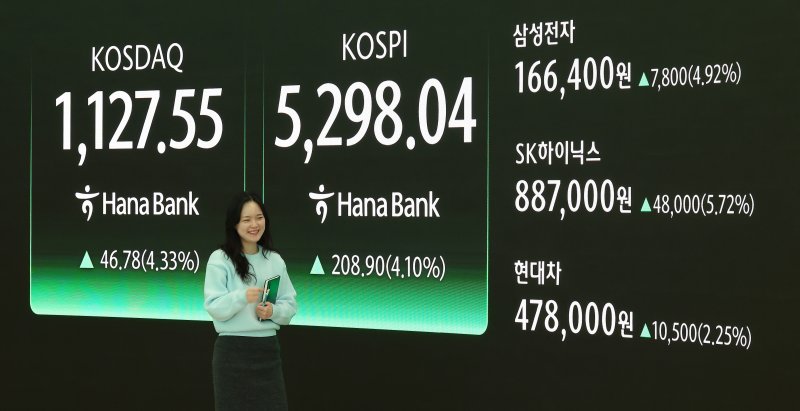
According to Financial News, foreign investors, who have been showing strong selling in the domestic stock market, are at the same time buying stocks outside the semiconductor sector. They appear to be positioning for a rotational market.
According to the Korea Exchange (KRX) on the 9th, foreign investors recorded net selling of about 10.38 trillion won over six trading days this month. On the 5th alone, they offloaded roughly 5.29 trillion won worth of shares, the largest daily net selling of Korean stocks so far this year. Shaken by the foreign sell-off, the KOSPI plunged 3.86% in a single day.
Foreign investors have been dumping SK hynix, with net selling of about 5.21 trillion won, and Samsung Electronics, with around 4.64 trillion won in net selling. Nearly 10 trillion won has flowed out of just these two semiconductor bellwethers.
Analysts say that after the index’s rapid short-term surge, concerns about overheating have grown, while mounting uncertainty over U.S. artificial intelligence (AI) stocks has increased the incentive for foreigners to take profits in semiconductor names.
Kyung-Min Lee, a researcher at Daishin Securities, said, "After the KOSPI broke above the 4,600 level, foreign investors switched to net selling, and the scale of that selling has expanded." He added, "We are seeing large net selling this month, and profit-taking is concentrated in semiconductors, which have led the market."
However, buying is piling into stocks viewed as undervalued. The stock that foreign investors have purchased the most this month is Doosan Enerbility, with net buying of 381.2 billion won. Celltrion has been the top net buy by foreign investors so far this year, drawing strong interest. Doosan Enerbility’s share price has also surged 26.8%, from 75,200 won at the start of the year to 95,400 won as of the 9th.
Min-Jae Lee, a researcher at NH Investment & Securities, raised his target price for Doosan Enerbility to 111,000 won, saying, "Increased order value and volume tied to Korea Electric Power Corporation (KEPCO)’s expansion into the U.S. market, the full-scale launch of SMR projects with partners such as X-energy and TerraPower, and the prolonged shortage of gas turbines are all positive catalysts." He continued, "We also raised our target price to reflect a 30% increase in equipment order prices for Team Korea and the expansion of AP1000-related project work in the United States."
After Doosan Enerbility, foreign investors have been buying Hanwha Solutions, with net purchases of 194.2 billion won, and Celltrion, with 173.5 billion won. Celltrion is the second-most purchased stock by foreign investors so far this year, after Doosan Enerbility. Its share price has risen 13.5%, from 202,500 won at the start of the year to 230,000 won on the 9th. Hanwha Solutions has soared 80.0% this month alone, jumping from 26,500 won to 47,700 won on the back of strong foreign buying.
Experts advise investors to look beyond large-cap semiconductor stocks and prepare for a phase of sector rotation.
Hyun-Yong Shin, a researcher at Yuanta Securities, noted, "As concentration in large-cap stocks persists, the number of names posting sharp gains has increased rapidly, heightening the market’s thirst for rotation." He added, "Rather than chasing weekly overbought names or stocks neglected by fund flows, investors are more likely to benefit from rotation into mid-tier names in terms of flows that show clear earnings improvement."
Researcher Kyung-Min Lee said, "Ahead of the Lunar New Year holiday, wait-and-see and risk-averse sentiment is likely to strengthen, which could increase short-term downside pressure on the KOSPI." He went on, "In a phase of heightened volatility, investors should focus on sectors that are undervalued relative to their earnings—such as energy, display, software, media, steel and biotech—and position themselves for sector rotation."
[email protected] Han Young-joon Reporter