"The Olympic boom is a thing of the past"...Small business owners sigh as customers stay away
- Input
- 2026-02-09 16:40:34
- Updated
- 2026-02-09 16:40:34
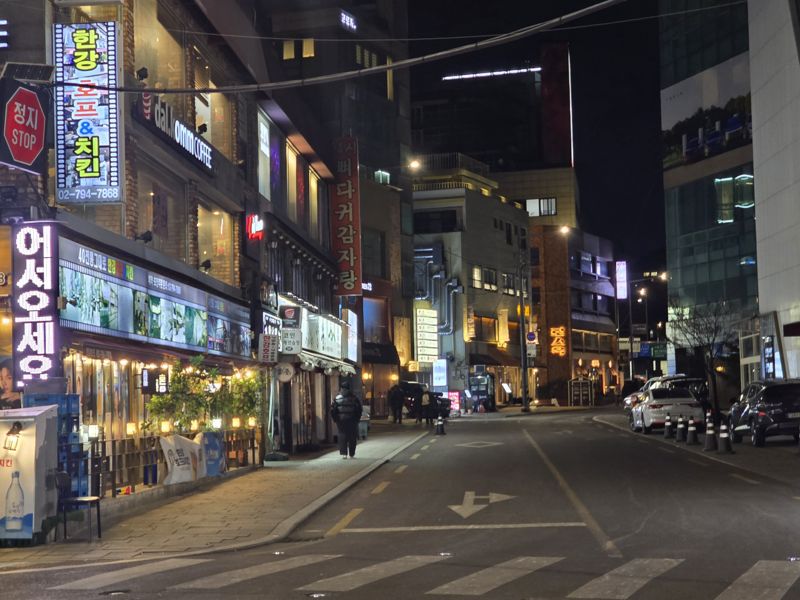
[Financial News]"There are a lot of people who don’t even know the Olympics are on." Around 9 p.m. on the 8th, a man in his 60s surnamed Park, who has run a barbecue restaurant in Seoul’s Yongsan District for more than five years, had a variety show on the TV instead of the Milano Cortina 2026 Winter Olympics broadcast. During the last World Cup, some customers asked him to put the matches on, but these days, he said, there has been virtually no talk about the Olympics. "Compared with the end of last year, the number of customers has been cut in half. The Olympic boom is all in the past," Park said.The Milano Cortina 2026 Winter Olympics opened on the 7th, but self-employed business owners are not enjoying the kind of Olympic boom or trickle-down effect they saw in the past. Because a general programming cable channel holds exclusive broadcasting rights, viewers have less access to the games, and a prolonged cold snap has reduced foot traffic. Analysts also point out that, with the time difference, many key events are scheduled in the early morning hours, which has dampened demand for dining out.According to Seoul Real-Time Urban Data on the 9th, as of around 5 p.m. the previous day, sales in the commercial district around Yongsan District—an area packed with eateries—fell 35.7% compared with the same time a week earlier, and 2.6% compared with the average for the same time over the past 28 days. A broader look at nearby commercial zones showed a similar lack of any noticeable increase in sales. In the Gwanghwamun area of Jongno District, sales were down 6% from the same time last week and 9.9% from the 28-day average for that time. Around Ssangmun Station on Seoul Subway Line 4, home to the Suyu-ri Food Alley, sales dropped 38% from the same time last week and 43.1% from the 28-day average.
In many parts of central Seoul, there was little sense of an Olympic atmosphere. Even during the dinner rush, it was rare to see large groups coming into restaurants together or crowds gathering to cheer. The Olympic promotional posters and flyers from liquor companies that used to appear every Games were nowhere to be seen. Few establishments had large screens, and many had news or variety shows on instead of Olympic events. Kim, a 56-year-old who runs a beer pub in Yongsan District, said, "Just like last week, I don’t have a single group reservation for this week’s evenings," adding, "I didn’t even expect more customers because of the Olympics."
Changes in the broadcasting environment are seen as a primary factor. In a rare move in Korean broadcasting history, this Olympics is being aired exclusively by a general programming cable channel rather than the three major terrestrial broadcasters (KBS, MBC, and SBS). It is the first time in 62 years, since 1964, that the three major terrestrial broadcasters have not carried Olympic coverage. On top of that, a record cold snap has driven down foot traffic, leading to a sharp drop in sales. Last weekend, the wind chill in Seoul fell to minus 18 degrees Celsius. Although the cold wave advisory that had been issued across the city has now been lifted, daytime temperatures in the central region are still below freezing. With an eight-hour time difference between Italy and Korea, many key events are scheduled after midnight or in the early morning, which has further reduced demand for dining out and is cited as another reason the Olympic boom has vanished.
Experts say small business owners need their own strategies to stimulate spending during the Olympics. Lee Hong-joo, a professor in the Department of Consumer Economics at Sookmyung Women's University, noted, "It is becoming increasingly important to create a rationale that connects with each individual’s consumption tendencies, characteristics, and tastes." Lee advised, "Rather than focusing only on the games themselves, it is crucial to foster situations and atmospheres that make watching the games more enjoyable, thereby drawing out 'contextual consumption.'" Lee added that holding events such as offering discounts during specific matches or selling special package menus "could be helpful."
[email protected] Reporter Seo Ji-yoon Reporter