"60 Trillion Won Printed Out of Thin Air"... Bithumb Sprayed 620,000 'Ghost Coins' with a Single Click
- Input
- 2026-02-09 07:28:17
- Updated
- 2026-02-09 07:28:17

[Financial News] A roughly 60 trillion won erroneous Bitcoin payout at cryptocurrency exchange Bithumb has exposed a blind spot in the "book-entry" structure of coin trading and sparked controversy over so-called "money printing."
Unprecedented Bithumb incident fuels "money printing" debate
On the afternoon of the 6th, some Bithumb users were mistakenly credited with 2,000 Bitcoins. The exchange had intended to pay a total of 620,000 won to 249 winners of a "random box" event, but an input error that treated the unit as Bitcoin instead of won resulted in 620,000 Bitcoins being sent.
Even when converted at Bithumb's intraday low of 81 million won per Bitcoin, the amount was worth about 160 billion won, and some winners are already known to have sold 1,788 Bitcoins. As some users rushed to dump the windfall, Bitcoin's price on Bithumb alone briefly plunged to 81.11 million won at around 7:30 p.m. the previous day, causing a momentary crash.
The fallout from this baffling incident has been intense. According to Yonhap News Agency on the 8th, users watched as the number of coins recorded in the database (the internal ledger) — which had usually been about 1% lower than the exchange's actual Bitcoin holdings — suddenly ballooned to more than 12 times that level and then vanished, prompting allegations of "money printing."
Centralized exchanges (CEX) like Bithumb keep customers' deposited coins in their own wallets and, instead of recording every trade directly on the blockchain, operate by updating balances on an internal ledger. This contrasts with decentralized exchanges (DEX), where users connect personal wallets and trade coins via smart contracts recorded directly on the blockchain.
The centralized exchange model offers advantages in speed, fees, and convenience, but it has a key weakness: when system errors occur, discrepancies can arise between the amount the exchange actually holds and the quantities shown on its books. To maintain user trust, domestic exchanges regularly disclose that they hold more crypto assets than the total recorded in customer accounts.
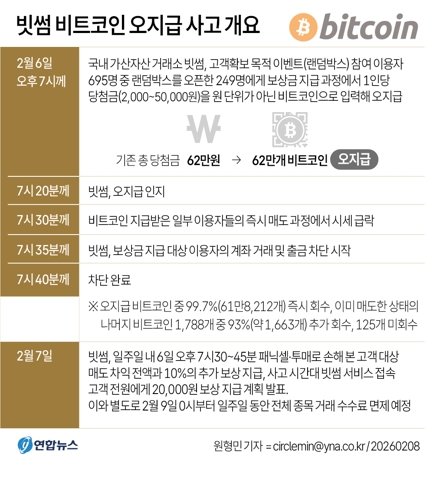
Controversy grows after 620,000 Bitcoins — over 12 times Bithumb's holdings — are mistakenly paid out
The core issue is that the 620,000 Bitcoins (worth about 60.76 trillion won) sent as random box event prizes on the 6th amounted to more than 12 times Bithumb's actual holdings. In a year-end audit report, Bithumb had stated that it held 1.4% more crypto assets in reality than the total recorded on its books, and in its report for the end of the third quarter last year, it specified that it held 42,794 Bitcoins in total — 42,619 entrusted by customers and 175 owned by the company.
At the time of the incident, the internal circulating supply of Bitcoin shown in Bithumb's mobile app suddenly jumped from the usual level of around 46,000 to well over 660,000. That is a massive amount equal to about 3% of Bitcoin's total global supply of 21 million coins. Under the book-entry system, the winners' accounts each showed an average of 2,490 Bitcoins, worth roughly 244 billion won per person.
Bithumb responded by saying it had "recovered" the Bitcoins by adjusting the ledger figures, stressing, "The number of coins held in our wallets is kept 100% identical to the amounts displayed on customer screens through strict accounting controls."
However, some users continue to question whether effective "money printing" is possible within the exchange. They worry that if an insider were to deliberately create and circulate ledger-only coins rather than doing so by mistake, users would have no way of detecting it.
An industry official noted, "There have been cases where far more coins were circulated than were actually held, making withdrawals impossible," and criticized, "From the perspective of regulated finance, something that should never happen has occurred." The official added, "Database-based transactions are a natural part of how centralized exchanges operate, so rather than blaming the ledger system itself, the key question is whether internal controls, risk management, and real-time balance verification mechanisms functioned properly."
bng@fnnews.com Reporter Kim Hee-sun Reporter