Victor Cha Says 'Security with the U.S., Economy with China Is Over' and Urges Korea to Shift Strategy
- Input
- 2026-02-08 12:32:41
- Updated
- 2026-02-08 12:32:41
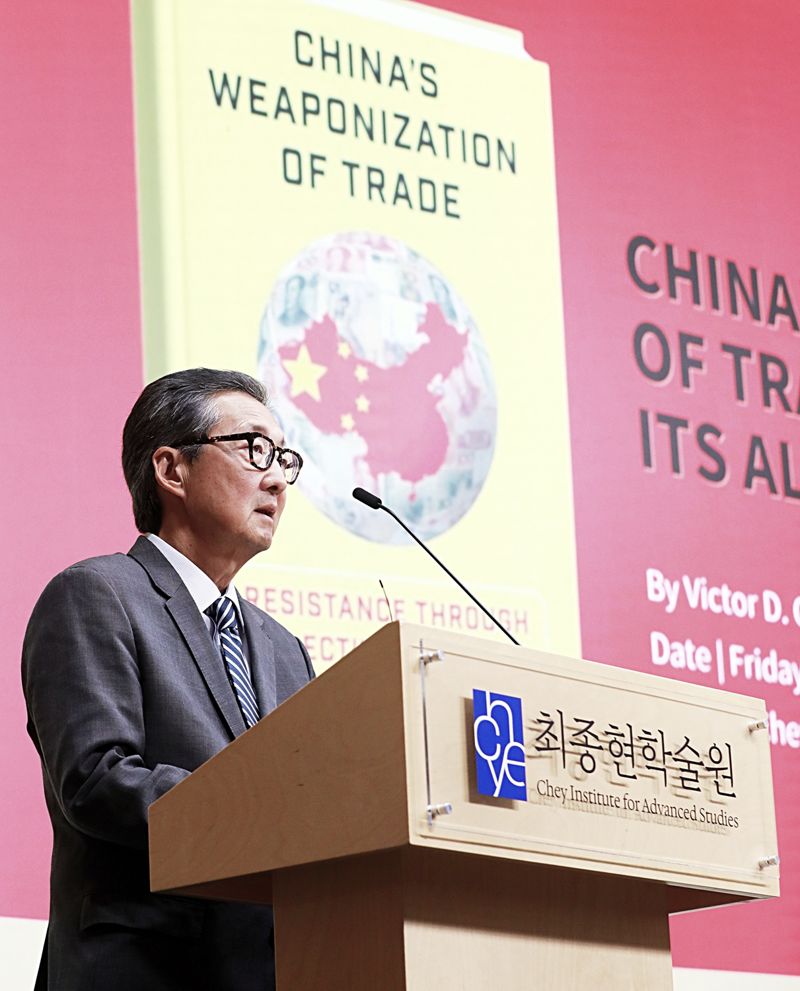
Economic coercion by China—using trade as a tool of diplomatic and security pressure—has entered the stage of a structural threat, according to a new assessment. As countries face a new type of challenge that cannot be blocked simply with tariffs or trade regulations, Korea is being urged to respond more strategically as a central pillar of international coordination.
At the special lecture on the 6th, Victor Cha, director at CSIS and Georgetown University distinguished professor, argued that "China's economic coercion is not just a trade dispute but a new threat that shakes democracy and the international order." As a solution, he proposed building collective resilience.
According to Cha, over the past 25 years China has used more than 600 cases of economic coercion to pressure 18 countries and 470 companies. Thirty-three Korean companies were among the targets. He noted, "Even these figures are an underestimate," adding, "Many governments and firms do not disclose the damage because they fear retaliation."
He explained that China's style of economic pressure is characterized by informal and opaque measures, a lack of clear legal basis, and tools that are difficult to challenge at the World Trade Organization (WTO). The suspension of imports of Norwegian salmon, restrictions on rare earth exports to Japan, and the halt of group tourism to Korea, he said, all fall into this same pattern.
Cha stressed that in responding to this offensive, countries must go beyond simple defense and instead identify China's structural vulnerabilities. Data from UN Comtrade, the UN International Trade Statistics Database, for 2024 show that China has an import dependence of 70% or more in 589 product categories, and in 259 of those its dependence exceeds 90%.
In particular, for organic light-emitting diode (OLED) display panels, China's import dependence reaches 94%. Because a large share of these imports come from Korea, coordinated action among allies could serve as real leverage, he assessed. U.S. non-cyclic hydrocarbons, Japanese industrial robots, and silver paste used in solar panels were also cited as items that China would struggle to replace.
Cha expressed skepticism about the "de-risking" strategies that many countries are currently pursuing to diversify supply chains. "If you protect one supply chain, China will attack another," he said, arguing that "the issue is not response but deterrence."
His proposed solution is the concept of collective resilience. This model applies the collective defense principle of the North Atlantic Treaty Organization (NATO) to the economic realm: when one country comes under pressure from China, other countries in similar positions would be prepared in advance to respond and retaliate together. Under this approach, countries would divide responsibility for highly dependent items and prepare them as shared tools of deterrence.
He emphasized, "Korea has strong technological capabilities, a significant position in global supply chains, and has directly experienced Chinese pressure," adding, "Together with the United States and Japan, it is well placed to discuss a framework for collective economic deterrence."
Cha also argued that the traditional strategic ambiguity of "security with the United States, economy with China" is no longer valid. "This formula is unsustainable," he said, noting that "Korean companies' investment flows and supply chain restructuring are already moving toward a U.S.-centered direction."
At the same time, he warned about pressure from Washington. "We are in an era when we must manage not only China risk but also U.S. risk," he said, pointing out that "middle powers are seeking ways to avoid relying solely on one side by pursuing mutual cooperation and institutional arrangements."
He concluded, "What the United States should do is not impose tariffs on its allies, but bring them together to respond jointly to China's economic coercion," adding, "Collective resilience is both a means of deterring China and a way for the United States to restore confidence in its own strategy."
[email protected] Lee Dong-hyuk Reporter