"If You’re Not at the Table, You’re on the Menu"...Middle Powers Like Korea Step Up Cooperation Amid U.S.-China Rivalry
- Input
- 2026-02-08 07:39:26
- Updated
- 2026-02-08 07:39:26
Amid intensifying rivalry between the United States and China, middle powers such as Korea, Canada and Germany are moving to strengthen cooperation for their own survival, The Wall Street Journal (WSJ) reported on the 7th (local time).
From trade to security, these countries are scrambling to cooperate so they do not end up as "roadkill" caught between the two great powers in a new world order.
"If you’re not at the table, you’re on the menu"
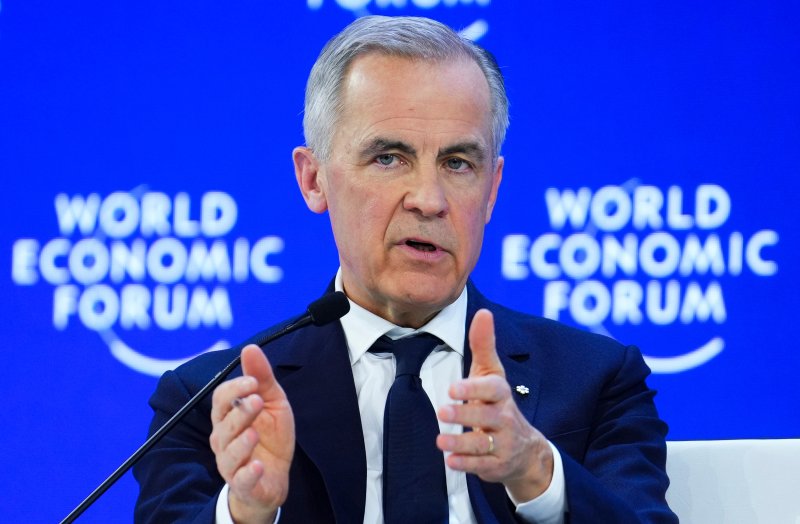
Mark Carney, the Canadian prime minister who made a strong impression at the World Economic Forum (WEF), also known as the Davos Forum, has emerged as a symbolic figure of this trend.
Carney stressed, "Middle powers need to act together," adding, "If we are not at the table, we will end up on the menu of the great powers."
He urged countries including Canada, most European states, Japan, Korea, Australia, India, Brazil and Türkiye to unite.
Driving this sense of urgency is the fear that, if middle powers fail to speak with an independent voice in the U.S.-China confrontation, they will ultimately be sacrificed for the interests of the major powers.
At the center of this anxiety is the United States.
The United States is dismantling the post–World War II order it once built. The Donald Trump administration has been reshaping supply chains around the United States, reducing dependence not only on China but also on its allies. Tariff wars are a key tool in this restructuring, aimed at erecting trade barriers and rebuilding new supply chains inside the United States.
Trump has also claimed sovereignty over Greenland, a territory of NATO ally Denmark, in the name of protecting U.S. security.
The consistent principle of the Trump administration is that, when U.S. economic and military interests are at stake, both adversaries and allies alike can be sacrificed.
China, however, is not seen as a viable alternative.
Although China presents itself as a new alternative, it has failed to gain trust because it is an authoritarian state that disregards international rules.
Self-reliance and cooperation, and Korea’s defense industry
Middle powers are striving not only to build solidarity and cooperation, but also to strengthen their own self-reliance.
They are developing self-sufficiency where possible in supply chains, energy and technology, while seeking partnerships with other countries in areas where cooperation is essential.
France is developing its own software, and Canada is expanding energy self-sufficiency. The message is that they will stand on their own where they can. This marks a major shift from the old doctrine of comparative advantage, which held that countries should focus on what they do best and rely on foreign partners for everything else.
At the same time, they are deepening cooperation to reduce dependence on the United States. The European Union (EU) recently concluded a Free Trade Agreement (FTA) with the Southern Common Market (MERCOSUR) in South America and a free trade agreement with India.
Military cooperation is also expanding, with Korea’s K-defense industry at its center.
Poland has purchased large quantities of Korean-made weapons, including tanks and self-propelled howitzers, while Norway has bought the Korean K239 Chunmoo multiple rocket launcher.
As the United States pulls back from the war in Ukraine, European countries exposed to Russia’s threat have begun to rely on Korean weapons for their security.
In addition, the United Kingdom, Italy and Japan are jointly developing a next-generation fighter jet, while Australia and the United Kingdom are cooperating on nuclear-powered submarines.
Limits
Yet such cooperation clearly has limits.
The biggest obstacle is that there is no realistic substitute for the U.S. nuclear umbrella.
As NATO Secretary General Mark Rutte has pointed out, Europe still finds it difficult to defend itself without the U.S. nuclear umbrella and U.S. aircraft carriers.
Korea, too, stands out in conventional weaponry, but it remains powerless on its own in the face of the nuclear threats posed by China, Russia and North Korea.
Clashing values also make it hard to expect a broad, unified coalition of middle powers.
It is unclear whether democratic states and more authoritarian middle powers in regions such as the Middle East and the Arab world can forge genuine cooperation.
Even within these clear constraints, however, middle powers including Korea are gaining momentum in both self-help and cooperation as the international order faces fundamental change under a potential second Trump administration.
[email protected] Song Kyung-jae Reporter