"What Is Justice?" A Clash of Convictions Hotter Than a Bomb: The Play "The Just Assassins" [A Glass of Performances for the Weekend]
- Input
- 2026-02-07 10:00:00
- Updated
- 2026-02-07 10:00:00
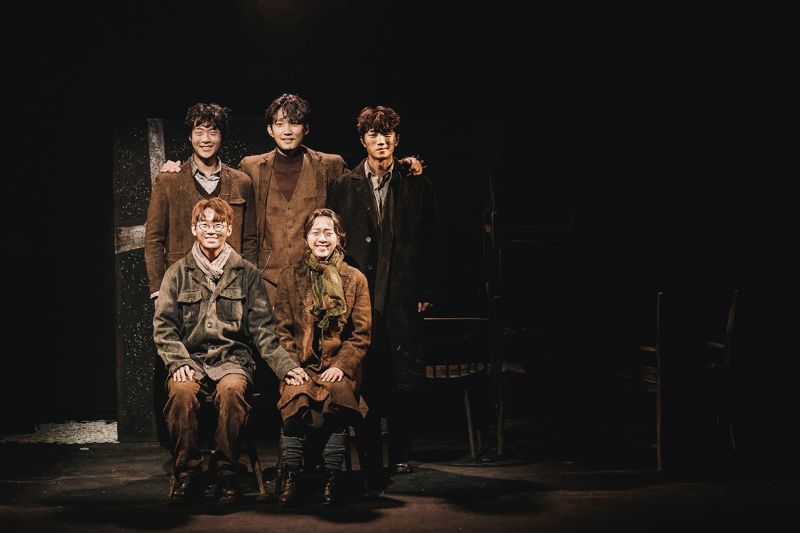
[Financial News]"If justice is the goal, can that goal ever justify violence as a means?"February 1905, Moscow, Russia. In an apartment charged with revolutionary fervor, five young people gather. They share a single objective: to assassinate the tyrannical Grand Duke Sergei and liberate the people. Yet on the eve of the operation, a taut tension hangs over these supposedly "just" terrorists.
The play "The Just Assassins," which opened last month at Link Art Center Dream Theater 4 in Daehak-ro, is based on a script by Nobel Prize in Literature laureate Albert Camus. Although it draws on an actual historical incident and was written more than 120 years ago, the work still poses weighty questions that resonate with audiences in 2026.
"There were children"...The bomb stops, and the argument begins
On a stage so stark you can almost feel the chill, the figures of the revolutionaries emerge one by one between piles of stacked chairs. As the actors warily scan their surroundings from the very first moment, the audience’s tension rises with theirs. Then the conflict explodes when Yanek, the poet and revolutionary tasked with throwing the bomb, returns after failing to carry out the attack.
Yanek, who had spoken of justice in the most idealistic terms, sees the Grand Duke’s young nieces and nephews inside the carriage at the decisive moment. He breaks down, insisting that the one he meant to kill for the sake of justice was the oppressor, the Grand Duke, not innocent children. His anguish is the desperate struggle of a man trying to protect his own conscience. But Yanek’s idea of justice collides head-on with that of Stepan, a cold realist who argues that "for the revolution, the sacrifice of children must be accepted."
To what extent can the means be justified in the name of achieving justice? If a revolution born from love for humanity ends up destroying human dignity, can it still be called a revolution? It is not only Yanek’s and Stepan’s competing visions of justice that haunt the stage. Each character brings their own definition of justice, and those conflicting notions drift painfully through the play.
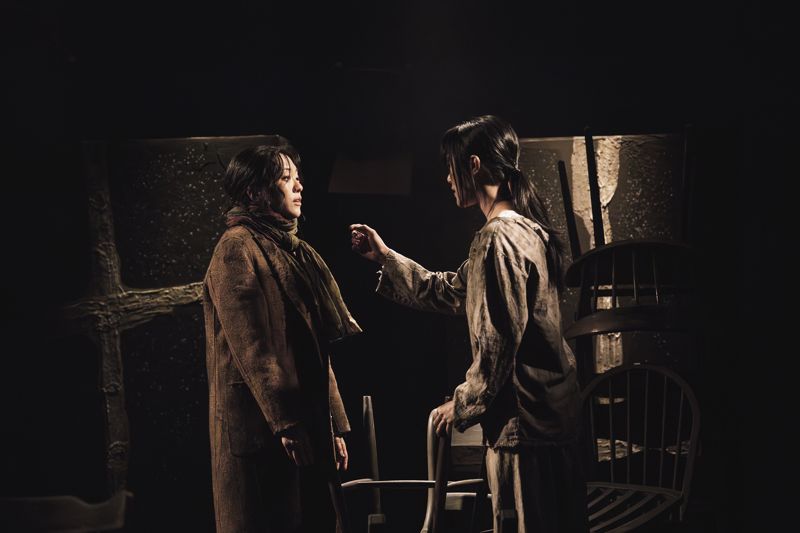
Why did Camus call them "the just"?
Camus wrote this play in the late 1940s, a time when ideological conflict was fueling brutal acts of violence. In opposition to a world that instrumentalized human beings in the name of lofty ends, he summoned the "delicate murderers" of 1905. Today, once again facing the thorny question "What is justice?", we in turn summon the play "The Just Assassins."
Their almost obsessive insistence on paying for the lives they take by willingly offering up their own sharply distinguishes them from today’s indiscriminate terrorists. "We die to be sure that justice still exists in this world." The scene in which Yanek and Dora, bound by a tragic love, say, "The only place we can love is on the gallows," lays bare the human torment of revolutionaries who must trample on their own happiness for the sake of a cause.
The power of the message heightened by gender-free casting, and the immersion of an intimate theater
This 2026 production adds a contemporary layer of interpretation to the original’s weighty themes through gender-free casting. By casting roles without regard to gender, it underscores that the revolutionaries’ anguish is not the preserve of any one gender, but a universal human dilemma.
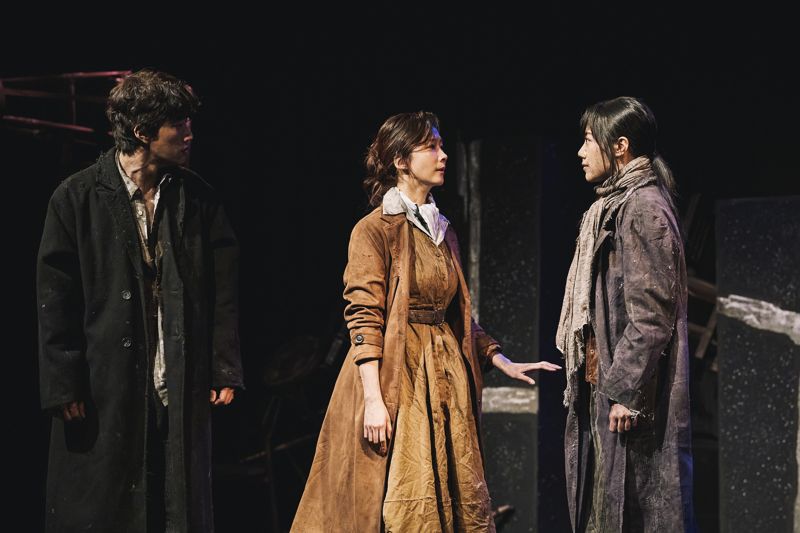
Jeong Ji-woo and Lee Seo-hyun, who share the role of the passionate protagonist Yanek, delicately portray a character who is gentle yet steely inside. The role of Yanenkov, the leader of the group, is played by Lee Jeong-hwa and Lee Ye-jun, showcasing the appeal of gender-free casting.
Dora, who shares a tragic love with Yanek, is played exclusively by Choi Ha-yoon, who delivers searing emotion with outstanding acting. The ruthless revolutionary Stepan is likewise played in the original cast by Kim Jun-sik, while the role of Voinov is shared by Lee Sa-gye and Kim Min-ho. The Grand Duke’s henchman Skouratov is portrayed by Choi Seung-ha and Seo Ju-won, and the Grand Duchess is played by Jeon Jae-hee and Lee Jae-eun.
Because of the intimate scale of the theater, audiences can catch every subtle shift in the actors’ expressions, hear their ragged breathing, and even see the trembling of the hand that grips the bomb. "The Just Assassins" runs through the 22nd at Link Art Center Dream Theater 4 in Daehak-ro, Jongno-gu, Seoul.
"What’s really worth seeing these days?"Each weekend, a performance-obsessed reporter shares stories about the stage with you. For audiences overwhelmed by the flood of new shows and unsure what to choose, I introduce works that I have personally seen and carefully selected. For tips on enjoyable cultural experiences to fill your weekend,[A Glass of Performances for the Weekend]is here to keep you company.
bng@fnnews.com Kim Hee-sun Reporter