"The 'black semiconductor' has soared to 150 won per sheet"... Korean snack in chaos, selling out everywhere
- Input
- 2026-02-08 05:00:00
- Updated
- 2026-02-08 05:00:00
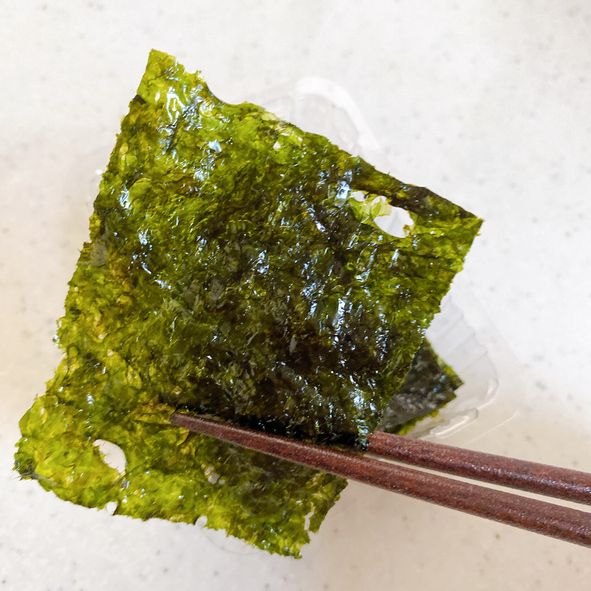
[Financial News] As Korean gim (roasted seaweed) enjoys global popularity and its price surges, foreign media have begun to spotlight the trend.
The British Broadcasting Corporation (BBC) recently reported on this in an article titled, "The global craze for Korean culture is making even humble snacks hard to afford."
From "black paper" to "black semiconductors"
The BBC noted that "gim, once a common sight on Korean dining tables, is now drawing attention overseas, prompting concerns about rising prices," and relayed the comments of a vendor in his 60s who has sold roasted gim at a traditional market in Seoul for nearly 50 years.
The vendor said, "In the past, Westerners thought Koreans were eating something strange that looked like black paper, but now they come looking for it on purpose," adding, "Who would have imagined that I’d end up selling this addictive food to them?"
The BBC explained that Korea is the world’s largest producer and exporter of semiconductors, and, drawing a parallel, reported that gim is now regarded as a strategic export item to the point that it is called "black semiconductors."
Citing statistics released by the Korea Maritime Institute (KMI), the report said that Korea’s exports of dried seaweed products reached a record high of 1.13 billion dollars (about 1.66298 trillion won) last year. With export volumes rapidly increasing, especially to North America and Europe, gim has moved beyond being a simple side dish to establish itself as a global snack.
As demand has grown, prices are also said to be climbing quickly.
As of 2024, a single sheet of gim cost about 100 won (0.06 dollars, 0.05 pounds). It is usually sold in packs of ten or more sheets, with each pack priced at around 0.60 dollars.
The BBC reported that the price per sheet of gim recently exceeded 150 won, hitting an all-time high, and that premium products have soared to 300–350 won per sheet.
It also pointed out that this has become a financial burden for consumers who used to buy in bulk.
A consumer in her 30s told the BBC, "I was checking prices online and was shocked to see they had gone up by several dollars in just a few months," adding, "Once I finish the stock I have now, I’ll have to think hard about whether to buy more."
K-culture’s boost to gim’s popularity — and its price
The BBC cited the global spread of K-culture, including K-pop and K-dramas, as the main driver behind the rise in gim prices.
It also pointed to the case of gimbap sold by the U.S. supermarket chain Trader Joe’s, which went viral in 2023 and triggered a wave of sellouts across the United States shortly after its launch.
Miki, a 22-year-old tourist from Japan visiting Korea, told the BBC, "I first learned about gim from Korean dramas. It’s a quintessential Korean food that appears often in those shows," and explained, "Japan has something similar to gim, but the taste is completely different. Korean gim is lighter and crispier, and it’s usually roasted with sesame oil and salt."
Viola, a 60-year-old visitor from Brooklyn, New York, said she enjoys gim as a snack. "I just pop it into my mouth like potato chips," she said, emphasizing that "it feels like a healthier alternative."
Experts say the surge in global demand has had a direct impact on prices in the domestic market.
Lee Eun-hee, a professor of consumer studies at Inha University, analyzed, "As awareness of gim has grown from Asia to the West, global demand is increasing," adding, "Domestic prices are rising as producers work to meet overseas demand."
On the production side, the industry is scrambling to respond as it struggles to keep up with demand for gim.
An industry insider who runs a gim processing plant in Wando, South Jeolla Province, said, "Processing facilities are insufficient compared to demand," and revealed, "We are considering increasing the share of exports relative to the domestic market."
The government and industry are moving to respond. The Ministry of Oceans and Fisheries (MOF) is closely monitoring price trends and reviewing stabilization measures, while food companies are pushing to expand investment in land-based aquaculture and Research and Development (R&D) to enable year-round production.
y27k@fnnews.com Seo Yoon-kyung Reporter