KOSPI Rises on Earnings While KOSDAQ Splits Along Stock Picks
- Input
- 2026-02-06 06:00:00
- Updated
- 2026-02-06 06:00:00
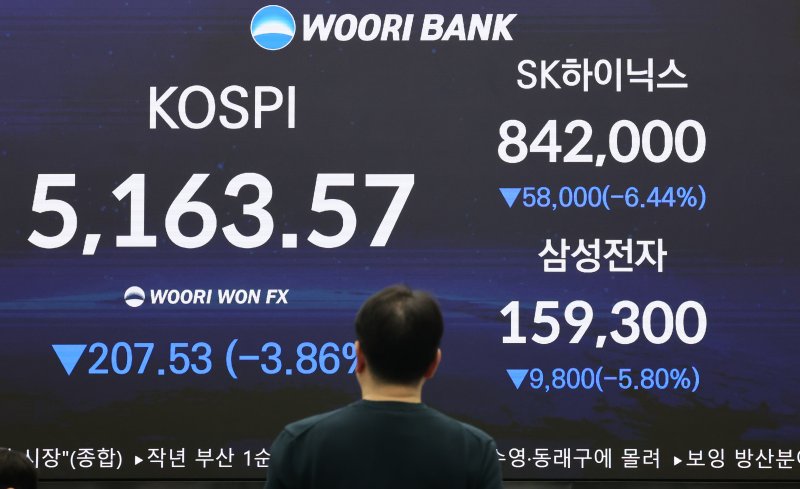
[Financial News] At the start of the year, the domestic stock market has seen a sharp rally in both the Korea Composite Stock Price Index (KOSPI) and KOSDAQ. However, analysts say the drivers of the rise and the appropriate investment strategies are clearly diverging. For KOSPI, upward revisions to earnings per share (EPS), led by semiconductor stocks, are pushing the index higher. By contrast, KOSDAQ is entering a phase where, with limited earnings improvement at the index level, differences in fundamentals between sectors and individual stocks are determining performance. While index-based strategies have worked well on KOSPI, the KOSDAQ environment is rapidly shifting into one where "what you buy" is the key factor that decides returns.
According to the securities industry on the 6th, both KOSPI and KOSDAQ have staged strong rebounds if one looks only at headline returns from the early-year rally. Yet a closer look at what is driving the gains shows that the two markets have very different characteristics. On KOSPI, 12‐month forward EPS is clearly trending higher, centered on the semiconductor sector, creating a structure in which earnings improvement is supporting share-price gains. KOSDAQ, on the other hand, has seen valuation expansion, measured by the price‐to‐earnings ratio (PER), precede earnings growth during the index’s rise, leaving overall fundamental improvement at the index level relatively limited.
The key driver behind the recent KOSPI rally is clear. As corporate earnings forecasts, particularly in the semiconductor sector, are being revised up rapidly, EPS for the index as a whole is improving. As a result, KOSPI’s 12‐month forward PER remains around 11 times, meaning valuation pressure is relatively modest even as the index level climbs step by step. Market watchers describe this as a classic "earnings‐driven bull phase" in which fundamentals are pulling the index higher.
Kim Joong-won, a researcher at Hyundai Motor Securities, said, "In this kind of environment, approaching the market via the index is more efficient than focusing on individual stock picking," adding, "As earnings visibility improves for large‐cap names, especially in semiconductors, index‐tracking strategies and approaches centered on large growth stocks are working effectively."
KOSDAQ, by contrast, is showing a very different pattern. The index has rebounded quickly, but the pace of earnings improvement is far slower than on KOSPI. The 12‐month forward PER for KOSDAQ is in the high‐28‐times range, well above its five‐year average, indicating that valuation pressure has increased. In other words, the index is rising in tandem with an expansion in PER.
A look inside the KOSDAQ market reveals even clearer discrepancies between sector performance and fundamentals. The most notable sector is semiconductors. KOSDAQ semiconductor stocks are maintaining a mid‐14% return on equity (ROE), securing earnings visibility that far exceeds the KOSDAQ average. Their valuation burden has also eased compared with the past, making them the sector where earnings trends and share‐price movements are most closely aligned. Accordingly, many analysts judge that an overweight stance on semiconductors within KOSDAQ is a reasonable strategy.
Kim commented, "In the current market, an earnings‐focused approach is valid for KOSPI, whereas KOSDAQ requires selective strategies by sector and stock based on ROE levels and their direction of improvement, as well as valuation," and went on to say, "In particular, KOSDAQ semiconductor stocks are maintaining the strongest alignment between earnings trends and share‐price movements."
[email protected] Choi Doo-seon Reporter