Even a Hiker Who Climbed Thousands of Mountains Could Not Escape Cancer... Take Off Your Shoes and Connect With the Earth [Park Dong-chang’s Study of Barefoot Walking]
- Input
- 2026-02-06 04:00:00
- Updated
- 2026-02-06 04:00:00
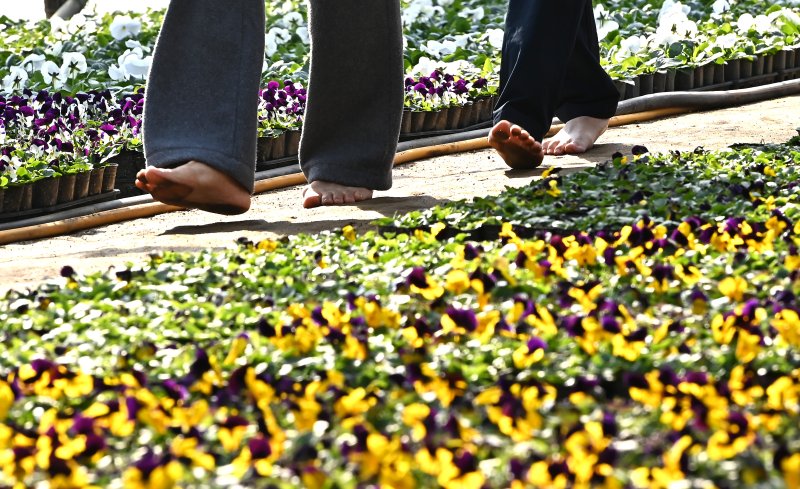
Mr. Park (male, 74), a mountaineer who had climbed around 3,000 mountains across the country over his lifetime, one day developed such severe hip pain that he could no longer walk and went to the hospital. There he was told that his PSA level was as high as 935.6 and that he had terminal prostate cancer. Preparing for death, he began walking barefoot on Geumdae Mountain near his home at his daughter’s suggestion. He later testified that within just two months his PSA level had dropped to 0.058, calling it a miracle. Once a man who gave a “tearful testimony,” he now stands tall as the barefoot healing hero of Geumdae Mountain.
The mechanism behind such healing through barefoot walking is as follows. First, when you walk barefoot on a forest trail, the acupressure effect and the blood-pumping action of the foot arch promote vigorous blood circulation. As a result, the body’s immune system is strengthened and a healthy physiological environment is created in which cancer cells cannot survive. Second, through grounding, the reactive oxygen species inside the body—identified as a cause of various modern lifestyle diseases, including many cancers—are neutralized and eliminated. In this process, deformed cancer cells themselves can be restored to normal cells.
Barefoot walking costs nothing more than taking off your shoes and walking barefoot. Yet it can be applied to virtually any type of cancer and can be seen as having an effect similar to a “natural immune-based anticancer agent.”
However, we constantly hear heartbreaking news of countless people around us who die from cancer or stand at the crossroads between life and death without ever knowing about the miracle of barefoot walking. Each time, my heart aches with regret as I think, if only they had known about barefoot walking earlier, or if only they had come and walked barefoot with us, they too might have enjoyed the joy of healing.
In fact, several years ago we heard the sad news that a singer had been given only a short time to live due to terminal lung cancer. Smoking is usually cited as a decisive factor in causing lung cancer, yet he did not smoke, did not drink, and managed himself very strictly. Why, then, did he develop cancer?
This question is closely related to doubts I had in other cases. One was a business group chairman who had a private gym on the floor above his office, ran on a treadmill whenever he had time, ate good food every day, and was generous to those around him, yet passed away in his early seventies from a brain tumor. Another was a high school classmate of mine who devoted himself to exercise, running along the Hangang River every day, but one morning suddenly died of cardiac arrest while jogging in his running shoes as usual. These cases show that lung cancer is not necessarily caused by smoking, and that brain tumors or sudden cardiac arrest are not simply the result of a lack of exercise.
If so, what is the real reason behind the onset of cancer, brain tumors, and sudden cardiac arrest? One possible explanation is that, by living in shoes, we cut off grounding with the earth and soil. Reactive oxygen species then cannot be discharged out of the body, but instead circulate inside, raising the body’s electrical potential and attacking healthy cells, turning them into cancer cells. In this way, cancer may have developed in the lungs or a tumor may have formed in the brain.
Another possibility is that when we exercise in shoes, grounding with the earth or soil is blocked, preventing negatively charged free electrons in the ground from entering the body. As a result, the surface charge (zeta potential) of red blood cells decreases, the blood becomes sticky, and blood clots form. These clots can travel through the blood vessels and block a narrowed coronary artery, leading to sudden death from cardiac arrest. Or, because the body is not grounded to the earth, a serious disturbance may at some point occur in the electrical signaling system that controls the heartbeat. Then the “grim reaper” of arrhythmia may suddenly strike, resulting in death. This, too, is a plausible assumption.
In the end, we must take off shoes that block electrical communication with the earth through rubber soles and insoles that disable the function of the foot arch—whether they are dress shoes, sneakers, or hiking boots—and place our bare feet directly on the ground. Only then, by charging the body with the free electrons of life contained in the earth, can reactive oxygen species—the cause of inflammation and many chronic diseases—be neutralized in real time. This helps prevent cancer and other chronic illnesses, clears the blood, and reduces the risk of heart and cerebrovascular diseases caused by blood clots.
Yet in our busy modern lives, and in a world where most walkways are paved with asphalt and concrete, it is realistically difficult to go barefoot all day long. Even so, in recent years, more than 185 local governments nationwide have passed ordinances to promote barefoot walking, initiated by the Barefoot Walking National Movement Headquarters. As each municipality has begun creating barefoot trails, by the end of last year more than 2,000 new barefoot and red-clay paths had been established across the country. We should therefore find a barefoot trail near where we live and walk barefoot every day, just as we eat three meals a day.
For people suffering from serious illnesses such as cancer or cardiovascular disease, I recommend walking barefoot all day long, and at a minimum walking three times a day for a total of more than six hours. In short, I urge them to walk barefoot as if their life depends on it. Over the past ten years of the barefoot walking national movement, we have repeatedly confirmed that, in such cases, people can become free even from very serious cancers or cardiovascular diseases. Even when receiving hospital treatment, if patients also walk barefoot, in many cases they show such rapid improvement that their doctors are astonished. I therefore strongly ask that you practice barefoot walking while also making use of modern medicine, because I am convinced that barefoot walking is the best path to help patients.

Park Dong-chang, President of the Barefoot Walking National Movement Headquarters
jsm64@fnnews.com Jung Soon-min Reporter