Calls Grow for Introducing Collective Action System Amid Successive Data Breaches: "Every Victim Must Be Compensated"
- Input
- 2026-02-05 15:29:21
- Updated
- 2026-02-05 15:29:21
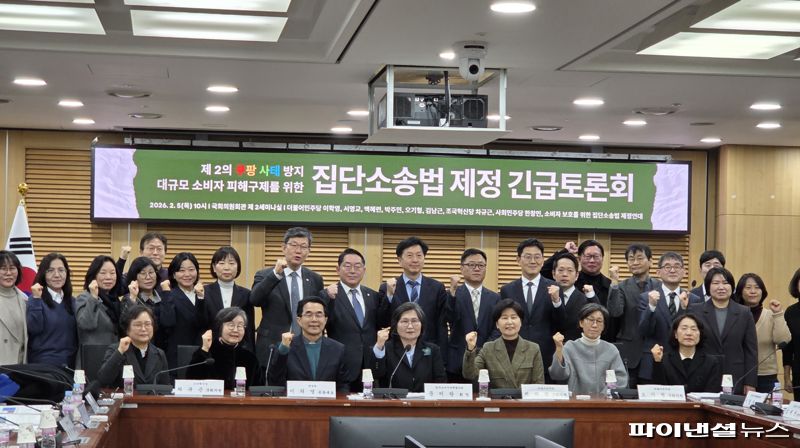
At the "Emergency Forum on Enacting the Collective Action Act for Large-Scale Consumer Relief" held on the 5th at Seminar Room 2 of the National Assembly Members' Office Building in Yeouido, Seoul, presenters, discussants, and lawmakers all stressed that legislation on the Collective Action Act should be completed within the first half of this year. Seven bills related to collective actions have been introduced in the 22nd National Assembly, and an additional draft prepared by 19 civil society groups in the Coalition for Enacting the Collective Action Act for Consumer Protection is scheduled to be submitted by Democratic Party of Korea lawmaker Seo Young-kyo.
Attorney Han Kyung-soo of WeMin Law Firm, who delivered the first presentation, explained the need to introduce the Collective Action Act and reviewed the eight related bills. Han argued, "We are seeing a social loss as countless people across the country each incur significant costs to file thousands of individual lawsuits against Coupang, which caused the problem." He said that, as social consensus has already formed around enacting a Collective Action Act, differences among the bills should be reconciled and the legislation completed as quickly as possible.
He went on to argue that the range of parties who can bring a lawsuit should be defined broadly to include representative plaintiffs and consumer organizations, and that the scope of application should also be kept wide. "At a minimum, consumer protection, collusion cases under the Fair Trade Act, and personal data breaches must be included in the areas covered," he said. He added that an opt-out mechanism, under which court decisions also bind those who did not formally join the lawsuit, is essential, as are rules on evidence that allow courts, on their own authority, to order companies to submit documents.
Currently, the collective action system is limited to the securities sector, which means consumers must file individual lawsuits. As a result, their personal burden in terms of litigation costs and proving damages is significantly increased, speakers explained.
Attorney Lee Eun-woo of Jihyang Law Firm, who gave the next presentation, criticized the fact that among member states of the Organization for Economic Cooperation and Development (OECD), only Korea allows neither consumer collective actions nor lawsuits seeking confirmation of illegality. "This is a premodern reality, like the old family-head system we used to have," he said. "For a top-10 global economy, we have a backward legal infrastructure," he added, arguing that adopting global standards is not premature but already overdue and that immediate introduction is necessary.
Addressing concerns about a flood of lawsuits, he said this would be "not chaos but the restoration of justice." As safeguards against abusive litigation, he proposed strict screening of claims with early dismissal where the cause of action is insufficient, shifting litigation costs to the losing party, and limiting repetitive lawsuits.
Lawmakers from the Rebuilding Korea Party, including Representative Cha Kyu-geun, who co-hosted the forum, also weighed in. Cha said, "Once a strong ex post civil regulatory tool like the Collective Action Act is in place, it will create an opportunity to ease unnecessary ex ante regulations. It will be a major innovation that shifts our regulatory framework from a positive-list to a negative-list system."
Shim Je-won, an executive member of the Citizens’ Rights Center of the Citizen's Coalition for Economic Justice (CCEJ), who took part in the discussion, suggested a safeguard against delays in the court's certification process for collective actions. "We need a mechanism under which, if the court does not make a decision within a specified period, certification is deemed granted," he said. Attorney Park Jung-man of the Committee on People’s Livelihood and the Economy of Lawyers for a Democratic Society stated, "Under court supervision, a wide range of materials, including trade secrets, must be produced, and we should codify a rule that treats non-compliance as an admission of liability." Officials from the Ministry of Justice, the Korea Fair Trade Commission (KFTC), and the Personal Information Protection Commission (PIPC) who attended the event also expressed support for the purpose of introducing a Collective Action Act and pledged active cooperation.
The forum was co-hosted by lawmakers Lee Hak-young, Seo Young-kyo, Baek Hye-ryeon, Park Joo-min, Oh Ki-hyung, Kim Nam-geun, Cha Kyu-geun, and Han Chang-min, all of whom have introduced related bills, together with the Coalition for Enacting the Collective Action Act, which includes the Korea National Council of Consumer Organizations, the Citizen's Coalition for Economic Justice, Lawyers for a Democratic Society, and the People's Solidarity for Participatory Democracy (PSPD).
[email protected] Reporter Park Sung-hyun Reporter