President Lee: "Solving the ruinous housing problem depends on breaking the Seoul metropolitan monopoly"
- Input
- 2026-02-05 14:55:57
- Updated
- 2026-02-05 14:55:57
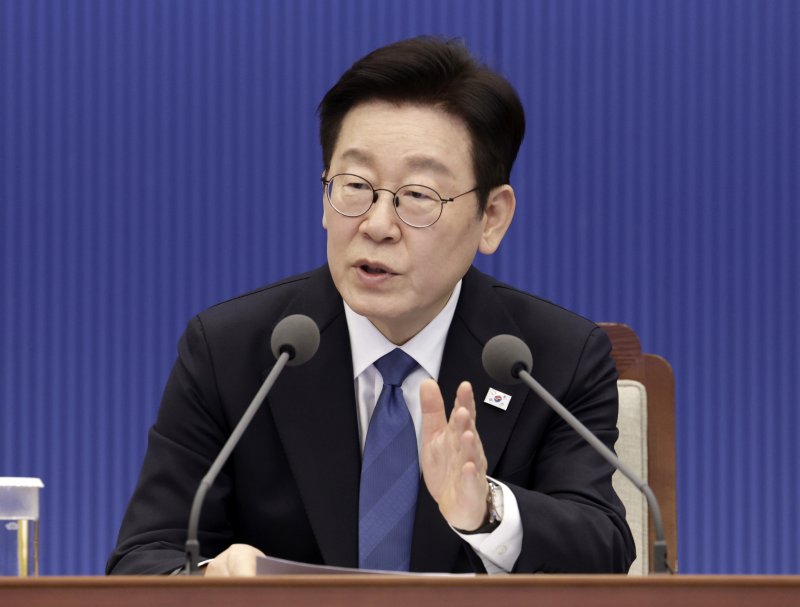
[Financial News] President Lee Jae-myung on the 5th stated, "The fundamental solution to the ruinous housing problem also depends on dismantling the single-centered structure of the Seoul metropolitan area," reiterating his commitment to a major shift toward region-led growth and stabilization of the real estate market.
Presiding over a Senior Presidential Aides Meeting at the presidential office that day, President Lee said, "Last year, the population gap between the Seoul metropolitan area and non-metropolitan areas reportedly exceeded 1 million. In other words, the population of the Seoul metropolitan area has grown to more than 1 million above that of the rest of the country."
President Lee continued, "We can no longer leave unchecked, nor should we leave unchecked, a single-centered system in which the Seoul metropolitan area, which accounts for only 12% of the national territory, sucks in people and resources like a vortex." He added, "The more congestion in the Seoul metropolitan area intensifies, the faster local regions will face extinction, and as the inefficiency of land use increases, our potential growth rate will inevitably decline."
He went on, "A major shift from growth centered on the already maxed-out Seoul metropolitan area to growth led by local regions, and the balanced use of national space that this entails, is the surest way to reopen the growth plate of our economy and lay the foundation for sustainable national development."
President Lee stressed that, to achieve this major shift toward region-led growth, the government must institutionalize policies that prioritize and favor local regions across the entire spectrum of national administration, including fiscal services, taxation, and financial procurement.
He said, "We have been giving a lot of thought to fiscal, tax, and financial measures, but it seems there are no systems in the area of government procurement that prioritize local regions or grant them additional points." He added, "If the utility and efficiency of goods produced in the Seoul metropolitan area and in non-metropolitan areas are the same, we could, for example, purchase local products first or give extra points in bidding to local suppliers. It would be good to prepare and implement such measures."
He went on, "Based on the overarching principle that the farther a region is from the Seoul metropolitan area, the stronger and bolder the support should be, we must accelerate improvements to infrastructure such as transportation and move quickly to prepare for the relocation of public institutions." He added, "In particular, I hope we can swiftly push ahead with an exceptional incentive system that will massively boost corporate investment in local regions."
During the meeting, President Lee also put forward ideas related to the relocation of public institutions. He said, "An idea came to me while I was having a meal at the presidential cafeteria today. When public institutions are relocated to local regions, instead of building in-house cafeterias for them, wouldn’t it be better to have employees eat outside and support them with meal allowances?" He continued, "There may be controversy over jobs or the use of existing space, but when institutions newly relocate, and especially when they move to local regions for the sake of regional revitalization, it might be worth studying a system where, even if it costs a bit more, we subsidize lunch expenses and have employees dine outside."
[email protected] Reporter Choi Jong-geun Reporter