Did U.S. imports work? ‘Gold eggs’ drop into the 6,000 won range in a month
- Input
- 2026-02-06 07:00:00
- Updated
- 2026-02-06 07:00:00
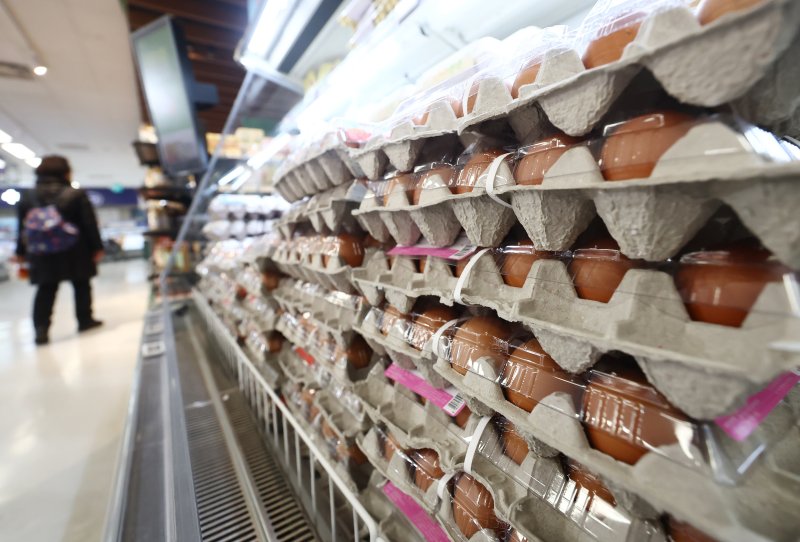
Financial News reported that egg prices, which had been soaring due to supply instability caused by the spread of Highly Pathogenic Avian Influenza (HPAI), have eased into the 6,000 won range per tray within a month, signaling a stabilization phase. Analysts attribute this to the distribution of 2.24 million U.S. eggs imported at the end of last month to stabilize prices, as well as a slight slowdown in HPAI transmission since the beginning of this month. However, with the massive nationwide travel expected for the Lunar New Year holiday and a high risk of HPAI spreading again across the country, significant uncertainty remains.
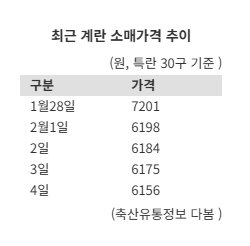
According to Livestock Distribution Information from the Korea Institute for Animal Products Quality Evaluation (KAPE), the average retail price of a tray of 30 large eggs stood at 6,156 won as of the 4th, down 0.31% from the previous day.
This is the first time egg prices have fallen back into the 6,000 won range in about a month, since December 25 last year, when they were 6,835 won. Prices are now even lower than a year earlier, when they were 6,590 won. Egg prices had peaked at 7,229 won on the 17th of last month.
The sharp rise in egg prices was driven by supply disruptions after large numbers of laying hens were culled due to the spread of HPAI.
According to the Ministry of Agriculture, Food and Rural Affairs (MAFRA), there have been 38 confirmed HPAI cases at poultry farms so far during the 2025–2026 winter season. By region, there were nine cases each in Gyeonggi Province and North Chungcheong Province, eight in South Chungcheong Province, three in North Jeolla Province, eight in South Jeolla Province, and one in Gwangju. In wild birds, 41 cases have been detected.
As HPAI spread, more than 4.4 million laying hens have been culled since November last year. The government judges that once the number of culled layers exceeds 4 million, it typically leads to higher egg prices. Officials believe the recent easing of price pressures is largely due to policy measures such as importing 2.24 million U.S. eggs, combined with a modest slowdown in HPAI transmission since the start of this month.
To prepare for possible egg supply shortages caused by the spread of HPAI, the government began importing 2.24 million fresh eggs from the United States at the end of last month and has been releasing them into the market in stages. This is the first time fresh eggs have been imported since January 2024, a gap of two years.
Even so, the risk of further price increases has not disappeared. Egg demand typically surges ahead of the Lunar New Year holiday, and there is a strong possibility that HPAI could spread nationwide again during the holiday period.
Quarantine authorities remain on high alert. Based on past outbreaks and the current winter season, they note that farms within the 10-kilometer quarantine zones and laying-hen farms have suffered the most damage, and they judge that new cases are likely to continue occurring at least through this month.
An official at the Ministry of Agriculture, Food and Rural Affairs said, "We expect increased movement of people and vehicles before and after the Lunar New Year holiday," adding, "We will strengthen quarantine measures by inspecting farms with poor disease control—such as inadequate disinfection or vaccination—to block additional outbreaks in advance."
ssuccu@fnnews.com Kim Seo-yeon Reporter