Massive crackdown on phishing crimes over five months: 26,130 suspects caught, 1,884 arrested
- Input
- 2026-02-05 14:55:22
- Updated
- 2026-02-05 14:55:22
[Financial News]#. The Busan Metropolitan Police Agency’s Anti-Corruption and Economic Crime Investigation Unit arrested 52 people, including a Korean team leader identified as A, on charges such as violating the Act on the Refund of Telecommunications Fraud Damage and joining a criminal organization. From August to December last year, they allegedly posed as officials at 144 public institutions across the country and induced proxy purchases in a so-called "no-show scam," defrauding 7.1 billion won from 210 victims. #. The Seoul Metropolitan Police Agency (SMPA) Cyber Investigation Unit apprehended 129 members of a group, including a ringleader identified as B, on charges including fraud and organizing a criminal group last year. Operating from overseas bases, they allegedly approached victims by pretending to be romantic partners or investment experts via Telegram and other channels, and then used romance scams and fake investment chat rooms to swindle about 42.2 billion won from more than 220 people.
Police carried out a large-scale crackdown on organized phishing crimes ranging from public-institution impersonation "no-show" scams to romance scams, achieving significant results in apprehending suspects. Authorities plan to continue concentrating investigative resources on eradicating phishing crimes this year and to use every possible means to trace and confiscate criminal proceeds to the very end.
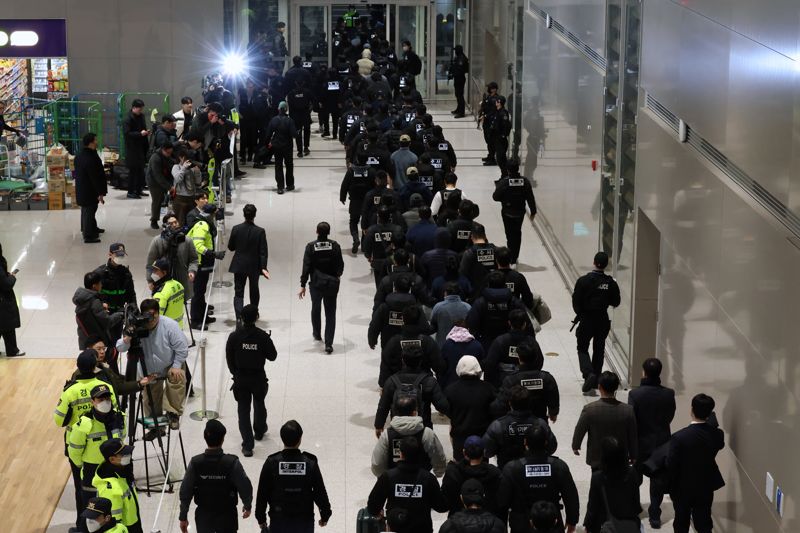
According to the National Office of Investigation under the Korean National Police Agency (KNPA) on the 5th, a special crackdown on phishing crimes conducted over five months from September 1 last year to January 31 this year led to the arrest of 26,130 suspects. Of these, 1,884 were taken into formal custody, and 127 suspects who had been staying overseas were forcibly repatriated to Korea in two separate operations.
Police also focused on cracking down on the creation and distribution of various tools essential to committing these crimes. They uncovered a total of 7,359 criminal tools and detected money laundering transactions worth about 149.8 billion won. In addition, they blocked 185,134 criminal tools, including phone numbers and messenger accounts used in the offenses, to prevent their use in further crimes.
Key characteristics of phishing crime organizations include establishing overseas bases, operating under strict internal rules, and maintaining an anonymized division of labor. Investigations found that most groups chose overseas locations as their base of operations and ran their organizations systematically, including by preparing detailed guidelines for different situations. In particular, all members used aliases, thoroughly blocking any exposure of their real identities.
A police official explained, "We found common patterns in which these groups set up bases overseas, beyond the reach of Korean investigative authority, operated under strict internal regulations, and carried out crimes in a cell-based, divided structure where even among themselves members used only aliases."
Although it had been difficult to apprehend members because the organizations were highly structured and anonymized and based overseas beyond the direct jurisdiction of Korean investigators, many groups were taken down through coordinated efforts. The Special Task Force on Transnational Crimes, liaison officers dispatched overseas, and investigative teams at each Metropolitan Police Agency worked together closely. As a result, during the special crackdown period, the number of voice phishing (vishing) cases fell by 20% and the total damage by 10% compared with the same period a year earlier. Over the same period, the number of suspects apprehended rose 46%, from 17,885 to 26,130.
Observers say the Government-wide Joint Response Team on Telecommunication and Financial Fraud, launched in October last year, played a major role in reducing vishing damage. During the special crackdown, the joint response team conducted a full analysis of victim reports and blocked 185,134 criminal tools such as burner phones. Working with the telecommunications industry, it also introduced an emergency blocking system that can cut off reported suspicious phone numbers within 10 minutes, and used it to block a total of 117,751 numbers during the period.
Having confirmed the effectiveness of strong crackdowns, close public–private cooperation, and broad-based joint responses in reducing vishing damage, police intend to continue mobilizing all available resources to eradicate such crimes. In light of the continued rise in multi-victim fraud beyond vishing, they plan to pursue a range of measures: tougher crackdowns on domestic and overseas criminal organizations, stronger international and domestic cooperation, comprehensive and real-time blocking of criminal tools, identifying and promoting institutional reforms, and extensive public-awareness campaigns including public service announcements.
Park Seong-ju, Commissioner of the National Office of Investigation, stated, "We will extend the special crackdown, which was originally scheduled to end in January, indefinitely and continue strong enforcement throughout this year." He stressed, "As part of the Special Task Force on Transnational Crimes, we will not only arrest offenders but also ensure that no one can profit from phishing crimes by using every possible means to trace and confiscate criminal proceeds and return them to victims, in order to make Korea safe from phishing."
[email protected] Jang Yu-ha Reporter