Painter of “Passages” Ha Tae-im Says, “Color Reaches the Heart More Directly Than Form” [Art & Culture]
- Input
- 2026-02-05 14:34:18
- Updated
- 2026-02-05 14:34:18
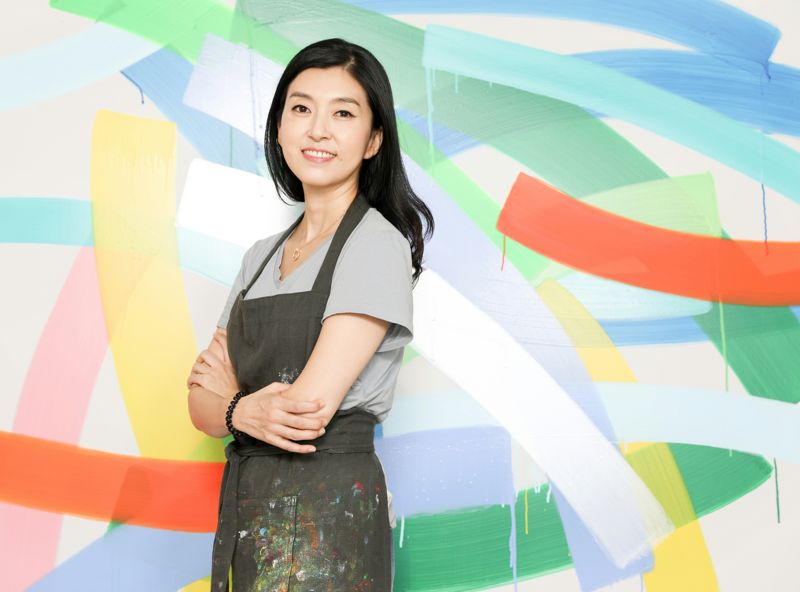
[Financial News] Viewers standing before abstract paintings often ask the same question: "What is this painting trying to say?"
In front of Ha Tae-im’s work, however, that question does not linger for long. Her canvases ask first not "What is it saying?" but "In what state does it leave you?"
Before her surfaces, where curved bands of color overlap and flow, viewers find it hard to walk away. People often say, "When I’m having a hard time, I end up standing in front of these paintings for a long while," a comment that is frequently heard in her exhibitions.
Until 2018, Ha was a full-time professor in the Department of Art Contents at Sahmyook University, but she resigned to focus entirely on her practice. Her conviction that "to understand a work, you must also look at the artist’s life" is clearly reflected in her recently published first essay collection, Color Rhapsody.
Because abstract painting does not offer a concrete narrative, many viewers find it difficult to approach. Ha says this is precisely where the context of an artist’s "life" becomes necessary.
"My work is abstract, so it’s hard for general viewers to find specific content or stories in the paintings. That’s why I thought you understand the work more quickly when you look into the artist’s life alongside it."
Her essay functions both as a working diary and a record of daily life. It calmly recounts the years she continued painting while raising a child, the physical pain and psychological fractures she endured, and the moments when she picked up the brush again. She explains that she wanted to convey more concretely the emotions that led to her work and the way she looks at her own life, which became the motivation for publishing the book.
The defining core of Ha’s painting is, without question, color. She regards color as a "means of expression" that comes before form.
"I think color is the most direct expressive tool for revealing the painter’s state of mind. I believe color is more important than form."
This is why recurring structures often appear on her canvases. The gently curved, band-like forms hardly change, but the colors laid over them are different every time. On this simple structure, the juxtaposition of diverse colors creates rhythm and tension across the surface.
Ha repeatedly emphasizes, "The moment the viewer’s memories and experiences of color meet my colors, a new world opens up."
The first work she wants to introduce to the world is a piece shown at her solo exhibition in 2017. It is markedly different from her earlier, clean and controlled bands of color. Traces of paint running down under the force of gravity remain visible on the canvas.
At the time, Ha was suffering from severe pain caused by herniated discs in her lower back and neck, as well as a torn rotator cuff. Her usual method involved laying the canvas flat on a table at thigh height and bending deeply over it to paint, a posture that only worsened her condition.
When she continued working with the canvas propped up against the wall, the paint inevitably began to run downward under gravity. Even though she knew what the result would be, she did not stop. The bands of color, unlike before, remained on the surface like streams of tears.
"Because the work was a large piece over 2 meters in both width and height, I needed to stand it up against the wall from time to time to check the progress. It was also an act of resistance against my own obsession with producing only neat, immaculate paintings."
Another representative work was completed during the Coronavirus disease 2019 (COVID-19) pandemic. Around that time, Ha was preparing a joint father–daughter exhibition with her late father and was deeply studying his artistic world. Her father, an abstract painter, often favored the color blue.
"I wanted to pay homage to my father’s work, so it was natural for blue to become the dominant color in the piece."
Yet the deeper she went into the work, the more the blue shifted into increasingly somber tones. The more intensely she painted, the more her inner landscape sank. At that point, the thought suddenly came to her that she wanted "to lay pink over the blue." After much deliberation, the pink she chose completely transformed the mood of the canvas.
Ha described the work as "the feeling of a single warm flower blooming in a desolate inner landscape." It also inspired the title of the subsequent solo exhibition, When Blue Meets Pink.
Every one of her works bears the title "Passage (Un Passage)" along with a unique number. This concept goes beyond a single series and runs through her entire artistic universe. "I hope my work can become a passage to encountering a new inner world."
Ha hopes that the moments we face in life will be transformed, through painting, into entirely different landscapes. Her canvases are not finished endpoints, but simply part of an ongoing process through which life and emotion move back and forth.
She, too, remembers moments when she was overwhelmed by art. Standing before works by Henri Matisse at the Metropolitan Museum of Art (The Met) in New York, the stained glass of Sagrada Família in Barcelona, and the yellow dot paintings of Korean abstract master Kim Whanki. "I found myself in tears in front of those works for no clear reason. Art overwhelms people at unexpected moments, and at the same time makes them humble."
She is currently preparing for a solo exhibition in Tokyo this April, another at OKNP Gallery in the Grand Josun Hotel in Busan, and a solo show in Paris in June, all while holding fast to the same principle: "Good work does not sway with the trends; it follows its own path." Ha plans to keep relentlessly experimenting with new combinations of color while continuing to write. Painting and writing are already interwoven in her life like warp and weft.
In closing, she offers readers and viewers a line from her essay. Life can collapse at any moment, but it can also be rebuilt. Recovery, she says, is not a dramatic transformation but the repetition of very small decisions. By creating passages through color and allowing us to cross our lives anew, Ha’s work continues to quietly fulfill its role today.
Born in Seoul in 1973, Ha graduated from the École Nationale Supérieure des Beaux-Arts in Paris and later earned her doctorate from Hongik University. She has since held 37 solo exhibitions at major venues in Korea and abroad, including POSCO Art Museum, Helen J Gallery (Los Angeles), Gallery AP Space (New York), Artside Gallery (Beijing), the Paris International Artists’ Community (Cité Internationale des Arts, Paris), Youngeun Museum of Contemporary Art, Schema Art Museum, and Seoul Auction, and has participated in more than 300 group exhibitions.
In 1999, she received the Principality of Monaco Prize at the Monaco International Contemporary Painting Exhibition, and in 2024 she was awarded the 10th Jeon Hyuk Lim Art Award. Her works are widely collected by public institutions, corporations, and international venues, including the National Museum of Modern and Contemporary Art, Korea, the Seoul Museum of Art, Samsung Electronics, the Seoul Family and Administrative Court, and the lobby of Capella Singapore. Capella Hotel is particularly well known as the site of the 2018 North Korea–United States summit.
rsunjun@fnnews.com Yoo Sun-joon Reporter