Federal–state cooperation leads to scaled-back raids...700 agents pulled from Minnesota
- Input
- 2026-02-05 00:07:49
- Updated
- 2026-02-05 00:07:49
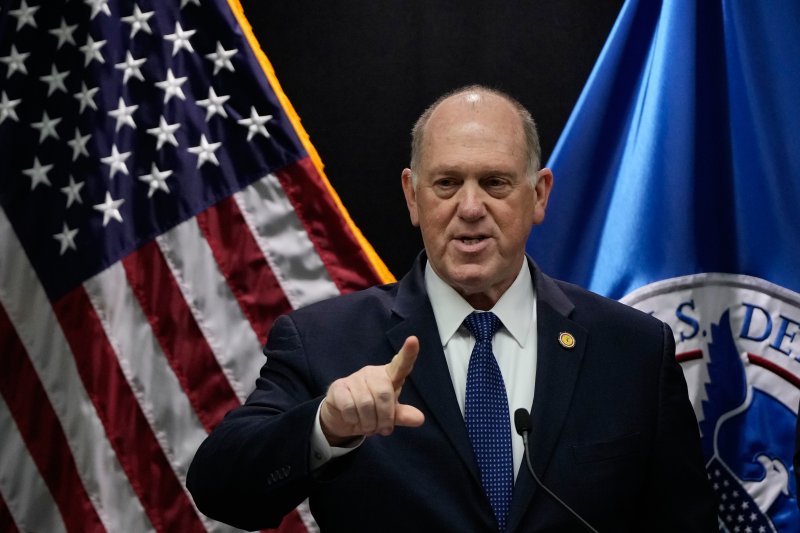
Financial News New York = Reporter Lee Byung-chulThe Trump administration has decided to reduce the number of immigration enforcement agents deployed to the State of Minnesota. The federal government agreed to ease its hard-line stance after the state and local governments consented to cooperate in turning over arrested immigrants to federal authorities.
Tom Homan, who oversees border policy at the White House, announced at a press conference on the 4th (local time), "Of the roughly 3,000 federal agents deployed in Minnesota, we will immediately withdraw 700." He explained, "We have achieved an unprecedented level of cooperation, and as a safer environment has taken shape, we can carry out enforcement with fewer personnel than before."
The immigration enforcement operation in Minnesota has sharply heightened social tensions in the Twin Cities area centered on Minneapolis and St. Paul. Tensions escalated further after protester Alex Pretty was killed by gunfire from federal agents, sparking widespread demonstrations criticizing what locals see as excessive federal crackdowns.
Homan had previously warned that there would be no reduction in federal agents unless state and local governments cooperated. His latest announcement came after President Donald Trump recently signaled the need to ease tensions in the Minneapolis and St. Paul area.
Homan stressed in particular that local jails must notify U.S. Immigration and Customs Enforcement (ICE) in advance when they hold inmates who may be subject to deportation. "Transferring people to ICE while they are still in custody is far safer than tracking down undocumented immigrants on the street," he said, adding, "That allows us to reduce the number of agents we need to deploy in the field."
The White House has long blamed so-called "sanctuary jurisdictions" for delays in arresting criminal immigrants. The term refers to state and local governments that limit cooperation with the Department of Homeland Security (DHS), and it has become a major flashpoint in federal–local conflicts since the Trump administration took office.
Homan gave a positive assessment of the results of the operation in Minnesota. "We detained a large number of people on the streets of the Twin Cities," he said. "From a public safety standpoint, I believe it was highly effective." He added, however, "It was not a perfect operation, but it was run under a single chain of command and in compliance with the rules," and said, "I do not believe anyone deliberately failed to do what they were supposed to do."
[email protected] Reporter Lee Byung-chul Reporter