Jang Dong-hyeok Proposes Hungarian-Style Solution to Low Birthrate and Bold Cut of Voting Age to 16
- Input
- 2026-02-04 14:29:51
- Updated
- 2026-02-04 14:29:51
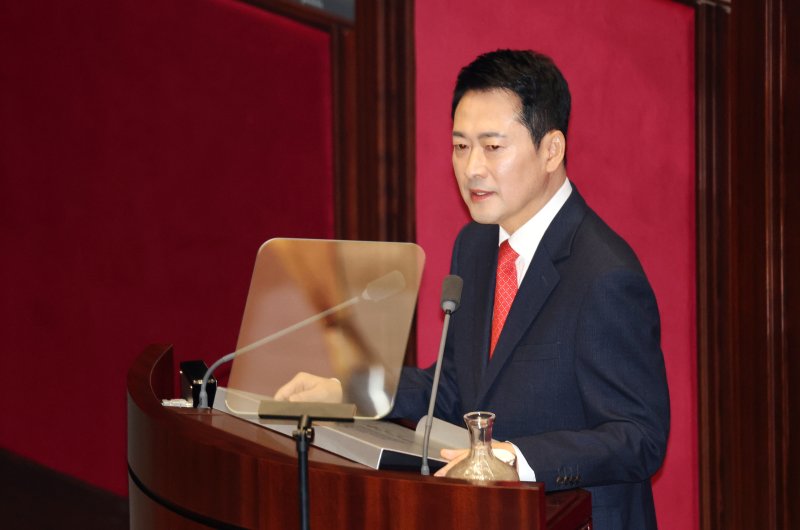
[Financial News] On the 4th, People Power Party leader Jang Dong-hyeok urged the government to actively participate in Ukraine reconstruction projects and development projects in Alaska and Greenland, which are expected to be led by the United States, as part of efforts to strengthen the ROK-US alliance and advance the national interest. He also proposed lowering the voting age from 18 to 16 and unveiled a "Hungarian-style solution to the low birthrate problem" to overcome the demographic crisis.
In his policy speech for negotiation groups at the National Assembly, Jang presented the Lee Jae-myung administration with a range of policy alternatives to address the tariff shock, overcome the demographic crisis, and advance political reform.
Regarding U.S. President Donald Trump’s announcement that he would reimpose reciprocal tariffs at 25%, Jang argued that this was because President Lee Jae-myung had lost the trust of the United States. He said Washington views the excessive sanctions on its own company, Coupang, as a "serious infringement against U.S. interests," out of concern that such measures could allow C-commerce—China-based e-commerce platforms—to encroach on the Korean market. Therefore, he stressed that strengthening the ROK-US alliance and restoring U.S. trust must come first. As a way to reinforce the alliance, Jang insisted that Korea should actively take part in U.S.-led Ukraine reconstruction projects and in the development of Alaska and Greenland.
He also sharply criticized President Lee for signaling the submission of a supplementary budget bill and maintaining an expansionary fiscal stance. Jang argued, "Instead of reviving the growth engine of the economy, this administration has chosen anti-market populism in the form of cash handouts," and warned, "If President Lee once again embarks on vote-buying style cash giveaways ahead of the local elections, our economy could suffer irreparable damage."
Jang also proposed a "Hungarian-style low birthrate policy" to tackle the demographic crisis. Under the plan, households could receive up to 200 million won in low-interest loans at 1% for home purchases or key money deposits, with all interest waived upon the birth of a first child, 30% of the principal forgiven for a second child, and the entire remaining principal canceled for a third child. To boost employment, he suggested expanding labor market flexibility, cutting the corporate tax, and raising the basic deduction for earned income tax. To support young people, he pledged to expand the current "1,000-won breakfast" program into a "1,000-won three meals a day" program and to improve the youth housing voucher, including support of 300,000 won per month for rent.
He also expressed his willingness to support the full relocation of the administrative capital, a campaign pledge of President Lee Jae-myung. Jang proposed that, within the Lee Jae-myung administration’s term, both the presidential office and the National Assembly be completely moved to Sejong, and that all necessary steps—such as a constitutional amendment, enactment of special legislation, and construction of government complexes—be pursued together.
As part of political reform, he proposed lowering the voting age. The idea is to reduce the current suffrage age from 18 to 16. Jang stated, "Young people in Korea receive one of the highest levels of education in the world and are in no way inferior to adults in terms of social judgment," and added, "Let us begin discussions in the Special Committee on Political Reform so that we can lower the voting age starting with the upcoming local elections."
[email protected] Lee Hae-ram Reporter