"Eight Months of the Lee Administration, a Time of Collapse and Decline"... Jang Dong-hyeok Calls for Summit Talks
- Input
- 2026-02-04 13:41:57
- Updated
- 2026-02-04 13:41:57
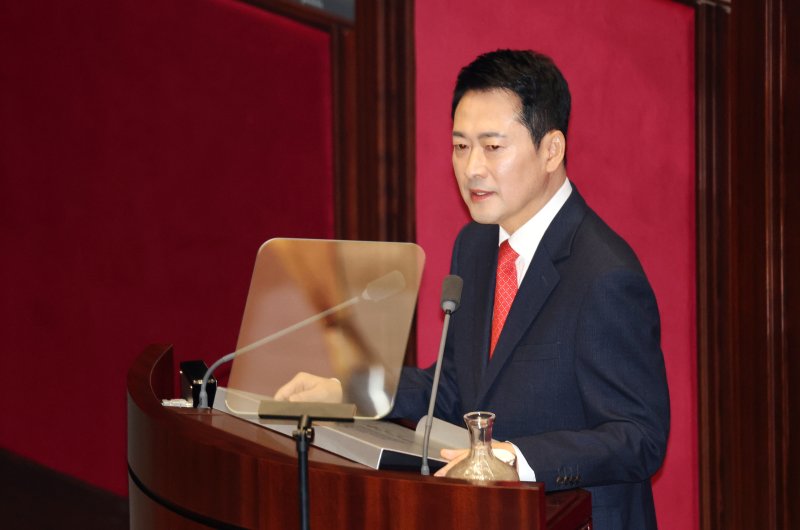
[Financial News] In his negotiation bloc speech at the National Assembly on the 4th, People Power Party leader Jang Dong-hyeok sharply criticized the first eight months of the Lee Jae-myung administration, calling them "a time of dismantling and destruction, collapse and decline." He again proposed introducing three major special counsel investigations—into the decision not to appeal in the Daejang-dong case, the Unification Church scandal, and alleged Democratic Party nomination bribes—as well as holding summit talks to discuss rising housing prices, the exchange rate, and other economic issues affecting people’s livelihoods.
Taking the podium in the National Assembly chamber, Jang accused the government and ruling camp of "dismantling the constitutional order and destroying the judicial order," adding, "The market economy is collapsing, and the real economy that supports people’s livelihoods is in free fall."
Referring to the ruling camp’s push for a second omnibus special counsel, the Special Tribunal for Insurrection, and the dismantling of the prosecution service, Jang argued, "President Lee Jae-myung and the Democratic Party of Korea are attempting to reshape the very system of the Republic of Korea." He went on, "They are pouring all their energy into rolling back liberal democracy and wrecking the judicial system." Comparing this to the Nazi regime’s special courts known as "People’s Courts," he charged that they are "following the path of the Nazis."
He said, "The National Assembly has ceased to be a forum for debating and competing over policies to improve people’s livelihoods, and has instead become a hall of legislative dictatorship used to eliminate political opponents and suppress the opposition." He urged, "Even now, the second special counsel and the Special Tribunal for Insurrection must be withdrawn, and attempts to dismantle the prosecution must be halted."
Jang stressed the need to uncover the full truth behind the Daejang-dong non-appeal decision, the Democratic Party–Unification Church scandal, and the alleged nomination-bribery case, saying, "The special counsel system was created to investigate those in power while they are still in office. If they have nothing to hide, there is no reason to refuse a special counsel investigation."
He also renewed his call for President Lee Jae-myung to agree to summit talks. "I do not wish for the Lee Jae-myung administration to fail," Jang said. "I have seen all too painfully how a government’s failure leads to national decline and public disillusionment." He added that his hope is for the meeting to be "not about political strife, but about sharing the difficulties facing the real economy and jointly discussing solutions."
Jang voiced concern over U.S. President Donald Trump’s recent decision to reimpose a 25% reciprocal tariff on Korean products. He argued that the delay in parliamentary ratification or in passing a special law on investment in the United States is not the only cause, claiming that pressure from the government and ruling party on Coupang is also a major factor. "The Coupang situation has gone beyond the troubles of a single company and has become a fuse for trade friction," he said, adding, "The United States is expressing concern that excessive sanctions on Coupang will lead to Chinese C-commerce platforms encroaching on the Korean market."
He further argued that South Korea should actively participate in future U.S.-led reconstruction projects in Ukraine, as well as development projects in Alaska and Greenland. Jang said, "We must dispel U.S. doubts about the Lee Jae-myung administration and take proactive steps to strengthen the ROK-US alliance." He emphasized, "Once the war in Ukraine ends, U.S.-led reconstruction projects will begin. Expanding South Korea’s participation will not only strengthen the ROK-US alliance but also serve as a way to increase our national interest."
On the government’s economic policy, including expansionary fiscal spending, Jang argued, "Instead of reviving the engines of economic growth, they have chosen anti-market populism in the form of cash handouts." He continued, "They are pushing ahead with expansionary fiscal policy that rejects the principles of a market economy and steers us toward Lee Jae-myung’s ‘basic social welfare’ model." He added, "Excessive liquidity has fueled a weak currency and high inflation," and demanded, "The government must first get the basics right—prices, the exchange rate, and real estate—and then move quickly to overhaul our industrial structure."
With local elections approaching, Jang also rolled out a range of policy pledges. His proposals included: raising the basic deduction for earned income tax; increasing labor market flexibility; tax incentives for companies that hire young people; cutting the corporate tax rate; providing three daily meals for university students at 1,000 won each; convenience-store lunchbox vouchers for young people who do not go on to higher education; a "Family Dream Loan" program for newlywed couples without homes; and a Hungary-style low birthrate policy package.
As part of political reform, he proposed lowering the voting age to 16 starting with the June local elections. "Young people in Korea receive one of the highest levels of education in the world and are in no way inferior to adults in terms of social judgment," he said, suggesting that the Special Committee on Political Reform begin discussions on the idea.
He also called for a constitutional amendment to fully relocate the administrative capital. "During the Lee Jae-myung administration’s term, let us work together to review and push forward all necessary measures—constitutional amendment, enactment of special laws, and construction of government complexes—so that the presidential office and the National Assembly can be completely moved to Sejong Special Self-Governing City," he said.
[email protected] Reporter Lee Haeram Reporter