Trademark Theft and Technology Leaks Becoming Routine...More Than 200 People Caught Every Year
- Input
- 2026-02-04 14:50:25
- Updated
- 2026-02-04 14:50:25

[Financial News] Illegal acts involving corporate trademarks and trade secrets are no longer one-off incidents but have become a constant risk in the industrial field. Crackdowns continue, yet large numbers of offenders are still being caught every year. Calls are growing for a prevention-centered response that strengthens internal controls and information management systems within companies.
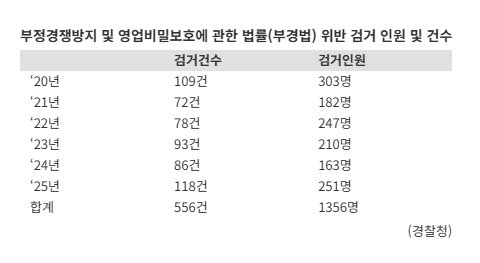
According to data Financial News obtained from the Korean National Police Agency (KNPA) titled “Number of people and cases caught for violating the Unfair Competition Prevention and Trade Secret Protection Act,” a total of 1,356 people were apprehended over the six years from 2020 to 2025. This translates to an annual average of 226 people being caught on suspicion of infringing corporate trademarks or trade secrets. During the same period, there were 556 cases in total, averaging more than 90 cases per year.
By year, the number of people caught was 303 in 2020, 182 in 2021, 247 in 2022, 210 in 2023, and 163 in 2024, showing ups and downs before jumping again to 251 last year. The number of cases also dipped slightly from 109 in 2020 to 86 in 2024, but then surged to 118 last year. In particular, both the number of cases and the number of people caught rose last year, marking the highest level in the past five years.
The Unfair Competition Prevention and Trade Secret Protection Act aims to maintain fair business practices by preventing the unauthorized use of well-known trademarks or trade names and the infringement of others’ trade secrets. Nevertheless, the fact that hundreds of offenders are still caught every year has raised concerns that the law’s institutional deterrent effect is limited.
In reality, suspected unfair competition crimes involving corporate trade secrets have continued to surface frequently in recent years. On the 2nd, the Criminal Division 3 of the Seongnam Branch of the Suwon District Prosecutors’ Office indicted, without detention, Ironmace CEO Choi and two others, as well as the company itself, on charges including violating the Unfair Competition Prevention and Trade Secret Protection Act by leaking trade secrets. Prosecutors allege that from 2021 to 2023, after leaving Nexon while it was still developing a game, Choi and others leaked original game files and other materials, then founded Ironmace, a competing firm, and used them to develop and release the game “Dark and Darker.”
Industry and legal experts point to the spread of the digital environment and the blurring of boundaries between industries as key reasons why these crimes keep recurring. As it has become easier to leak information through retirees or partner companies, collect data via web crawling, and transmit materials online, the risk that a company’s core information will be exposed externally has grown significantly compared with the past.
Hwang Seok-jin, a professor at the Graduate School of International Information Security at Dongguk University, noted, “As job changes and headhunting become more frequent, the movement of people increasingly creates incentives for the movement of technology as well.” He added, “Even if there are confidentiality agreements, there are limits to completely blocking the removal of data via USB drives or personal email from a technical standpoint.”
Although the current Unfair Competition Prevention and Trade Secret Protection Act contains criminal penalties, some analysts say it has not been effective enough in preventing these crimes. Attorney Yang Jin-young of Minwho Law Firm pointed out, “In serious cases of trade secret infringement, prison sentences are sometimes handed down, but for general unfair competition acts, it is rare for cases to go that far.”
An amendment to the Unfair Competition Prevention Act that includes strong measures to prevent technology leaks—such as raising the cap on punitive damages from three to five times the actual damages—passed the plenary session of the National Assembly in 2024. However, many observers say it is still difficult to apply in practice because the burden of proof, including calculating the amount of damages, rests with the victim.
Experts stress that punishment must be accompanied by prevention-focused measures. They say that, in particular, small and medium-sized enterprises need to review their internal systems for managing technology and information, strengthen security systems, and tighten management standards for retirees and external partners.
Professor Hwang emphasized, “We need to send a signal that violating the Act carries a heavy burden by combining administrative sanctions such as business suspension.” He continued, “Small and medium-sized firms should reduce structures in which specific individuals hold excessive control over technology and information, distribute access rights more broadly, and diversify their technology development processes.”
[email protected] Kim Ye-ji Reporter