Lung Cancer Remains Top Cause of Death: “Immunotherapy Claims Quadruple”
- Input
- 2026-02-04 08:50:29
- Updated
- 2026-02-04 08:50:29
[Financial News] Lung cancer remains the leading cause of death in South Korea, but a new analysis finds that the spread of cutting-edge treatments, especially immunotherapy, is helping improve survival rates.
Marking World Cancer Day on February 4, Samsung Fire & Marine Insurance announced that it used its integrated health information platform, known as the “Health DB,” to analyze lung cancer–related medical use among its policyholders.
The analysis was based on 10 years of accumulated data from 2015 onward and is the company’s third cancer-focused study, following breast cancer and prostate cancer.
According to National Cancer Registry Statistics released by the Ministry of Health and Welfare as of January 21, 2026, lung cancer ranks second in incidence nationwide and has remained the number one cause of cancer death since 2015. It is also the most common cancer among men and women aged 65 and older, underscoring the need for vigilance in an aging society.
An analysis of five-year mortality among patients diagnosed with lung cancer between 2015 and 2020 showed that the mortality rate for men was 53.0%, far above the overall average of 44.3%. It was also about 1.8 times higher than the average for women, which stood at 29.6%.
A sharp increase in lung cancer among older women also stood out. Based on Samsung Fire & Marine Insurance’s Health DB, the number of female lung cancer patients aged 60 and older who received insurance payouts rose from 211 in 2020 to 414 in 2024, nearly doubling in four years. The National Cancer Center (NCC) notes that more than half of female lung cancer patients are non-smokers and stresses that continued attention to secondhand smoke and environmental risk factors is essential.
Samsung Fire & Marine Insurance’s Health DB analysis also found that lung cancer mortality has declined. The mortality rate fell from 51.4% in 2015 to 41.3% in 2020, a drop of about 10 percentage points. Over a similar period, National Cancer Registry Statistics show that the lung cancer survival rate improved markedly, from 16.6% in 2001–2005 to 42.5% in 2019–2023.
Experts point to the spread of advanced treatments, particularly targeted therapies and immunotherapies, as the main driver of this change. Multiple studies report that the introduction of immunotherapy has had a positive impact by extending survival in lung cancer patients and reducing postoperative recurrence.
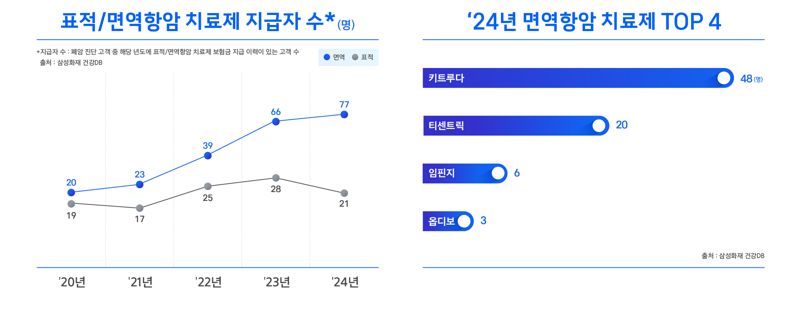
The changing treatment landscape is also visible in Samsung Fire & Marine Insurance’s Health DB. The number of policyholders receiving insurance payouts for immunotherapy rose from 20 in 2020 to 77 in 2024, roughly a fourfold increase. Use of genetic testing to enable personalized treatment also grew, from 102 patients to 165 over the same period, a 1.6-fold rise.
Samsung Fire & Marine Institute for Long-term Future Value stated, “Lung cancer remains a serious threat, but we confirmed that precision diagnostics and the latest targeted and immunotherapy treatments are now being actively used in clinical practice.” The institute added, “We will continue to analyze and share information on treatment technologies used in the medical field so that we can contribute to health-care policy and the advancement of medical technology.”
Meanwhile, since 2024 Samsung Fire & Marine Insurance has been jointly operating the Cancer Patient Quality of Life Research Center with Samsung Medical Center (SMC). The center conducts research to help socially vulnerable cancer patients return to daily life after treatment and improve their quality of life.
[email protected] Hong Ye-ji Reporter