Foreign Reserves Fall Again as Authorities Move to Curb Exchange Rate
- Input
- 2026-02-04 06:00:00
- Updated
- 2026-02-04 06:00:00
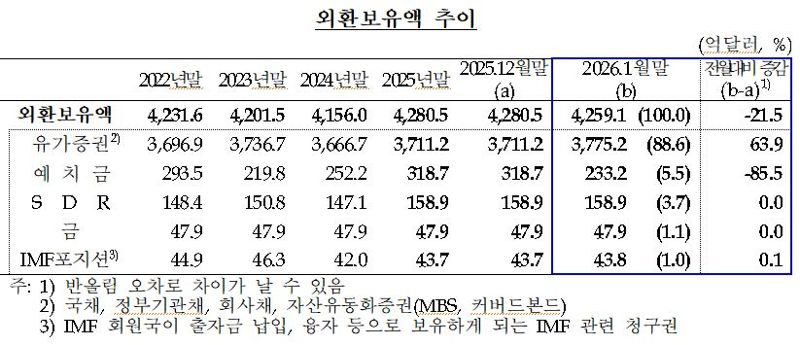
According to the Bank of Korea on the 4th, South Korea’s foreign exchange reserves came to 425.91 billion dollars as of the end of January. This was down 2.15 billion dollars from the end of the previous month, when reserves stood at 428.05 billion dollars.
Foreign reserves fell to 404.6 billion dollars at the end of May last year, the lowest level in about five years, then increased for six consecutive months through November. That recovery stalled in December, and reserves declined again in the first month of this year. A major factor was an 8.55 billion dollar reduction in deposits, which fell to 23.32 billion dollars.
Holdings of securities such as government bonds, agency bonds, corporate bonds, and asset-backed securities including mortgage-backed securities (MBS) and covered bonds increased by about 6.39 billion dollars, rising from 377.52 billion to 383.91 billion dollars.
Special Drawing Rights (SDRs), at 15.89 billion dollars, and gold, at 4.79 billion dollars, were unchanged.
The IMF reserve position, which represents a member country’s reserve tranche with the International Monetary Fund (IMF) arising from quota payments and lending, edged up by only 10 million dollars.
The US dollar–South Korean won exchange rate closed at 1,483.60 won on December 23. After the authorities stepped in, it retreated to around the 1,420 won level, but stood at 1,439.50 won at the end of January. On February 2, the first trading day of the month, it finished at 1,464.30 won.
A Bank of Korea official also explained the decline in foreign reserves, saying it was "mainly due to market stabilization measures such as the FX swap with the National Pension Service."
In terms of global ranking, South Korea’s foreign exchange reserves were the ninth largest in the world as of the end of December last year. China ranked first with 3.3579 trillion dollars, followed by Japan (1.3698 trillion), Switzerland (1.0751 trillion), Russia (754.9 billion), India (687.7 billion), Taiwan (602.6 billion), Germany (566.1 billion), and Saudi Arabia (460.1 billion).
[email protected] Kim Tae-il Reporter