"Overseas Transfer of High-Precision Maps Could Cause Up to 197 Trillion Won in Losses Over 10 Years"
- Input
- 2026-02-03 16:44:32
- Updated
- 2026-02-03 16:44:32
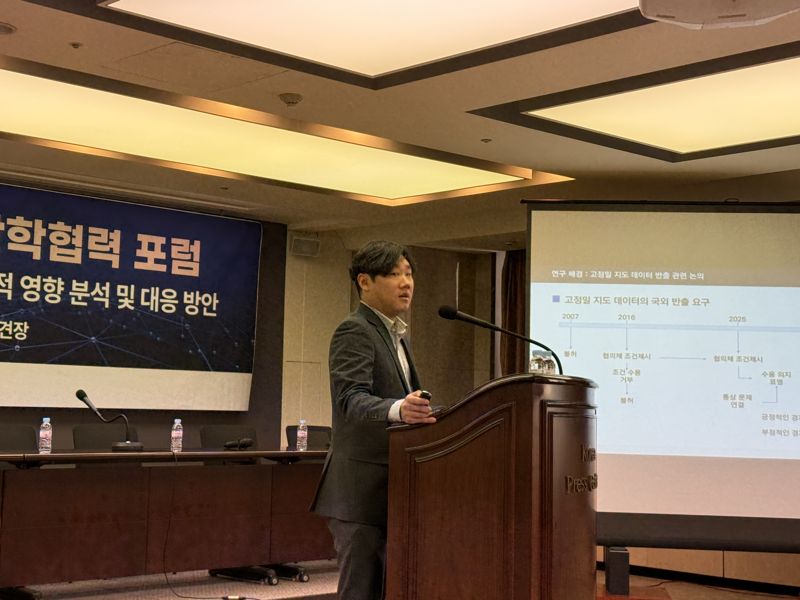
As the government is expected to begin discussions as early as February on Google's request to transfer high-precision map data overseas, a new analysis warns that allowing such exports could lead to cost losses of up to 197 trillion won over the next 10 years.
At a forum titled "Analysis of the Economic Impact on Domestic Industries and Response Measures in the Event of High-Precision Map Data Exports," held by the Korean Society for Geospatial Information Science at the Korea Press Center in Jung District in central Seoul on the 3rd, Professor Jeong Jin-do of Korea National University of Education (KNUE) stated, "If map exports are permitted going forward, our analysis shows that, compared with maintaining the current regime, the total cost losses in eight industrial sectors — including mapping, platforms, mobility, and construction — would reach approximately 150 trillion to 197 trillion won over the next 10 years."
Professor Jeong analyzed the ripple effects across various economic sectors that would be affected by map exports using a computable general equilibrium (CGE) model.
According to the CGE model, losses would accumulate after the export of map data, leading to an increasingly larger decline in Gross Domestic Product (GDP) over time. The analysis also suggests that the related ecosystem would become more dependent on foreign platforms, and that competitiveness in areas such as artificial intelligence (AI) and autonomous driving would weaken.
Professor Jeong explained, "If exports are allowed, total costs will continue to rise over time. In terms of composition, the largest share will come from the contraction of related domestic industries and royalties flowing overseas, and there is also the potential for additional expected security losses." He added, "In particular, the cumulative impact of growing dependence on foreign platforms and the disappearance of viable alternatives will accelerate the increase in damage." He noted that the resulting burden would ultimately fall on small business owners and micro-enterprises.
Before any decision is made on whether to allow map exports, Professor Jeong argued that several conditions must first be met to ensure fair competition. These include securing interoperability, institutionalizing fair platform competition, strengthening R&D and taking the lead in setting standards, improving the industrial ecosystem, and establishing a risk management governance framework.
During the subsequent panel discussion, participants also argued that fair competitive conditions must be secured in advance as a prerequisite for any map exports. The discussion was chaired by Professor Shin Dong-bin of Anyang University, former president of the Korean Society for Geospatial Information Science, and joined by Senior Researcher Kim Dae-jong of the Korea Research Institute for Human Settlements, Principal Researcher Kim Ju-wan of the Electronics and Telecommunications Research Institute (ETRI), and representatives from related industries.
Participants at the discussion shared concerns that if high-precision maps are allowed to be transferred overseas under the current circumstances, the domestic geospatial information industry could be devastated.
They cited Google's refusal to accept the requirement to install domestic servers — a precondition for map exports — as a representative case of unfair competition. They also pointed out that even if violations are later found in the course of providing services, it would be difficult to impose effective sanctions on activities conducted on overseas servers.
wongood@fnnews.com Reporter Joo Won-gyu Reporter