[Comprehensive] Han Byung-do: "Stop stock price suppression and begin a debate on a basic society"
- Input
- 2026-02-03 11:43:03
- Updated
- 2026-02-03 11:43:03
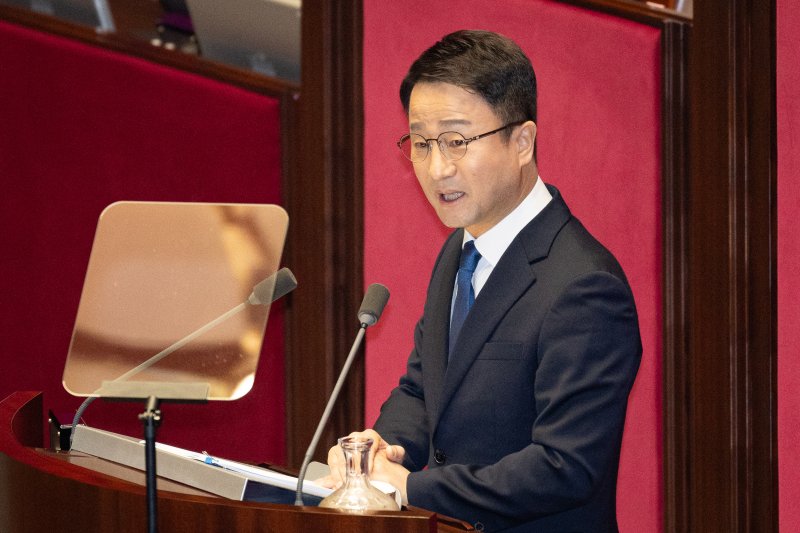
[Financial News] Han Byung-do, floor leader of the Democratic Party of Korea, announced on the 3rd, in his speech as representative of his negotiation bloc, that he would pursue legislation to sustain the Korea Composite Stock Price Index (KOSPI) at the 5,000 level, and that he is determined to advance "basic society" policies, including the basic income initiative championed by President Lee Jae-myung.
Mandatory cancellation of treasury shares and a floor for inheritance and gift taxes: an attempt to sustain high stock prices
Taking the podium for the negotiation bloc policy speech at the plenary session that day, Floor Leader Han first declared his intention to support, through legislation, the Lee Jae-myung administration’s policies aimed at channeling investment funds into the domestic stock market.
Referring to two previous amendments to the Commercial Act and the introduction of separate taxation on dividend income, as well as the move to establish a duty of loyalty to shareholders, Han stated, "The Lee Jae-myung administration has consistently pursued policies to redirect funds excessively concentrated in real estate into productive financial sectors such as the stock market," adding, "Going forward, we will accelerate capital market reform by pushing for a third amendment to the Commercial Act centered on mandatory cancellation of treasury shares, the introduction of a Korean-style discovery system, expansion of the Stewardship Code, and a stock price suppression prevention bill."
The third amendment to the Commercial Act entered deliberations on the same day at the first subcommittee on bill review of the Legislation and Judiciary Committee of the National Assembly. The Democratic Party of Korea plans to seek passage at the plenary session as early as the 5th. The stock price suppression prevention bill would set a lower limit for the valuation of listed shares for inheritance and gift tax purposes at 0.8 times the price-to-book ratio (PBR), in order to prevent artificial stock price declines aimed at facilitating business succession.
The Stewardship Code serves as the guideline for the exercise of voting rights by the National Pension Service, and the Democratic Party’s plan is to strengthen it to enhance shareholder value. The Korean-style discovery system is designed to ease the burden of proof for companies that have suffered technology theft.
All of these capital market reform bills appear intended to maintain the unprecedented stock market rally. With the June local elections approaching, there is a shared perception that high stock prices must be sustained as much as possible.
Administrative integration and support for SMEs and youth to drive growth; Special Act on Investment in the United States to counter U.S. tariffs
The party will also step up legislative efforts to promote economic growth, which is the real engine behind rising stock prices. It plans to push bills aimed at overcoming the crisis facing small and medium-sized enterprises (SMEs) and small business owners, even as certain sectors such as semiconductors enjoy a super boom.
“For the first time in our history, exports have reached 700 billion dollars, but not all citizens are sharing in the fruits,” Han said. “We will pay closer attention to vulnerable sectors such as regional areas, SMEs, small business owners, and low-income groups,” he continued, as he laid out related bills.
For balanced regional growth, he pledged to pass a special administrative integration bill to launch entities such as Gwangju Metropolitan City and Daejeon Metropolitan City in integrated form, along with amendments to the Local Autonomy Act, during the February extraordinary session of the National Assembly. As part of the administrative integration process, he also plans to carry out initiatives such as "creating ten Seoul National University-level institutions" and a "second relocation of public institutions."
For SMEs, the party will promote a market access support bill and an Act on Supporting Overseas Expansion of SMEs and Startups, under which the government would help them enter public procurement markets and expand abroad. For small business owners, it has proposed a Small Business Act to build a recovery framework that includes tailored artificial intelligence (AI) support. The goal is to pass all of these within the first half of this year. In addition, to prevent more young people from losing the will to work amid a tough job market, the party will prepare amendments to the Youth Employment Promotion Act to expand AI education and vocational training.
Regarding tariffs imposed by the Donald Trump U.S. administration, which he described as the biggest external shock factor for Korea’s economy and stock market, Han called on the People Power Party (PPP) to swiftly pass the Special Act on Korea–U.S. Strategic Investment Management, also known as the Special Act on Investment in the United States.
Han warned, "If tariffs are raised again to 25%, the automobile industry alone will shoulder more than 4 trillion won in additional annual costs. This will not stop at affecting corporate profits; it will lead to higher vehicle prices and reduced investment, resulting in structural shocks that increase the burden on domestic consumers and put pressure on jobs." He urged cooperation from the opposition party, saying, "Only when we pool our strength and wisdom for people’s livelihoods and the national interest can this truly be a parliament that represents the will of the people."
Debate begins on President Lee’s flagship "basic society" policy: "A survival system for the AI era"
Han also proposed launching discussions on basic society policies to respond to the era of artificial intelligence. The idea is to lay the groundwork for policies that guarantee people’s basic standard of living, including basic income, which is President Lee Jae-myung’s signature initiative.
There is growing concern that as AI is introduced across all sectors, jobs will shrink dramatically and maximized profits will be concentrated in the hands of a few, leading to extreme polarization. In response, since his time as Mayor of Seongnam, President Lee has advocated a basic society, centered on the introduction of basic income along with basic housing and basic finance.
“We must completely reorganize our institutional framework so that AI becomes not a threat that takes away our jobs, but a great tool that infinitely expands our people’s capabilities,” Han stressed. “We need to lay the foundation for a basic society that prevents extreme polarization.”
He went on to say, "If the enormous added value created by AI and robots is concentrated only in the hands of a few, the vast majority of citizens will be left in despair at the edge of a jobs cliff," adding, "A basic society is the minimum survival system needed to maintain our community in an era of technological revolution. Let us seriously discuss concrete solutions to ensure that all citizens can fairly share in the fruits of growth created by AI."
The Democratic Party of Korea has already had Representative Shin Jung-hoon, who chairs the National Assembly’s Public Administration and Security Committee, introduce the Basic Act on a Basic Society for Ensuring National Well-being. The bill would require the government to establish a comprehensive plan for providing basic services, including basic lifetime income. The party is reportedly planning to move forward in earnest after appropriate consultations between the government and the ruling party.
To advance this broad legislative agenda more efficiently, the Democratic Party of Korea has decided to set up a Task Force for People’s Livelihood and Economic Legislation within its parliamentary wing. Han said, "We will scrutinize, on a weekly and monthly basis, the legislative progress of key state tasks and livelihood-related bills that are directly linked to people’s lives, and we will report the status of progress to the public."
Han also called for holding a constitutional amendment referendum alongside the June local elections. Arguing that there is not enough time to debate a full-scale constitutional revision, he proposed a "one-point constitutional amendment" to enshrine the spirit of the May 18 Gwangju Democratization Movement in the preamble of the Constitution, an idea he said both the ruling and opposition parties could agree on.
[email protected] Reporter Kim Yun-ho Reporter