Korea AeroSpace Administration to Launch New Aviation Projects Worth 211.7 Billion Won, Briefing Session on February 5
- Input
- 2026-02-03 12:00:00
- Updated
- 2026-02-03 12:00:00
[Financial News] The Korea AeroSpace Administration (KASA) will launch new aviation projects worth a total of 211.7 billion won starting this year. The initiatives will focus on core engine technologies, eco-friendly materials and components, and the development of crewed aircraft using artificial intelligence (AI).
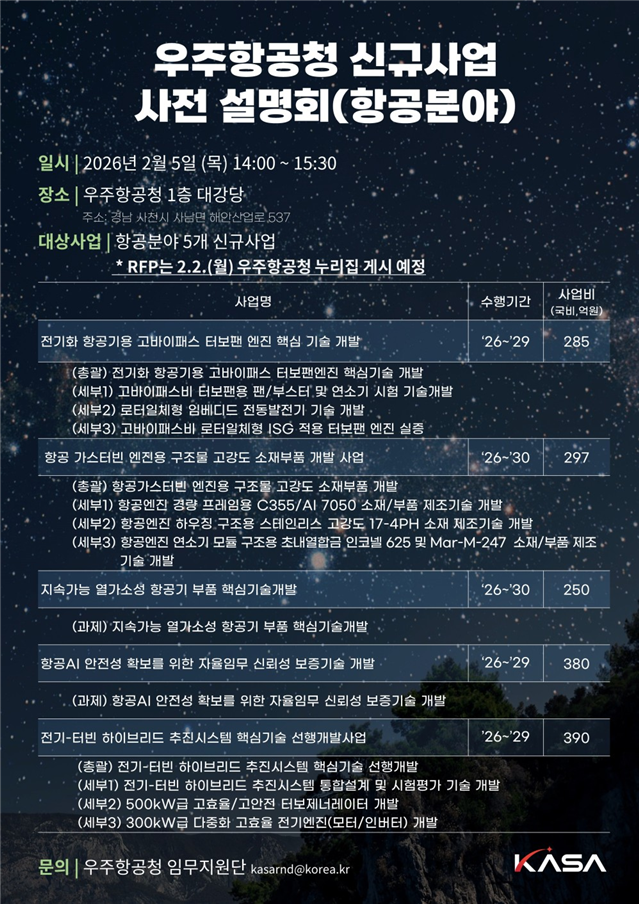
KASA announced on the 3rd that it will hold a preliminary briefing session at 2 p.m. on the 5th in the main auditorium on the first floor of its headquarters in Sacheon, South Gyeongsang Province. The session will share key details of the new aviation projects scheduled for 2026 and encourage active participation and deeper understanding among researchers from industry, academia, and research institutes.
The briefing is intended to directly explain the goals and main content of the 211.7 billion won aviation program that will fully begin in 2026, and to gather feedback from researchers in industry, academia, and research institutes. The five new projects to be unveiled cover core areas for aviation innovation, including engine core technologies and materials development, eco-friendly materials and components, reliability assurance technologies for aviation AI, and preliminary development of core technologies for future aviation.
First, the project to develop core technologies for high-bypass turbofan engines for electrified aircraft is being promoted in response to the aviation industry’s shift toward eco-friendliness and the trend of developing commercial aircraft with high-capacity electric power consumption. The main goal is to develop a 4,500 lbf-class high-bypass turbofan engine model that includes an integrated rotor-type embedded integrated starter-generator (ISG) with an electric output of at least 100 kW. The project has a total budget of 47 billion won, including 28.5 billion won in government funding, and is scheduled for completion by 2029.
KASA will also push ahead with the development of high-strength structural material components for aviation gas turbine engines. By localizing engine materials and parts that are currently entirely imported, the project aims to secure independent technological capabilities, build an ecosystem for domestic materials and parts suppliers, and strengthen their competitiveness in global exports. The project will proceed with a total budget of 39.5 billion won, including 29.7 billion won in government funding, and is planned to run through 2030.
The agency will additionally launch a project to develop core technologies for sustainable thermoplastic aircraft components. Beyond securing high-speed forming technologies for aircraft parts, the project seeks to ensure quality equivalence in high-speed processes, which is a prerequisite for entering the supply chains of global original equipment manufacturers (OEMs). It also aims to proactively respond to international carbon neutrality requirements through resource-circulating technologies that recycle structural components into interior parts. The project has a total budget of 31.2 billion won, including 25 billion won in government funding, and is scheduled for completion by 2030.
Another project will establish national standards for applying AI to aircraft, an area that is currently a gap, and lay the groundwork for developing crewed aircraft that use AI. The work will include developing and validating modules for autonomous missions, as well as designing and validating a demonstrator aircraft. The total budget is 47 billion won, with 38 billion won in government funding, and development is planned through 2029.
KASA will also secure core technologies for an electric–turbine hybrid propulsion system, which is essential to extending operating time and range for future advanced aircraft, known as Advanced Air Vehicles (AAVs). The project will be funded with a total of 47 billion won, including 39 billion won in government support, and is scheduled to run until 2029.
KASA plans to reflect the feedback collected at the briefing and, during February, publish the official call for proposals and begin accepting project applications through the Integrated Government-wide Research Support System (IRIS).
jiany@fnnews.com Yeon Ji-an Reporter