Lee administration declares 'war on speculation,' opposition counters with 'fast-track strategy'
- Input
- 2026-02-02 14:46:06
- Updated
- 2026-02-02 14:46:06
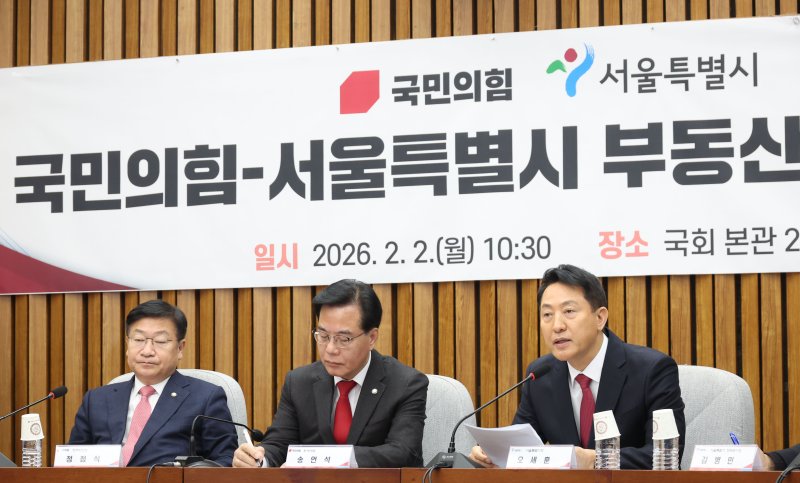
[Financial News] As Lee Jae Myung, President of South Korea, has been repeatedly raising what he calls a "real estate doomsday" narrative and in effect declaring a "war on speculation," the opposition camp has stressed the need to ease redevelopment and reconstruction regulations to spur housing supply driven by the private sector. The Seoul Metropolitan Government and the People Power Party (PPP) branded Lee Jae Myung's demand-side-focused real estate measures as a "Moon Jae-in administration, season two" and vowed to push back with a "fast-track strategy" that would move up the start date for housing construction in Seoul by one year.
The PPP and the Seoul Metropolitan Government held a real estate policy meeting at the National Assembly of the Republic of Korea on the 2nd. They sharply criticized the Lee Jae-myung administration for tightening loans through its June 27 Real Estate Measures and October 15 Housing Market Stabilization Measures, saying these demand-suppression steps amounted to a de facto "banishment from Seoul," and argued that the Jan. 29 Housing Plan focusing on supply lacked effectiveness. At the meeting, Oh Se-hoon said, "This latest package is a regression to the past, once again relying on ineffective, government-led approaches," adding, "In reality, the private sector already accounts for 90% of housing supply in Seoul, but the stricter relocation loan rules and caps on association members' rights introduced after the October 15 Housing Market Stabilization Measures are choking off private redevelopment projects."
Regarding the inclusion of the Yongsan International Business District and the Taereung Country Club site as candidate locations in the Jan. 29 Housing Plan, he criticized it as "a déjà vu of the already failed August 4 Housing Supply Measures, in which sites were unilaterally announced without prior consultation with local governments or thorough verification of feasibility." He went on, "Designating sites that still face numerous hurdles, such as World Heritage impact assessments, only raises false hopes in the market," and stressed, "We cannot agree to a rush to boost supply merely to hit numerical targets by even damaging greenbelt areas, or to pushing out volumes that prioritize the short-term impact of announcements over actual feasibility."
The PPP also condemned Lee Jae Myung for urging multiple-home owners to sell before higher capital gains taxes take effect, calling it "politics of intimidation." The party maintains that, rather than policies that suppress demand, regulations should be eased to activate private-sector-led supply. Parliamentary leader Song Eon-seok said, "We must actively step in to restore the profitability of private apartment construction projects," and emphasized that the government should pursue measures such as easing the Floor Area Ratio (FAR) and streamlining approval and permitting procedures.
The PPP and the Seoul Metropolitan Government put forward Seoul's "fast-track strategy" for housing supply as a countermeasure to the government's real estate policies. Assessing that under the Jan. 29 Housing Plan construction would not begin until as early as 2029, they announced a plan to move up by one year the construction start dates for 254,000 housing units already secured by the Seoul Metropolitan Government, in order to alleviate the looming supply cliff. They also unveiled a blueprint to supply 310,000 homes in central Seoul, where end-users prefer to live, by 2031.
The PPP said it would support this plan through legislation. Proposals under discussion include easing the restriction on transfer of association member status in Speculative Overheating Districts for redevelopment and reconstruction and small-scale housing improvement project areas, relaxing the legal upper limit on FAR for private redevelopment projects, and abolishing or easing the Reconstruction Excess Profit Recovery System. The party also suggested that the government should take a more flexible approach by expanding the Loan-to-Value ratio (LTV) to 70 percent, shifting away from its current focus on suppressing demand.
In addition, targeting Lee Jae Myung's remark that "no market can defeat the government," Oh Se-hoon argued, "The market is not something to be subdued," and stressed, "The market is a reality that must be acknowledged, and there is no case in which a policy that goes against reality has succeeded."
[email protected] Lee Haeram Reporter