Ruling party feud over merger goes public: "We must unite to win" vs. "Second-in-command’s naked ambition"
- Input
- 2026-02-02 12:49:46
- Updated
- 2026-02-02 12:49:46
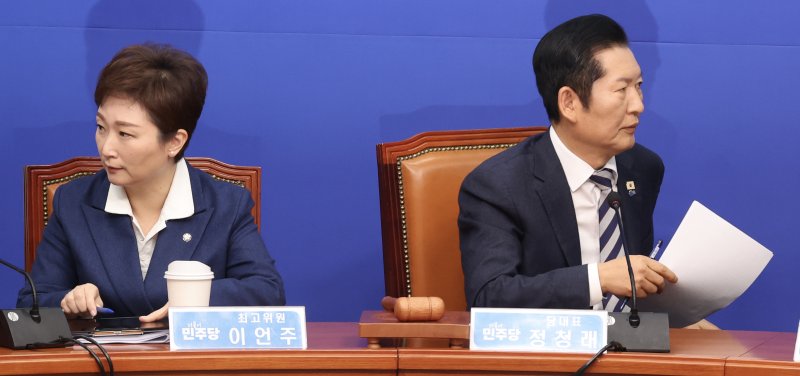
[The Financial News] As Jung Chung-rae, leader of the Democratic Party of Korea, refuses to back down from his push for a merger with the Rebuilding Korea Party, internal resistance is intensifying. The dispute has now erupted into a public war of words at an open Supreme Council meeting. When pro–Lee Jae-myung Supreme Council member Lee Un-ju and others criticized Jung’s merger drive as "the lust for power of the No. 2 and No. 3 figures," pro–Jung Chung-rae Supreme Council members hit back.
At the Supreme Council meeting held at the National Assembly of the Republic of Korea that day, Jung said, "If we unite, we win; if we split, we lose," stressing the need for a merger. He added, "In a razor-thin race decided by just 2 to 3 percentage points, it is basic election strategy that even the smallest contribution of strength matters."
Addressing the main source of backlash—the procedural problems surrounding his merger proposal—he argued, "All I did was propose a merger; I did not decide on a merger or declare one." He went on, "As party leader, I have opened the door to public debate, and now I ask our party members to decide the party’s fate."
Jung continued, "Integration means joining forces, while division means weakening our strength," dismissing internal criticism directed at him. "To say that unification is division is a contradiction," he said. He then added, "I hope we will unite and pool our strength to fight for victory in the local elections and for the success of the Lee Jae-myung administration."
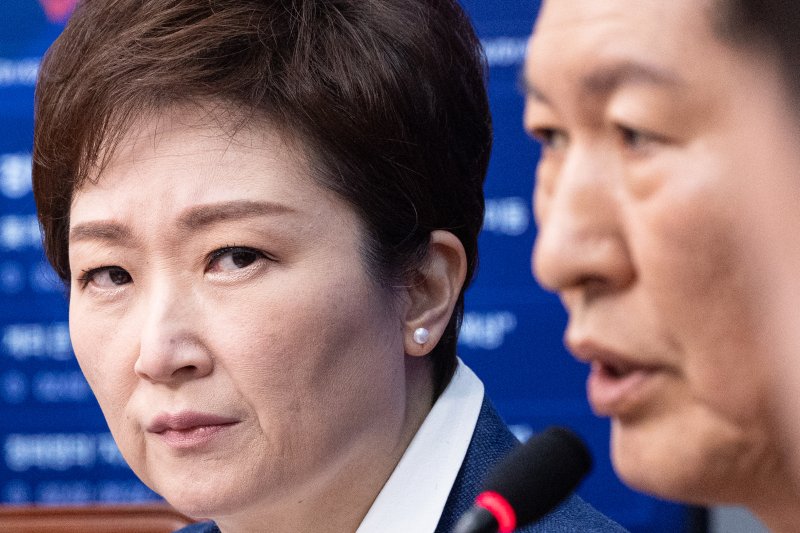
In response, Supreme Council member Lee, who has opposed the merger on grounds of procedural flaws and policy differences, again put forward a firm case against it. In particular, she has previously clashed with the Rebuilding Korea Party over its advocacy of a "public concept of land ownership."
Lee warned, "The public trusts and overwhelmingly supports the Lee Jae-myung administration’s centrist, pragmatic line. If the party keeps trying to pursue its own separate course and internal policy conflicts become severe, the party’s approval ratings will continue to decouple from the President of South Korea’s, and even public support for the President’s governance will inevitably be shaken."
She also directly targeted Jung and leader of the Rebuilding Korea Party, Cho Kuk. "At the start of a presidential term, when the President’s authority is at its strongest, we are seeing the No. 2 and No. 3 figures try to upend the board and change the frame," she said. "What we are witnessing is the expression of their desire for party leadership and the presidency, and their desire to become the party’s frontmen. An early merger is an attempt to replace the party’s mainstream, to turn Lee Jae-myung’s Democratic Party into Jung Chung-rae and Cho Kuk’s Democratic Party."
Supreme Council member Hwang Myung-seon, who opposes the merger alongside Lee, also joined in criticizing Jung.
Hwang said, "We must reflect on and examine the reality that the party has not fully supported the Lee Jae-myung administration’s governance," adding, "The merger is only fueling internal strife and creating unnecessary conflict with the Rebuilding Korea Party, which should be our ally."
He went on, "The President is relentlessly sending out policy messages focused on people’s livelihoods, such as on real estate and the sugar tax, and the Democratic Party must soberly ask itself what it is doing right now."
Supreme Council member Kang Deuk-gu made clear that the current merger push is Jung’s personal decision. "Under no circumstances should this begin as a backroom discussion or backroom deal by the party leader personally or by a small group," he said.
He added, "There is a fundamental premise that elections must always be fought by expanding support among centrist voters," and stressed, "We must look coolly at how the public and the political center will judge this."
In response, Supreme Council member Moon Jung-bok, from the pro–Jung Chung-rae camp, launched a counterattack.
Moon asked, "Is it really in line with the Democratic Party of Korea’s values to publicly dress down and criticize the party leader to his face in an open setting like this?" He continued, "At the very least, to take a proposal made by the leader of a major political party and respond with remarks bordering on insult in such a public forum is, in my view, not the proper attitude of a party member."
He then added, "Remember where all those people are now who hurled harsh words at President Lee Jae-myung to his face when he was party leader."
As opposition to the merger, previously voiced through press conferences, radio appearances and TV interviews, has now escalated into an open war of words during a Supreme Council meeting, the party’s internal strife is deepening. In particular, while merger opponents initially focused on procedural flaws in Jung’s proposal, they are now openly invoking his "lust for power," suggesting that attacks on Jung Chung-rae are likely to intensify going forward.
[email protected] Kim Hyeong-gu Reporter