Around 10 Trillion Won in Price-Fixing on Essential Goods: 52 Business Executives Indicted for Disrupting the Household Economy
- Input
- 2026-02-02 13:39:20
- Updated
- 2026-02-02 13:39:20
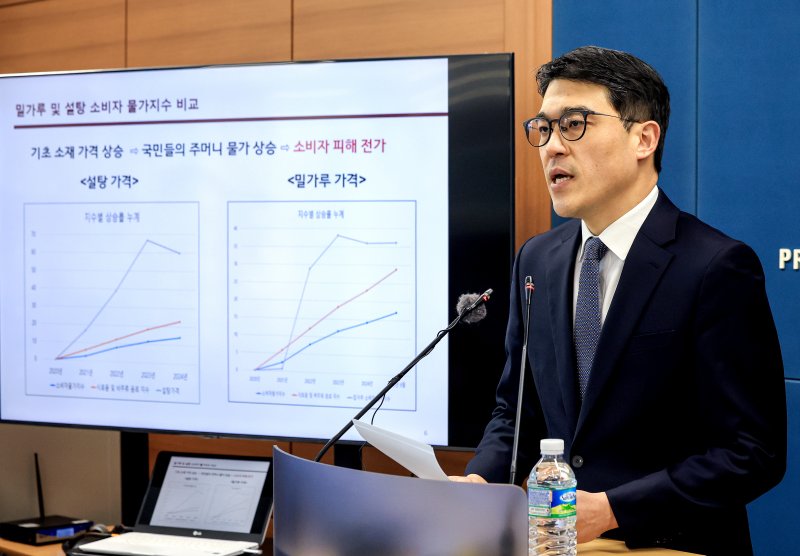
The Fair Trade Investigation Division of the Seoul Central District Prosecutors' Office, led by Na Hee-seok, announced at a press briefing room at the Seoul High Public Prosecutors' Office on the morning of the 2nd that it had investigated the 'flour price-fixing case,' the 'sugar price-fixing case,' and the 'Korea Electric Power Corporation bid-rigging case' over a five-month period from last September to this January. As a result, six people were indicted and detained, and 46 others were indicted without detention on charges of violating the Fair Trade Act.
According to prosecutors, in the flour price-fixing case, six flour milling companies — Daehan Flour Mills, SAJODONGAONE, Samyang Corporation, DAESUN Flour Mills, Samhwa Flour Mills, and Hantop — had 20 executive-level officials and managers indicted without detention on charges of violating the Fair Trade Act. In the sugar price-fixing case, two sugar producers, CJ CheilJedang and Samyang Corporation, had senior executives indicted and detained on Fair Trade Act charges, while nine other employees and two corporate entities were indicted without detention. In the Korea Electric Power Corporation (KEPCO) bid-rigging case, eight power equipment manufacturers — Hyosung Heavy Industries, HD Hyundai Electric, LS ELECTRIC, ILJIN Electric, Cheryong Electric, DONGNAM, Intek, and the Heavy Electrical Equipment Cooperative Association of Korea — had four employees indicted and detained, and seven employees along with eight corporate entities indicted without detention, all on charges of violating the Fair Trade Act.
The six flour milling companies, including Daehan Flour Mills, are accused of jointly and unfairly restricting competition with other businesses by agreeing on whether to change flour prices, the scale of any changes, and the timing of those changes from January 2020 through October last year. Prosecutors estimate the scale of this collusion at 5.9913 trillion won. They found that, as a result of these acts, flour prices in January 2023 were 42.4% higher than six months earlier, and during the collusion period prices generally rose by just over 20% over each six‐month span. The flour consumer price index rose 36.12%, exceeding the 17.06% increase in the overall consumer price index over the same period. Prosecutors added that they twice requested the Korea Fair Trade Commission (KFTC) to file criminal complaints against 15 individuals whose level of involvement was deemed particularly serious.
The two sugar producers, including CJ CheilJedang, are accused of creating an unfair competitive environment in concert with other businesses from February 2021 to April last year. When the price of raw sugar, the main input for sugar, went up, they actively reflected this in sugar price hikes, but when raw sugar prices fell, they only partially passed the decrease on to sugar prices. Using this method, when they raised sugar prices in October 2013, they increased them by up to 66.7% compared with the pre‐collusion level, but when lowering prices, they cut them by only 55.6% compared with before the collusion. Prosecutors estimate the scale of this collusion at 3.2715 trillion won.
Hyosung Group and others are accused of agreeing in advance on which company would win each contract and even sharing bid prices so that the designated company could win at a high price in 145 tenders for gas-insulated switchgear placed by KEPCO between March 2015 and September 2022. Prosecutors believe that in bids totaling 677.6 billion won, the companies obtained at least 160 billion won in unlawful gains.
Prosecutors stated that there is a need to strengthen criminal penalties for market-disrupting crimes committed through collusion. Na Hee-seok noted, "These companies have repeatedly engaged in similar offenses despite being caught multiple times by the KFTC in the past, because the sanctions imposed on the corporations have been relatively weak, limited to administrative surcharges or fines." He pointed out, "Administrative sanctions focused on surcharges target only the business entity, that is, the corporation, and not the actual perpetrators, so it is essential to toughen criminal penalties for the individuals who carried out the offenses."
In fact, in South Korea the statutory maximum penalty for market-disrupting crimes through collusion is relatively low: up to three years in prison or a fine of up to 200 million won. By contrast, in the United States of America (US), offenders can face up to 10 years in prison or a fine of up to 1 million dollars, equivalent to about 1.42 billion won. In the United Kingdom of Great Britain and Northern Ireland (UK), the penalty is up to five years in prison or an unlimited fine; in Canada, up to 14 years in prison or an unlimited fine; and in Australia, up to 10 years in prison and a fine of 660,000 Australian dollars, or about 660 million won. Neighboring Japan also imposes tougher sanctions than South Korea, with penalties of up to five years in prison or a fine of up to 50 million yen, roughly 500 million won.
Na Hee-seok stated, "To eradicate collusion crimes that disrupt the household economy, we will closely examine other essential goods directly tied to people's livelihoods, such as meat and alcoholic beverages, and respond firmly so that those who participate in collusion receive punishments commensurate with their actions." He added, "By responding strictly to offenses that harm people's livelihoods in accordance with the law and principles, we will take the lead in establishing a fair competitive order and protecting consumers."
[email protected] Kim Dong-gyu Reporter