Entry-Level Pay at South Korean Conglomerates Twice as High as in Taiwan; KEF Urges Caution on Extending Retirement Age to 65
- Input
- 2026-02-01 12:00:00
- Updated
- 2026-02-01 12:00:00
The Korea Enterprises Federation (KEF) released a report on the "International Comparison of Entry-Level Salaries for University Graduates in South Korea, Japan, and Taiwan" on the 1st, presenting these findings. The analysis drew on the latest comparable data available for 2024, including the Employment Type Survey by the Ministry of Employment and Labor (MOEL), the Basic Survey on Wage Structure by the Ministry of Health, Labour and Welfare of Japan, and starting salary statistics from the Ministry of Labor, Republic of China (Taiwan).
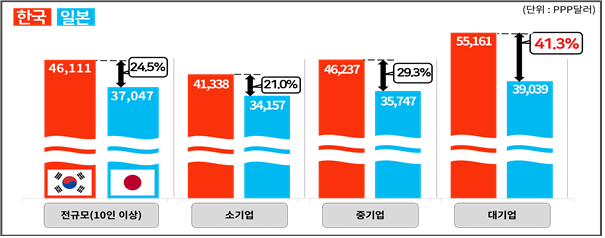
According to the Korea Employers Federation (KEF), when calculated using purchasing power parity (PPP) exchange rates that reflect price levels, the overall average entry-level salary for university graduates in South Korea was 46,111 dollars, 24.5% higher than Japan’s 37,047 dollars. The gap was even wider among large companies: South Korean firms with 500 or more employees paid 55,161 dollars, while Japanese firms with 1,000 or more employees paid 39,039 dollars, a difference of 41.3%.
By industry, South Korea’s entry-level salaries for university graduates exceeded Japan’s in 9 out of 10 sectors, excluding those where industrial classifications differed significantly or where statistical reliability was low. The gaps were particularly large in finance and insurance (144.7% of the Japanese level), professional, scientific and technical services (134.0%), and manufacturing (132.5%).
Income polarization also appeared more pronounced in South Korea. When setting the entry-level salary at small firms (10–99 employees) to 100, large firms in Japan (1,000 or more employees) recorded 114.3, whereas large firms in South Korea (500 or more employees) reached 133.4.
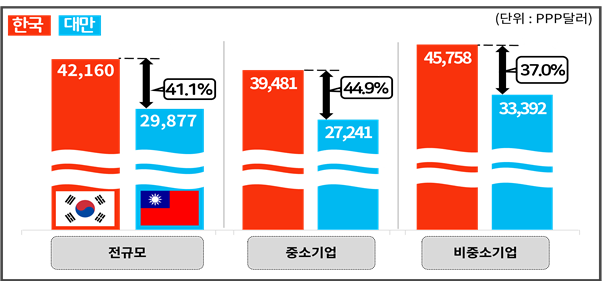
Compared with Taiwan, South Korea’s entry-level salaries for university graduates were higher across all company sizes. According to KEF, the average entry-level salary for university graduates in South Korea was 42,160 dollars, 41.1% higher than Taiwan’s 29,877 dollars.
By company size and based on PPP exchange rates, entry-level salaries at small and medium-sized enterprises in South Korea (5–99 employees) were 44.9% higher than in Taiwan (1–199 employees. Among larger firms, South Korea’s level was 37.0% higher than Taiwan’s. Using market exchange rates, the average entry-level salary for university graduates in South Korea was 24,295 dollars, nearly double Taiwan’s 12,706 dollars.
By industry, South Korea’s entry-level salaries for university graduates exceeded Taiwan’s in all 17 comparable sectors. The gaps were especially striking in construction (161.0% of the Taiwanese level), water supply, sewerage and waste management (157.3%), and professional, scientific and technical services (155.3%).
Looking at the gap by company size between South Korea and Taiwan, and setting each country’s entry-level salary at small and medium-sized enterprises to 100, non-SME firms in South Korea recorded 115.9, while non-SME firms in Taiwan came in at 122.6. This indicates that the wage gap between large and smaller firms is actually greater in Taiwan than in South Korea.
Ha Sang-woo, Head of Economic Research Division at KEF, stated, "We have confirmed that entry-level salaries for university graduates at South Korean conglomerates are significantly higher than in Japan and Taiwan." He pointed out, "In South Korea, high starting salaries are combined with a strongly seniority-based wage system, and unions consistently demand uniform and steep wage increases, which has entrenched a high-wage structure at large companies."
He went on to stress, "Under this kind of high-wage structure, extending the statutory retirement age to 65—which would mainly benefit workers at large companies—could weaken youth employment and deepen the dual structure of the labor market. Therefore, such a change should be considered cautiously, and only after creating the necessary conditions in the labor market, including the wider adoption of job- and performance-based wage systems."
[email protected] Reporter Kim Dong-chan Reporter