Foretold ‘chicken coop’? Yongsan’s 10,000 homes smaller than the minimum standard for two people
- Input
- 2026-02-08 12:50:58
- Updated
- 2026-02-08 12:50:58
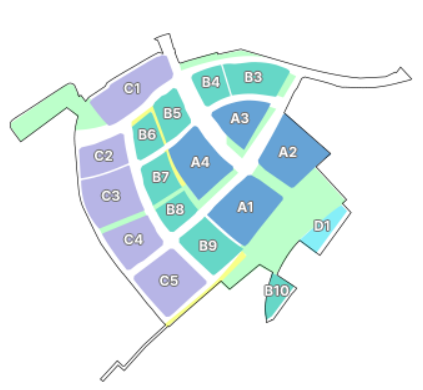
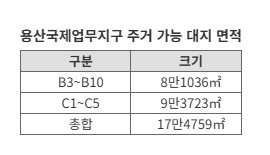
■Simple calculation puts usable area per household at 17.5m2According to Seoul and the redevelopment industry on the 8th, the plots within YIBD that can be used for residential purposes are eight mixed-use office buildings (B3–B10) and five office-support buildings (C1–C5).
The total area of the eight mixed-use office buildings is 81,036m2, and the five office-support buildings add 93,723m2, for a combined 174,759m2. This is about 38% of the total 456,099m2 site.
While factors such as unit layouts and floor area ratio need to be considered, a rough calculation that ignores these and assumes 10,000 units are built yields 17.4759m2 of land per household.
The problem is that this is smaller than the minimum residential standard for two people under the Housing Act. The Act sets the minimum at 14m2 for one person, 26m2 for two, 36m2 for three, and 43m2 for four. In Yongsan’s case, the figure is only about 3m2 larger than the one-person minimum.
If the initial proposal of 6,000 units by Seoul is applied, the usable land area per household would be about 29m2. That is only 3m2 above the two-person minimum standard, and still hardly spacious. This is why critics say it would be difficult not only for a family of four, but even for newlyweds to live there.
A real estate industry official remarked, "The space doesn’t even meet the Housing Act’s standard for two people, so how are newlyweds supposed to move in?" and predicted, "If it is built as planned, it will be even harder for three- or four-person households to live there."
■Compared with large complexes in Seoul... about half the sizeThe gap becomes clear when compared with large-scale complexes in Seoul. Olympic Park Foreon in Gangdong District, the largest single complex in the country, has a site area of 462,271m2 and 12,032 units. That works out to about 38.4m2 per household. Compared with the residential land in YIBD, its total site is about 2.6 times larger, and the per-household area is roughly 2.2 times greater.
Helio City in Songpa District, the second-largest complex, has a site area of 342,000m2 and 9,510 units, or 35m2 per household. That is roughly twice as large as the residential area planned in YIBD, yet Helio City still faced controversy at the time of sale for being "chicken-coop apartments." The criticism focused on the dense arrangement of buildings and disputes over sunlight and views.
Industry observers warn that if a high-density redevelopment is pushed in YIBD, a large number of small units for one- to two-person households—where demand is relatively weaker—will be supplied, ultimately harming the residential environment. They also note that reducing land for office and commercial facilities could undermine YIBD’s identity as an international business district and leave everyday social infrastructure (SOC) lacking. Eunhyeong Lee, a research fellow at the Korea Research Institute for Construction Policy (RICON), said, "The importance of housing is self-evident, and it must be viewed as part of the city’s overall functions," adding, "There needs to be ongoing discussion about how this area should be used."
The Seoul Metropolitan Government, the Yongsan-gu Office, and Yongsan residents have also mounted strong opposition. Seoul has repeatedly pointed out that "if the land-use plan is changed, construction will be delayed by more than two years." If Seoul’s view is correct, groundbreaking for the Yongsan international business project would be pushed back from 2028 to sometime after 2030. Local residents have been sending condolence wreaths to YIBD to signal their opposition to the central government’s plan, and the Yongsan-gu Office has been collecting residents’ opinions through its own survey since the 5th.
Some analysts warn that escalating conflict between the central government and local authorities could derail the Lee Jae-myung administration’s first housing supply package. This is because the authority to designate urban development zones within Seoul and approve development plans currently lies with Seoul. In other words, MOLIT cannot unilaterally push the project through.
[email protected] Choi Ah-young and Kwon Jun-ho Reporter