'Space' explored through Kim Swoo-geun’s Space Group Building... A place to feel culture, coffee and architecture [Coffee and Space: 'Kkik']
- Input
- 2026-02-07 10:00:00
- Updated
- 2026-02-07 10:00:00
In the Ottoman era, it was called the 'school of the wise.' In 17th-century Britain, people paid a penny to join heated debates at what were known as 'penny universities.' These are spaces where people gather around the premise of 'coffee'—what we now simply call a 'cafe.'In places where we sip coffee and inhabit space—where we 'kkik,' to drink and savor—we also fully indulge in stories.On a weekend, how about a cup of 'architecture' in such a space?
[Financial News] In 2013, more than 110 cultural and artistic figures, including film director Park Chan-wook, National Museum of Korea director Yoo Hong-jun, and samulnori master Kim Duk-soo, issued a public statement. Their purpose was clear: to save a single building. They declared that this building was "not real estate, but culture."The building that had become culture itself was the Space Group Building, often cited as one of Korea’s finest works of modern architecture.
A space everyone fought to protect
Kim Swoo-geun, a leading figure in modern Korean architecture, built the Space Group Building in 1971—a structure that would later be regarded as culture in itself. When the construction market slumped, Space Group of Korea went into court receivership, and the building was put up for auction.
Figures from the cultural and arts communities rallied to save the Space Group Building. The government also moved to designate it as a registered cultural heritage site. In the end, the building was sold to Arario, but Space Group attached a condition: the new owner must not damage the headquarters and must preserve 'Kim Swoo-geun’s studio.'
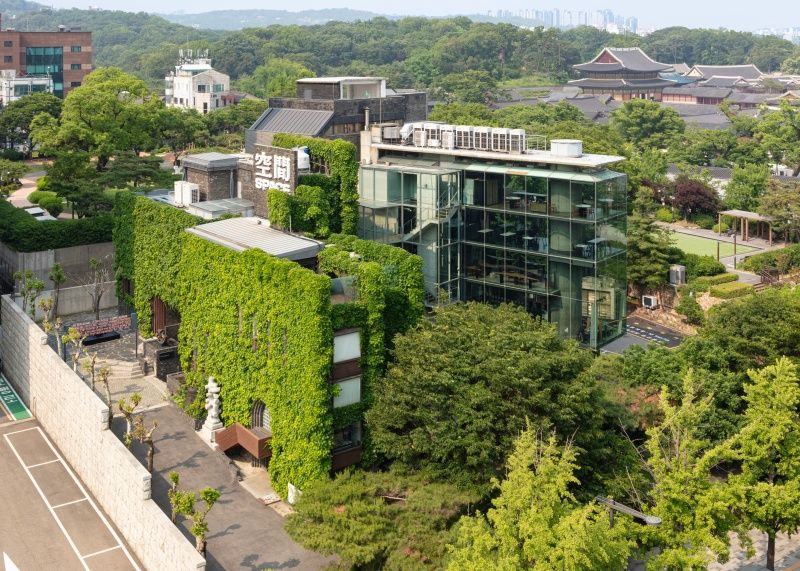
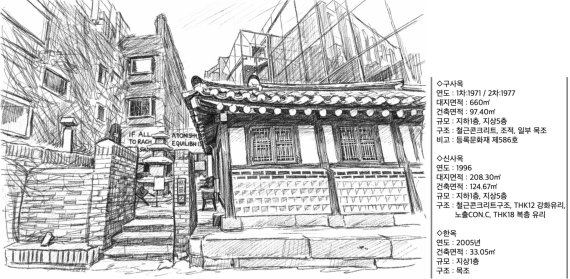
Thanks to that, several structures remain today: the ivy-covered old building designed by Kim Swoo-geun, the glass annex added by the late Jang Se-yang, Space Group’s second principal architect, and the C-shaped hanok extended and remodeled by current principal architect Lee Sang-lim. In February 2014, the old building was officially listed as Registered Cultural Heritage No. 586.
Now owned by Arario and operating as the Arario Museum, the Space Group Building is about to undergo renovation this month. Its full appearance will be hidden for at least six months, so we decided to visit in haste. Before going, we first listened to those who remember the place well.
Jung In-ha, a professor of architecture at Hanyang University (HYU) who studied architecture in France and later worked at Space Group, explained, "Because of the circumstances of his time, Kim Swoo-geun initially created architecture that catered to external expectations. Later, through collaborations with artists and humanities scholars such as the late Professor Lee O-young, he established his own architectural philosophy, and the Space Group Building is one of the most representative works of that period."
Lee Sang-lim, who witnessed the sale of the Space Group Building, shared a similar view.
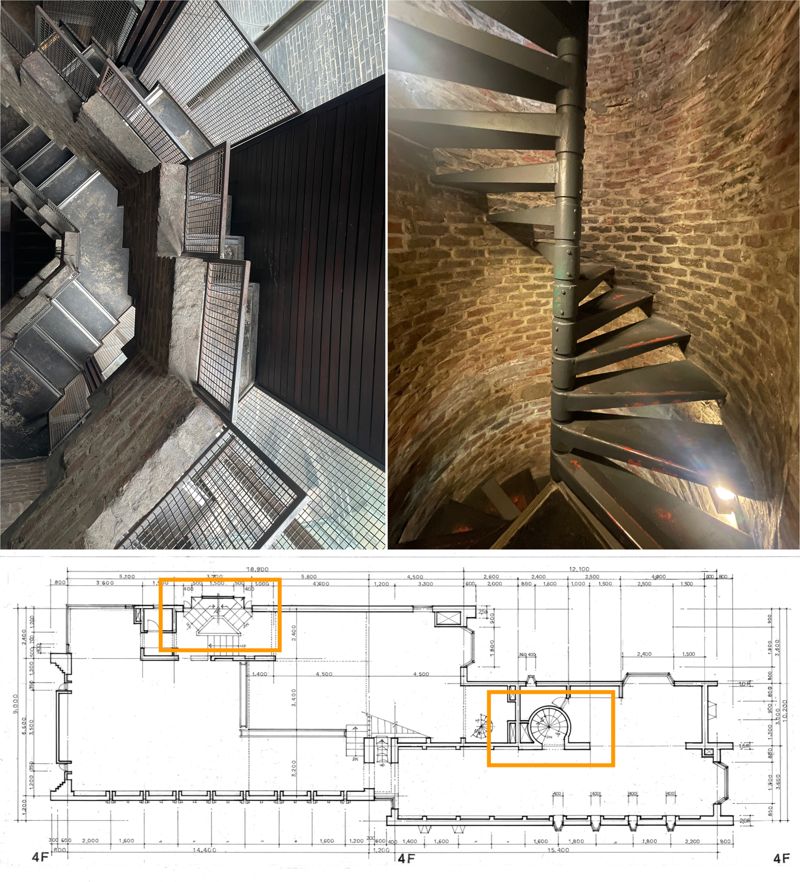
Both men also pointed out what visitors should pay attention to in the old building: the differences between the original main wing and the later annex, and the stairs and passages that link one space to another. They also urged visitors to experience the design principle of 'Human Scale,' in which dimensions are based on the human body.
Professor Jung recalled, "A wide range of functions was packed into a relatively small building. Corridors and staircases were used to separate and reconnect those functions," adding, "That’s why, during the year I worked there, I never had a moment to feel bored."
Lee Beom-jae, an emeritus professor at Dankook University, kindly agreed to act as our guide to the Space Group Building. From 1969 to 1982, he studied under Kim Swoo-geun and served as head of design and head of research at Space Group. Later, while teaching students, he designed more than 200 projects, including theaters and museums.
Looking into 'space'
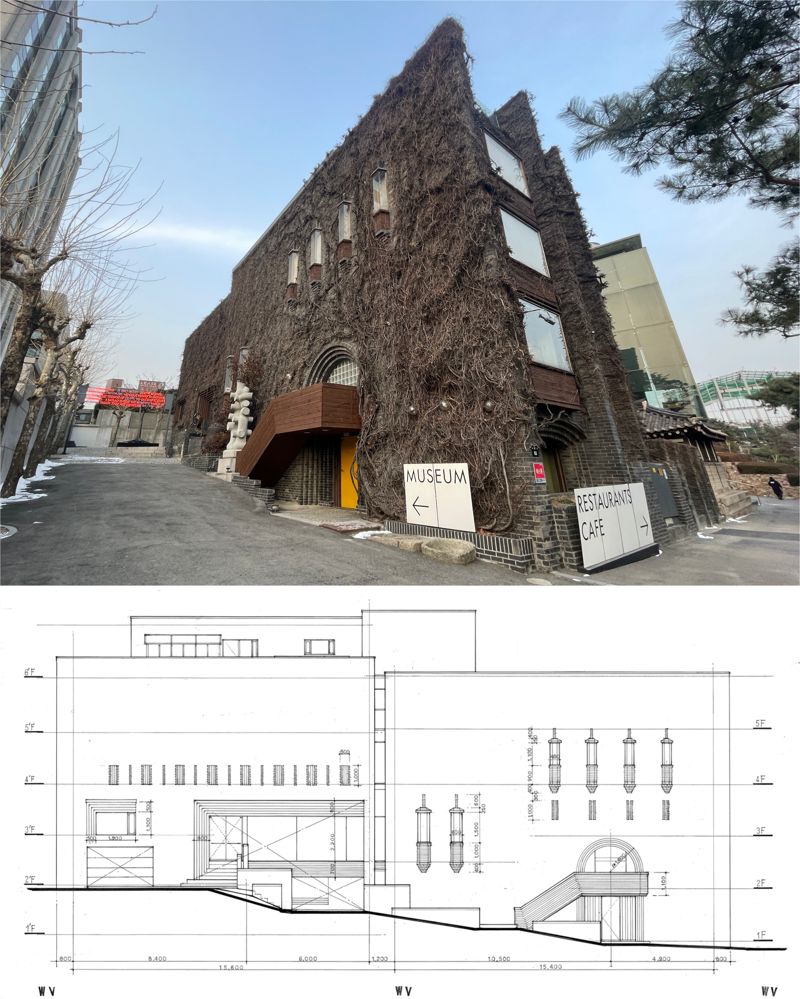
As we walked up the sloping path along the left side of the old building, Professor Lee began his story. Pointing to the wooden stairs on the side of the main wing, he asked, "Do you know where the main entrance is?" It was a question clearly designed to elicit the obvious answer—"the facade facing the street." He then revealed, "The spot above those stairs, now sealed with glass blocks, used to be the main entrance."
A little farther up, we reached the boundary between the old and new wings that Professor Jung and Lee had mentioned.
Professor Lee noted, "The side wall of the annex is set slightly back from the old wing, so there’s a visible offset. There’s something else you should notice here as well."
He was referring to one of the building’s defining features: its brickwork.
He explained, "We thought hard about how to harmonize with hanok, so we made the bricks the way roof tiles are made from tile clay. Because they’re vulnerable to water, red bricks were used indoors," adding, "The annex and the old wing use the same bricks, but there is a difference: the bricks in the annex are lower in height, so the pattern looks denser."
Once he said that, what had seemed like a single building suddenly separated in our minds into two: the original wing built in 1971 and the annex completed in 1977.
Stepping into the old building beneath the vines, we encountered a very different scene. The interior uses a skip-floor system that rises in half-levels along the slope, with large and small rooms in the old and new wings intricately connected. Because the same spot looks different depending on where you stand, it felt as though you could easily lose your sense of direction if you let your guard down.
Arario Museum curator Jang Yeon-woo said, "Because the concepts of floors and spaces aren’t clearly defined here, we tell new staff to walk through the building two or three times a day. Even for staff meetings, we say, ‘Let’s meet in front of such-and-such artwork,’ rather than on a specific floor." Professor Lee chimed in, "We did the same. We chose meeting spots by space names—like the administration office or the studio."
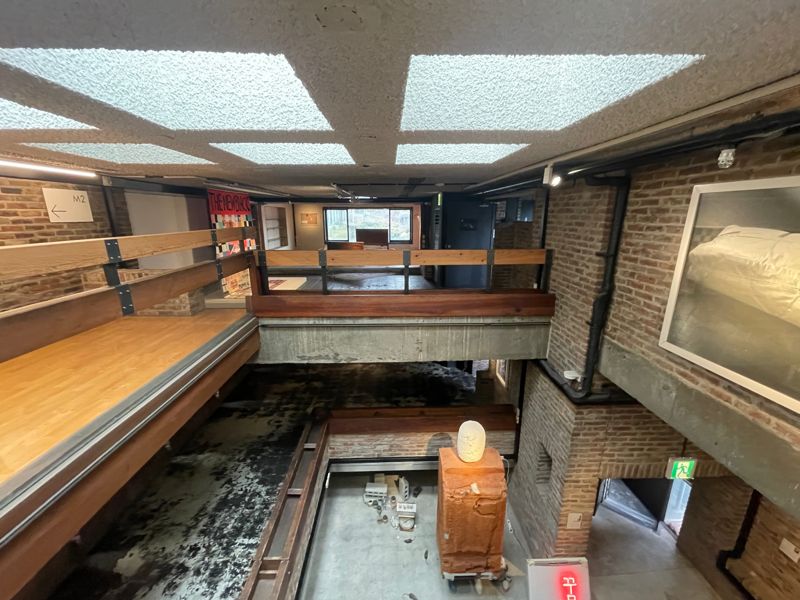
The corridors and stairways are as narrow as alleyways, and the ceiling heights are low, yet they never feel oppressive. This is Kim Swoo-geun’s Human Scale at work.
Hanok elements appear throughout the building. In the former reception room of the annex, one of video artist Nam June Paik’s works, 'Nomad' (1994), which combines a small truck and television sets, is installed below a recessed floor. Professor Lee described the depth of that recess as "the height at which a nobleman would open a door and rest his arms on the threshold."
Climbing the stairs, we emerged into the wide-open space that Professor Lee, Professor Jung and Lee all call the 'courtyard.' The second-floor courtyard of the annex is encircled by the third and fourth floors, which look down into it. A skylight that runs all the way up to the roof lets natural light pour in.
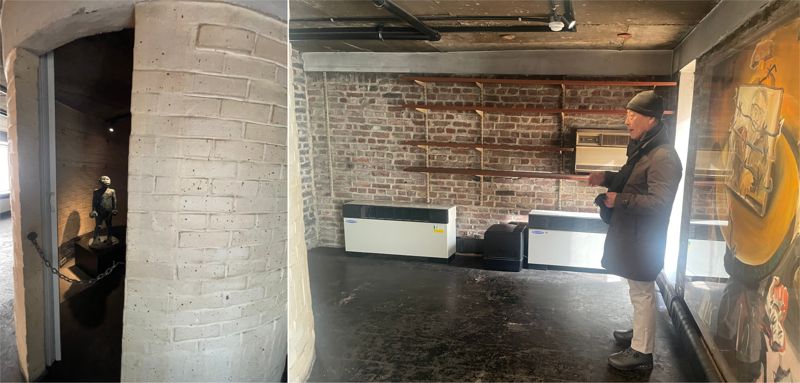
In Kim Swoo-geun’s studio in the original wing, we encountered a particularly meaningful space: a small, white, cylindrical room. Professor Lee emphasized, "It’s like a symbol of the Space Group Building, a place that evokes a mother’s womb," and added, "At a time when he was searching for the essence of architecture—saying that architecture is not something you see but something you feel—this was Kim’s place of rest."
There are hidden, playful corners as well. The bay windows that Kim introduced for the first time project outward like a small bay, with the two side panes angled at 60 degrees. At the top of a narrow, steep circular staircase is Kim’s private sitting room, where a broad wooden floor has been laid beneath an exposed rafter ceiling. The triangular staircase is another feature you should not miss.
Space, filled with diversity
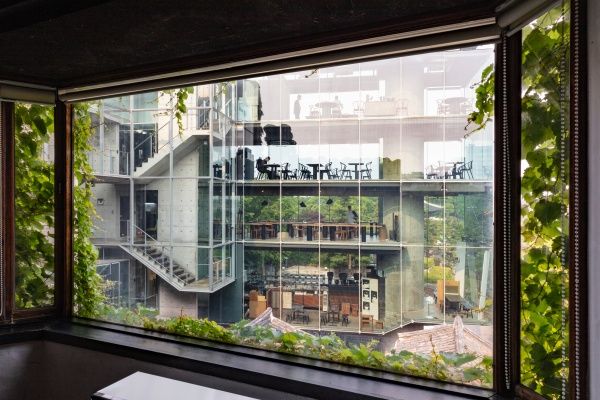
Alongside the old building, there is another structure at Arario Museum that deserves attention. In 1996, as the original building became overcrowded, architect Jang Se-yang designed a new headquarters with a fully glazed facade. Glass was used, he said, to emphasize openness between Changdeokgung Palace and Kim Swoo-geun’s monumental work, the old Space Group Building.
Lee later built a hanok structure between the old and new buildings. Today, the brick building serves as a museum, the glass building as a restaurant, and the hanok as a cafe.
Beyond its architectural significance, the old building carries another layer of meaning.
Professor Lee said, "It became a place where artists—literally ‘paupers’ with no money—could show their work."
In the underground gallery of the original wing, artists such as 'water-drop painter' Kim Tschang-yeul and Korean abstract art pioneer Kim Whanki exhibited their works. In 'Sarang Space,' the underground performance hall of the annex, Nam June Paik, gayageum innovator Hwang Byung-ki, one-woman dance-drama pioneer Gong Ok-jin, and Kim Duk-soo’s samulnori troupe—praised as producing 'a sound that calls the gods'—all performed. In this way, the building became a focal point of contemporary Korean art in the 1970s and 1980s.
Even the space where Arario Museum now sells goods was special to artists back then. "It used to be a cafe," Professor Lee explained. "Artists drank coffee there, talked, and held bazaars in front of the cafe to raise money."
That cafe, now housed in a hanok
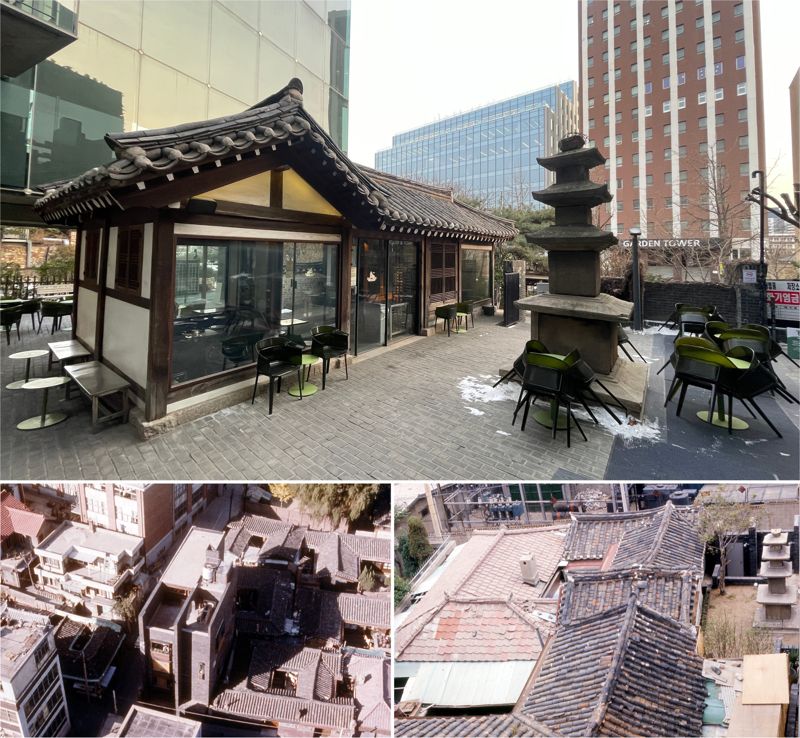
Today, the place where people drink coffee has been relocated to an 18-pyeong hanok in front of the old building.
Lee explained, "If you look at old photos of the Space Group Building, you can see that it was surrounded by hanok. This small two-room hanok was also a place where Space Group staff drank tea and rested," adding, "One of the strengths of hanok is that you can reuse the materials after dismantling them. For this building, we reused about 70 percent of the materials from the old hanok, raised the ceiling height, and pieced together the broken roof tiles."
He also used the hanok as a way to invite people to understand architecture and space.
Lee stressed, "In a hanok, spaces such as the men’s quarters, women’s quarters, courtyard and wooden floor are all distinct yet harmoniously arranged. Koreans used to respect that kind of spatial composition," and continued, "Now we live in apartment units that all look alike, and that sensibility has faded. I hope people can regain a sense of respect for space."
Cafe Fritz, housed in the hanok, serves coffee with a clear respect for 'that space.' It also brings plenty of know-how to the table.
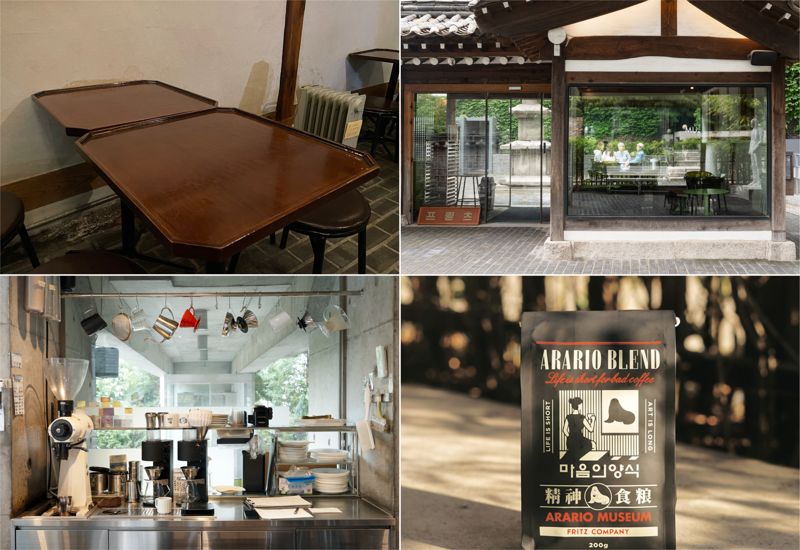
Launched in 2014 in an alley behind the Mapo Garden Hotel by a team of specialists including roasters, bakers and designers, the Fritz brand has won strong support from people in their 20s and 30s with its 'retro' concept and its reinterpretation of the old.
Seo Sol, brand manager at Fritz, said, "It was an honor when Arario invited us to open here. The place itself is meaningful, so we wanted to curate it well," adding, "Above all, the site fit our brand, which pursues 'Korean-ness' with the motto of being 'comfortable' and 'enjoyable.'"
The table tops that recall traditional soban and the 'Arario Blend' beans both convey a respect for the space. As a result, the cafe is filled with a remarkably diverse crowd in terms of age, gender and nationality.
As Professor Lee put it, "Kim Swoo-geun was the one who realized that the essence of architecture lies in space." True to that insight, Arario Museum and Cafe Fritz seem to speak of the essence of architecture, holding culture within and carrying the aroma of coffee.
That is why the next cafe we will visit is also a space where culture and coffee meet: Cafe Museum in Vienna, Austria.
[email protected] Seo Yoon-kyung Reporter