"Please Don’t Buy a Home Now"—Just Wait 10 Years... Another Long Wait [Real Estate Walk]
- Input
- 2026-01-31 09:00:00
- Updated
- 2026-01-31 09:00:00
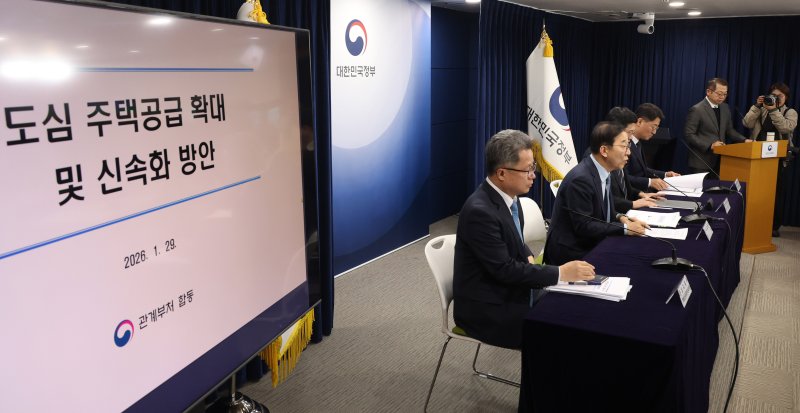
The government has unveiled its “1.29 Housing Supply” plan. The core of the plan is to quickly supply about 60,000 housing units in prime locations across the Seoul metropolitan area. This is twice the size of Pangyo New Town and about 1.7 times the size of Yeouido. In particular, 13,501 units are planned in and around Yongsan District, one of the most sought-after areas in Seoul. The government also says it will supply 9,800 units in and around Gwacheon City.
When will people actually move in... and how high will presale prices go?
In terms of location alone, these are golden sites. The problem is that construction on most of them will not even be able to start until around 2030. Local government cooperation is also essential, so it is unclear how much real impact this will have on housing supply.
Right now, home prices in the Gangnam 3 Districts (Gangnam-gu, Seocho-gu, and Songpa-gu) and the Han River Belt are soaring. Aside from a few areas like Yongsan, it is questionable how much demand there will be for the remaining sites. On top of that, people will have to wait more than 10 years to move in, so what will presale prices look like by then? As these areas have already been designated as land transaction permit zones, the supply of jeonse units in Seoul has dried up, and there are hardly any monthly rentals either, sending both jeonse and monthly rents sharply higher.
In short, what is most urgently needed now is a housing supply policy that can be addressed in a much shorter time frame. As online commerce grows, vacancy rates in retail properties are rising again. Unlike prime or Grade A offices, Grade B and C office buildings are also struggling. The rise of artificial intelligence is fueling a boom in smart offices. In this environment, old office buildings and small “mini-buildings” have become even less attractive.
On top of that, knowledge industry centers are facing severe oversupply, leaving a huge volume of vacant space. If we make good use of these empty properties, we could ease the jeonse and monthly rental shortage in a relatively short period of time.
Short-term measures are missing... Vacant commercial space should be converted to housing
Regulations have already been eased so that lifestyle accommodation facilities can be more easily converted into residential officetels. Yet many downtown retail spaces, offices, and knowledge industry centers remain empty. We need to open the door for these vacant properties to be converted into shared housing or shared lodging, among other uses.
If you go to SoHo in Manhattan, you will find so-called studio units—essentially one-room spaces. A key feature is that they can be used flexibly as housing, offices, or retail, depending on need.
Likewise, we should completely lift use restrictions on currently vacant properties so they can be easily converted into the functions we lack most—residential and lodging.
If existing retail spaces, offices, and knowledge industry centers are remodeled into shared housing, a massive volume of jeonse and rental units could come onto the market. We also lack enough low-cost accommodation to handle the recent surge in foreign tourists. If existing buildings could be easily converted into hostels and other shared lodging facilities, we could rapidly add a huge amount of accommodation capacity.
There are many other possible short-term housing supply measures. Yet the government keeps rolling out supply plans whose move-in dates are more than 10 years away. We first need policies that identify ways to supply housing in the short term by converting existing spaces into uses that fit the times./Choi Won-cheol, head of the Yonsei Advanced Program in Future Real Estate Development at Yonsei UniversityThis article reflects the author’s personal views and may differ from the editorial stance of this newspaper.
[email protected] Lee Jong-bae Reporter