[Editorial] Semiconductor Special Act Finally Passes After Many Twists and Turns; No More Obstructionism Like This
- Input
- 2026-01-29 18:11:06
- Updated
- 2026-01-29 18:11:06
It is fortunate, albeit late, that the Semiconductor Special Act has finally been passed after so many twists and turns. However, the ruling and opposition parties cannot avoid criticism for wasting so much time because they failed to reach an agreement on the bill’s contents in a timely manner. During this delay, competing countries swiftly enacted corporate support laws and policies and moved ahead of us. Politicians must fully recognize their responsibility for the fact that South Korea’s semiconductor industry is being chased by China and failing to narrow the gap with Taiwan.
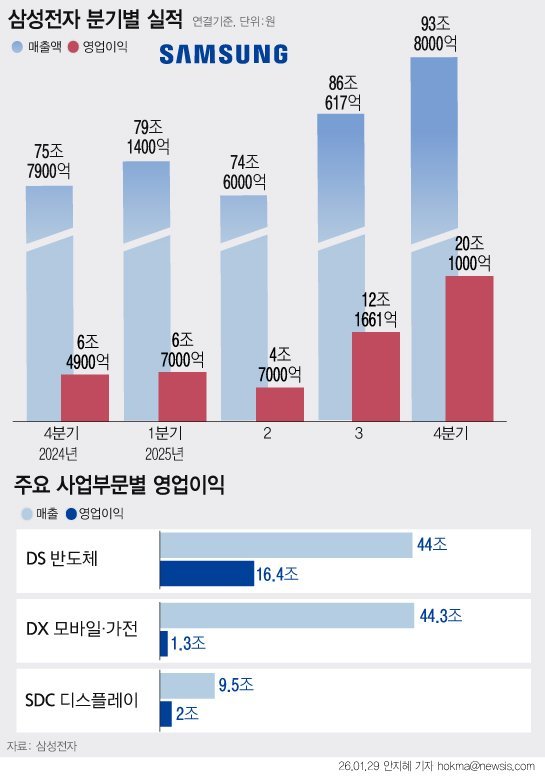
Despite political obstructionism and difficult external conditions, our semiconductor companies have miraculously posted record-breaking results. Following SK hynix, Samsung Electronics also announced that it had achieved all-time high sales on the same day. It is hardly an exaggeration to say that the Government of South Korea contributed almost nothing to this outcome. These achievements stem from companies themselves looking ahead and devoting their efforts to technological innovation.
The main sticking point that delayed the bill’s passage was the issue of flexible working hours. The proposal was to allow flexible working hours for R&D personnel, yet politicians dragged their feet, trading blows with each other regardless of what workers or companies actually wanted. Competing countries such as Taiwan have already implemented such systems, but we alone continue to resist. The idea is simply to allow those researchers who wish to do so to work at night as well, so that the lights in the labs never go out and research can continue around the clock. Is that really something to oppose so fiercely?
Even in Taiwan, where political confrontation between the ruling party and the opposition party is as intense as in South Korea, bills that support businesses are handled swiftly on a bipartisan basis. The progressive ruling party there takes an even more proactive stance than the opposition, leaving the conservative opposition party with no reason to object. In Taiwan, both the government and the public recognize and value the importance of corporate activity. Taiwan’s rapid economic growth in recent years, culminating in its per capita Gross Domestic Product (GDP) surpassing that of South Korea last year, is the result of corporate innovation combined with a government determined to support those companies by any means necessary.
When we compare our own situation—where, to use a colloquial expression, the authorities seem almost desperate to make life difficult for businesses—with Taiwan’s, the contrast is stark. The Government of South Korea talks about deregulation but only pays lip service, while actual implementation proceeds at a snail’s pace. Business leaders face excessive pressure from the government and the political establishment over issues such as corporate governance reform and industrial accident prevention. On top of that, they must also contend with militant unions, making management challenges one mountain after another. With the Yellow Envelope Law set to take effect in March, companies are already deeply anxious about what may unfold.
It is remarkable that companies are delivering such notable results despite all these adverse domestic and external conditions. Without firms like SK hynix, Samsung Electronics, and Hyundai Motor Company, which firmly uphold their status as leading global corporations, the South Korean economy would be on the brink of collapse. One only has to look at the recent trajectory of Germany’s economy. Germany’s decline has been driven by its nuclear phase-out policy and the slump in its automotive industry.
The kind of situation we saw with the Semiconductor Special Act must never be repeated. Politicians need to understand that industries and companies hold the key to the rise or fall of the national economy. The state must take the lead in revitalizing industry by pulling out the nails of excessive regulation and must constantly identify and resolve the management difficulties faced by businesses. Lawmakers should clearly recognize that if they wield the sword of political power in the wrong way, they can endanger the very fate of the country.