Fewer Young People and Housing Shortage Drive Domestic Migration to 51-Year Low
- Input
- 2026-01-29 12:00:00
- Updated
- 2026-01-29 12:00:00
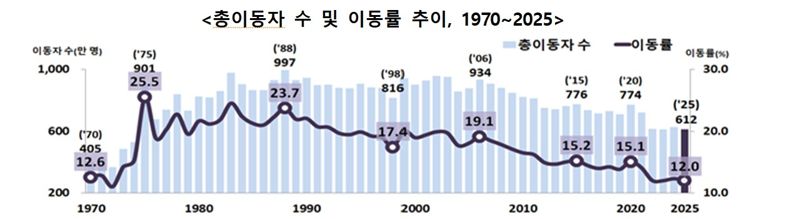
According to The Financial News, the number of people moving across eup, myeon, and dong administrative boundaries in South Korea last year fell to its lowest level in 51 years, since 1974. The decline is mainly due to population aging, which has reduced the number of young people who tend to move more frequently. In addition, fewer completed homes and a drop in the number of apartments scheduled for occupancy left people with less reason to relocate.
According to the Ministry of Data and Statistics (KOSTAT)'s "2025 Internal Migration Statistics" released on the 29th, the number of movers last year was 6.118 million, down 2.6%, or 166,000 people, from a year earlier. The Internal Migration Statistics are compiled based on move-in reports that residents submit under the Resident Registration Act when they change their address across eup, myeon, and dong boundaries. The main reasons for moving were housing (33.7%), family (25.9%), and job (21.4%).
The number of movers is now at its lowest level since 1974, when it stood at 5.3 million. Over the long term, demographic changes driven by low birth rates and population aging have reduced the number of movers. The population of young adults in their 20s, who have high mobility, is shrinking, while the number of older adults, who tend to move less, is increasing. In the short term, limited housing supply has also played a role. In fact, the number of movers citing housing as their reason for moving fell the most year-on-year, by 105,000 people.
Yu Su-deok, Head of the Population Projection Team at KOSTAT, said, "In the past, with less developed transportation and communication, it was more common for entire households to move together as a family unit, but recently the share of single-person moves has increased." Yu added, "In the short term, last year's trend is linked to changes in housing market indicators. From December 2024 to November last year, housing transaction volumes increased, but the number of completed homes and the volume of apartments scheduled for occupancy declined compared with the same period a year earlier."
By region, the highest in-migration rates were recorded in Daejeon Metropolitan City (14.5%), Sejong Special Self-Governing City (13.9%), and Seoul Special Metropolitan City (13.5%). Out-migration rates were also highest in Daejeon Metropolitan City (14.3%), Sejong Special Self-Governing City (13.9%), and Seoul Special Metropolitan City (13.8%). Regions with net in-migration, where arrivals exceeded departures, included Gyeonggi Province (33,000 people), Incheon Metropolitan City (32,000), and North Chungcheong Province (Chungbuk) (11,000), for a total of six provinces and cities. In contrast, 11 regions experienced net out-migration, including Seoul Special Metropolitan City (-26,800 people), Gwangju Metropolitan City (-14,000), and Busan Metropolitan City (-12,000). Compared with a year earlier, net outflows increased in places such as Gwangju Metropolitan City and North Gyeongsang Province, while they decreased in Seoul Special Metropolitan City and Jeonbuk State.
Seoul Special Metropolitan City, in particular, has seen continuous net out-migration since 1990. Last year, the net outflow reached 26,800 people. There was significant net in-migration for job-related reasons (45,900 people) and education (34,500), but this was more than offset by net out-migration due to housing (-49,400), family (-48,400), and natural environment (-8,300). Of those leaving Seoul Special Metropolitan City, 59.5% moved to Gyeonggi Province. Conversely, 53.8% of those moving into Seoul Special Metropolitan City came from Gyeonggi Province. The data suggest that high housing prices in Seoul Special Metropolitan City are driving many residents to relocate to Gyeonggi Province.
[email protected] Choi Yong-jun Reporter