"Sugar like tobacco"...Lee's remark reignites sugar tax debate
- Input
- 2026-01-28 16:14:37
- Updated
- 2026-01-28 16:14:37
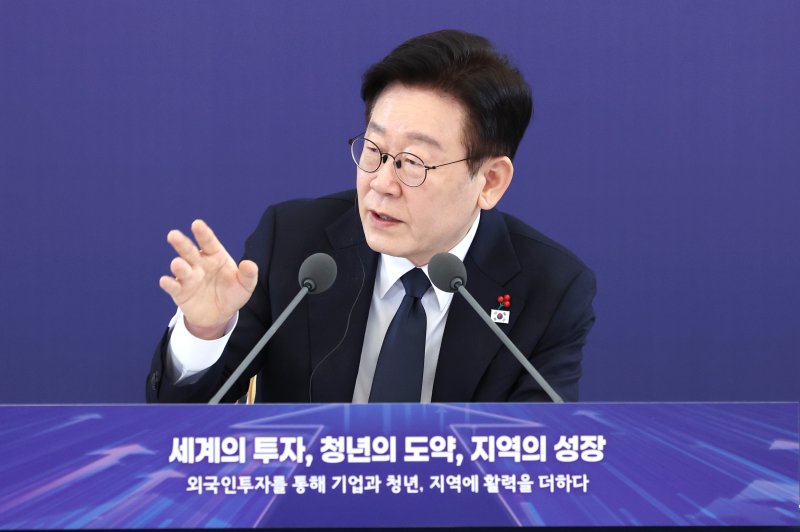
According to The Financial News, President Lee Jae-myung said on the 28th, "Let us curb sugar use by imposing a sugar surcharge, just like tobacco," thereby opening a discussion on introducing a so-called "sugar tax." The idea is to impose a quasi-tax surcharge to reduce sugar intake and use the proceeds to strengthen regional and public healthcare and to support the finances of the national health insurance system. However, as issues such as the scope of application to beverages and snacks, the regulation of "zero-calorie" drinks, and the possibility of the surcharge being passed on to consumers overlap, the debate is expected to escalate into a "second tobacco tax controversy."
President Lee wrote on X (formerly Twitter), "Like tobacco, we can curb sugar use through a sugar surcharge and reinvest the proceeds to strengthen regional and public healthcare... What do you think?" He shared a news article presenting opinion poll results in favor of introducing a sugar tax.
According to the article President Lee shared, a survey of 1,030 people conducted by the Seoul National University Center for Health Culture from the 12th to the 19th found that 80.1% of respondents supported introducing a "sugar tax that imposes a surcharge on companies that excessively use added sugars." As for taxable items, carbonated drinks (75.1%) and snacks, bread, and rice cakes (72.5%) were most commonly cited.
In addition, 94.4% agreed with introducing warning labels, similar to those on cigarette packs, to alert consumers to the risks of sugar consumption. The article also introduced overseas cases in the United Kingdom (2018) and France, and noted that a sugar tax could be used both to bolster health insurance finances and to curb medical costs by preventing chronic diseases.
The World Health Organization (WHO) recommended the introduction of sugar taxes in 2016, and they are now reportedly in place in more than 120 countries, including the United Kingdom and France. In many of these countries, sugar consumption has declined after adoption. In the United Kingdom, for example, a sugar tax on soft drinks with high sugar content was introduced in 2018, and the sugar content of taxed beverages has since fallen by about 47%. France also imposes a tax proportional to the sugar content of beverages and uses the revenue as a source of social security funding.
In South Korea, Kang Byung-won of the Democratic Party of Korea (DPK) introduced an amendment to the National Health Promotion Act in 2021 that would have imposed a surcharge on sweetened beverages ranging from at least 1,000 won to as much as 28,000 won per 100 liters, depending on their sugar content. The bill, however, was scrapped when the legislative term expired. In the current term as well, Jung Tae-ho, a DPK lawmaker who serves as the ruling party secretary on the Strategy and Finance Committee, held a "sugar overuse tax" policy forum in October last year.
The ruling party now appears poised to restart institutional discussions in response to President Lee's intervention. On the 12th of next month, Jung Tae-ho will host a "National Assembly forum on introducing a surcharge for excessive sugar use" at the small auditorium of the National Assembly Library of the Republic of Korea to discuss introduction plans. Lawmakers are considering possible legislative routes, including amending the National Health Promotion Act or enacting a separate special law.
A key issue in designing the policy is likely to be how far to follow the precedent of the existing "tobacco surcharge." Under the current National Health Promotion Act, a National Health Promotion Charge of 841 won is imposed per 20 cigarettes on conventional tobacco products, and 525 won per milliliter on e-cigarettes that use nicotine liquid. The funds are used for smoking-cessation programs, health education, and related research. This is why sugar is increasingly being compared to a "second tobacco."
If a sugar tax is introduced, disputes are also expected over its scope. There will likely be sharp disagreements over whether to limit the surcharge to beverages or extend it to other processed foods such as snacks and bread, and how to regulate "zero-calorie" drinks that use artificial sweeteners. Concerns are also being raised that the surcharge could be passed on to consumers in the form of higher prices, adding upward pressure on inflation.
[email protected] Seong Seok-woo Reporter