[Exclusive] 568 Police Officers Suspended from Duty for Misconduct over 5 Years...337 Cases Involved Drunk Driving, the Most Common Offense
- Input
- 2026-01-29 15:27:12
- Updated
- 2026-01-29 15:27:12
Financial News reported that cases of police officers being suspended from duty for misconduct such as drunk driving, sex crimes, and bribery continue to occur every year, fueling calls to overhaul management across the police organization. Critics argue that the response must go beyond post-incident disciplinary action for individual wrongdoing and instead strengthen preventive systems in personnel management, training, and internal inspections.
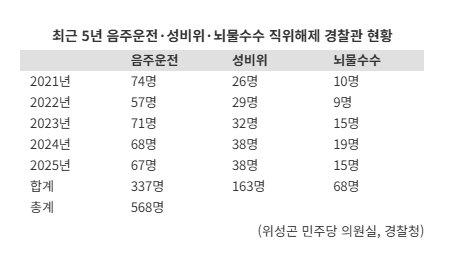
According to data that Financial News obtained on the 29th from the Korean National Police Agency (KNPA) via the office of Wi Seong-gon, a member of the National Assembly Security and Public Administration Committee from the Democratic Party of Korea, a total of 568 police officers have been suspended from duty over the past five years for drunk driving, sex crimes, or bribery. On a simple average, about 114 officers per year were suspended due to misconduct. Drunk driving accounted for roughly 60% of all cases, making it by far the most common reason for suspension.
The number of officers suspended for drunk driving was 74 in 2021, 57 in 2022, 71 in 2023, 68 in 2024, and 67 in 2025. Although the figures fluctuated slightly from year to year, several dozen officers were suspended annually. Over the five-year period, the total reached 337, exceeding the combined number of officers suspended for sex crimes and bribery, which stood at 231.
During the same period, 163 officers were suspended from duty for sexual misconduct. In particular, both 2024 and 2025 recorded 38 such cases, the highest annual figures in the five-year span. A total of 68 officers were suspended for bribery, with 2024 seeing the most cases at 19.
Cases of suspension related to drunk driving, sexual misconduct, and bribery were found not only in Seoul and the greater metropolitan area, but also at police agencies across the country, including Busan, Daegu, Gangwon Province, North Chungcheong Province (Chungbuk), South Chungcheong Province, North Jeolla Province (Jeonbuk), South Jeolla Province, North Gyeongsang Province, South Gyeongsang Province, and Jeju Special Self-Governing Province.
Even within just the past year, there have been a series of cases in which incumbent police officers were suspended for drunk driving or sexual misconduct. Earlier this month, an officer from the traffic division of Gwangju Police Station in Gyeonggi Province, who routinely carried out drunk and drug driving crackdowns, was suspended after causing a traffic accident while driving on a highway under the influence. In November last year, an officer in Seoul, known as the real-life model for actor Ma Dong-seok’s character in the film series "The Roundup," was suspended following a drunk driving accident. In July last year, an officer from a precinct under Incheon Nonhyeon Police Station was suspended and later arrested and referred to prosecutors on charges of statutory rape of a minor.
Suspension from duty is a measure that immediately removes an officer from their post when it is deemed inappropriate for them to continue performing official duties as a police officer, even before any criminal punishment or disciplinary decision is finalized. Given that some officers’ misconduct keeps recurring, observers argue that the issue should not be treated as confined to specific regions or departments, but as a problem requiring a review of the overall management system. They stress that the more authority an organization has over investigations and enforcement, the less room there should be for lax internal controls.
Lee Ung-Hyeok, a professor in the Department of Police Science at Konkuk University, said, "As the police stand at the very front of the criminal justice system, this trend can undermine the legitimacy of law enforcement and erode public trust in the government." He added, "Preventive inspections that check for early warning signs, along with an internal culture of control and whistleblowing that can expose and correct abnormal behavior within the organization, must function together."
Yeom Gun-woong, a professor in the Department of Police and Fire Administration at Yuwon University, also noted, "Although the police do have a code of ethics, in some respects it remains at a merely declarative level." He continued, "There is a need to strengthen training so that officers can develop clear values regarding ethics and misconduct, and we should re-examine whether the current level of disciplinary action for serious misconduct is truly sufficient."
[email protected] Kim Ye-ji Reporter