Government to release 270,000 tons of farm products to curb prices, farmers express discontent [Lunar New Year Cost-of-Living Measures]
- Input
- 2026-01-28 08:30:00
- Updated
- 2026-01-28 08:30:00
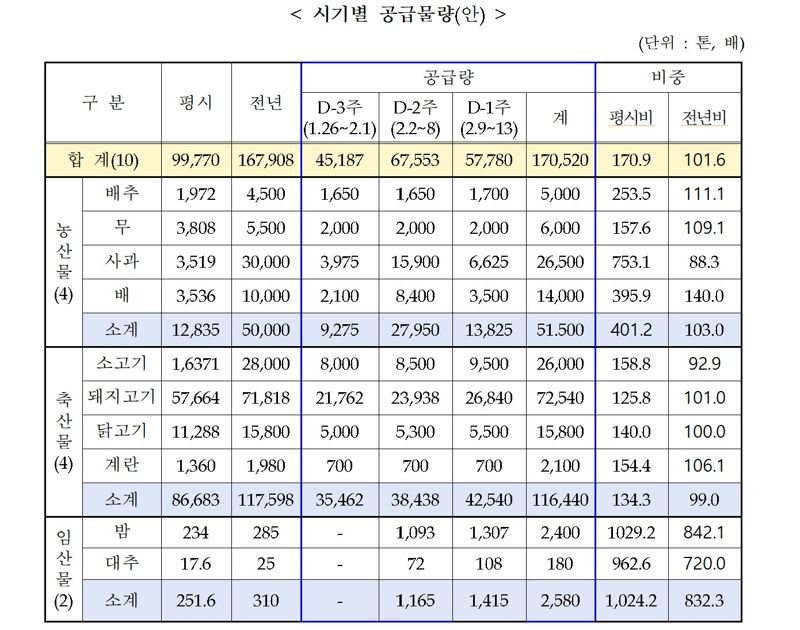
[The Financial News] The government has moved to rein in agricultural product prices ahead of the Lunar New Year holiday. It plans to release 270,000 tons of key holiday items from government stockpiles into the market. It will also launch a 91 billion won subsidized discount program. At each retailer, consumers will be able to buy major holiday items at up to half price, up to 20,000 won per person per week. In addition, new tariff-rate quotas will be applied to four agricultural and marine products, including mackerel.
On the 28th, the Ministry of Finance and Economy announced its “2026 Lunar New Year Cost-of-Living Stabilization Measures.” To stabilize prices of 16 key holiday items and other agricultural, livestock, and fishery products, the ministry unveiled three steps: a record 270,000 tons in supply, a record 91 billion won in discount support, and additional tariff-rate quotas for four agricultural and marine products. The 16 key holiday items are: vegetables and fruits such as napa cabbage, radish, apples, and pears; livestock products such as beef, pork, chicken, and eggs; forest products such as chestnuts and jujubes; and seafood such as pollock, squid, hairtail, yellow croaker, mackerel, and dried anchovies.
The government will release a total of 270,000 tons of the 16 key holiday items into the market, 1.5 times the usual volume. For napa cabbage, radish, apples, and pears, government-held stocks will be increased to up to four times normal levels. For livestock products, weekend operation of slaughterhouses and expanded shipments through agricultural cooperatives will raise supply to 1.4 times the usual level. Beef and pork supply will be increased to 104,000 tons, 1.4 times the normal volume, while chicken and eggs will be boosted to 18,000 tons, also 1.4 times the usual level.
In particular, the government will directly supply 13,000 tons of pollock, mackerel, and other items from its reserves to supermarkets and traditional markets, where they will be sold at up to 50% below prevailing market prices. The government also plans to process part of its reserved seafood into products such as frozen pollock fillets, salted mackerel, and packaged anchovies for stir-frying and braising, and then release them. This is the first time government reserves are being supplied not as raw products but in processed form. A Ministry of Finance and Economy official explained, “We decided to process government reserves so they can be supplied at the right time when prices are high,” adding, “The work will be carried out through the National Federation of Fisheries Cooperatives.”
The government will also provide a total of 91 billion won in budget-funded discount support. Consumers will be able to purchase major holiday items at up to 50% off, up to 20,000 won per person per week at each online and offline retailer. The discounts will be funded by both government subsidies and retailers’ own promotions. In traditional markets, the on-the-spot refund program for purchases made with the Onnuri Gift Certificate will be expanded from 27 billion won last year to 33 billion won this year. When consumers buy agricultural, livestock, and fishery products with Onnuri Gift Certificates, they will receive a 10,000 won refund for purchases between 34,000 and less than 67,000 won, and 20,000 won for purchases above that level.
New tariff-rate quotas will also be introduced for four agricultural and marine products: mackerel, bananas, pineapples, and mangoes. For mackerel, a tariff-rate quota will be applied to 25,000 tons through December this year. For bananas, pineapples, and mangoes, the measure will run through June. Currently, tariff-rate quotas apply to 22 items. For 12 of them, the quotas are in place until June this year, and for the remaining 10, until December. With the addition of four more items, tariff-rate quotas will now cover a total of 26 products.
Lee Joo-seop, Director General for Public Livelihood and Real Economy Policy at the Ministry of Finance and Economy, said, “In the case of mackerel under the tariff-rate quota, the catch volume in Norway has declined, which has pushed prices higher,” adding, “The prices of the other tropical fruits are also high. In coordination with the Ministry of Agriculture, Food and Rural Affairs, we will work to ensure that these measures lead to price reductions.” He went on, “We are also taking farmers’ interests into account. However, from the perspective of consumer welfare, the government has decided to apply tariff-rate quotas.”
However, farmers’ dissatisfaction is expected to grow over the government’s price-control measures. From the perspective of farm households, the application of tariff-rate quotas is effectively aimed at driving down agricultural prices. According to the Korea Rural Economic Institute (KREI) report “Analysis of the Impact of 2025 Import Tariffs on Agricultural and Livestock Products,” tariff cuts on bananas, pineapples, and mangoes—despite the fact that they are hardly grown domestically—have still had a negative impact on the domestic fruit market. As consumption of cheaper bananas has increased, consumption of domestically grown fruit has declined due to a substitution effect.
In fact, in 2024, tangerines saw declines in producer prices (-0.42%), production volume (-0.03%), and consumer prices (-0.30%). In 2024, 76.2% of banana imports were brought in under tariff-rate quotas, and the tariff reduction margin reached 16.9 percentage points, which is seen as having significantly amplified the substitution effect. This is because tariff-rate quotas, along with import dependence by item, the scale of tariff cuts, and the volume imported under the quotas, play a substantial role in price formation.
[email protected] Choi Yong-jun Reporter