FSS Special Judicial Police Gain Backing from President Lee... Grant of Ex Officio Investigative Powers Marks New Phase
- Input
- 2026-01-27 16:52:31
- Updated
- 2026-01-27 16:52:31
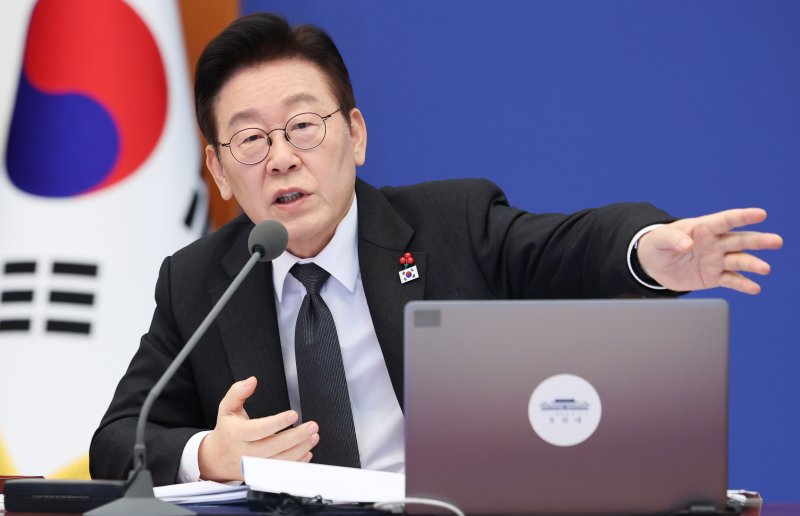
The Financial News reported that President Lee Jae-myung of South Korea on the 27th criticized the fact that the Financial Supervisory Service (FSS) Special Judicial Police Officers are barred from conducting ex officio investigations, calling it a "problem." The Financial Services Commission (FSC) has opposed expanding the FSS Special Judicial Police Officer system and granting it ex officio investigative powers, arguing this would amount to an abuse of authority, but Lee publicly threw his support behind the FSS.
During the State Council meeting he chaired that day at Cheong Wa Dae, Lee placed "discussion on expanding the introduction of Special Judicial Police Officers" on the agenda.
Lee stated, "If there is a serious criminal act, then in theory not only public officials but also ordinary citizens can make a citizen's arrest under current law," and went on, "Isn't it strange that a quasi-public institution entrusted with public duties cannot correct illegal acts unless a prosecutor gives approval?" At present, the FSS Special Judicial Police Officers are allowed to initiate and conduct investigations only into cases under the Financial Investment Services and Capital Markets Act (FSCMA) that are placed under the investigative direction of a public prosecutor.
Referring to the National Health Insurance Service (NHIS) and the Korea Internet & Security Agency (KISA), which are also seeking to introduce Special Judicial Police Officers, Lee said, "Let us apply this uniformly. We are introducing Special Judicial Police Officers because they are needed anyway, and it seems unfair to restrict only the FSS by requiring prosecutors' approval." In effect, he instructed that the FSS be granted broader authority as Special Judicial Police Officers for everyday financial crimes, including the power to launch ex officio investigations.
Observers say Lee is personally taking charge of the FSS Special Judicial Police Officer issue because he saw tangible results when he operated a similar system during his tenure as Governor of Gyeonggi Province. As a presidential candidate, Lee recalled, "I remember being shocked when I saw that among the illegal private lenders apprehended by Gyeonggi Province, there was a case where the maximum interest rate reached 31,000%." Under then-Governor of Gyeonggi Province Lee Jae-myung, the province's Special Judicial Police Officer teams grew to 20, and their investigative functions were expanded five times, eventually covering 108 areas.
Following last month's policy briefing, Lee has now personally stepped in on the question of ex officio investigative powers for Special Judicial Police Officers, and this is expected to speed up consultations between the FSC and the FSS. The FSS recently argued that the scope of duties for its Special Judicial Police Officers should be expanded beyond unfair trading in the capital markets and financial crimes affecting ordinary people, to include accounting oversight of general corporations and inspections of financial institutions, and that it should also be granted ex officio investigative powers. The FSC responded by saying the FSS had "crossed the line" and moved to block the plan.
Other government ministries have also urged caution about granting investigative powers to the FSS, a private-law entity, citing concerns over potential abuse of state authority. Justice Minister Jeong Seong-ho said that day, "Granting investigative powers ultimately entails the possibility of compulsory investigations, and the FSS already has many powers, including the ability to trace bank accounts without a warrant," adding, "If it becomes known externally that the FSS has begun an investigation, the impact on the capital markets could be very significant." Lee Eog-weon, Chairperson of the Financial Services Commission, also noted, "Because the FSS is a private organization, there were many concerns even when the Special Judicial Police Officer system was first introduced in 2015."
Nevertheless, the FSC plans to prepare measures to grant the FSS Special Judicial Police Officers ex officio investigative powers and establish control mechanisms, in line with the president's instructions.
[email protected] Park So-hyun Reporter