"I made a great deal with Lee" and rolled tariffs back to 25%—why? Trump singles out his 'reason' [Fact, Check Check Check]
- Input
- 2026-01-27 15:31:19
- Updated
- 2026-01-27 15:31:19
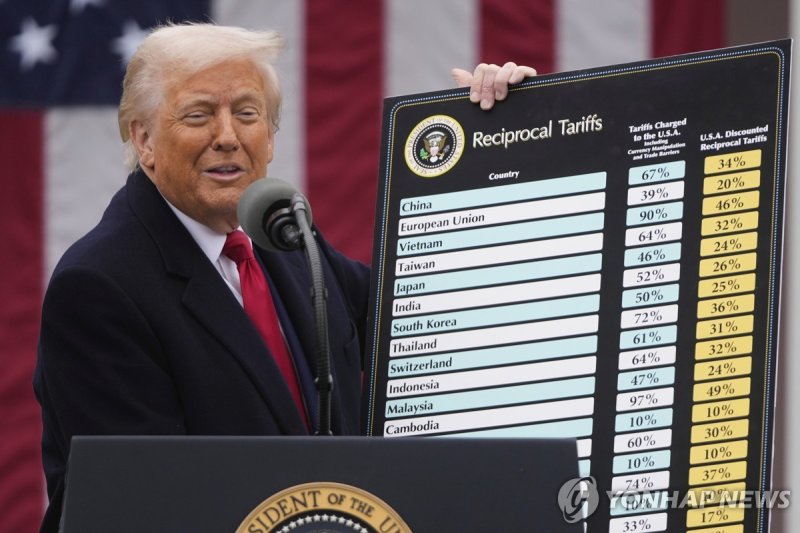
[The Financial News] U.S. President Donald Trump has directly criticized the National Assembly of the Republic of Korea, claiming that it has failed to carry out the legal procedures needed to implement the trade agreement between the Republic of Korea (ROK) and the United States. He also announced that he would restore tariffs on ROK products to the levels that applied before the trade deal.
On the 26th (local time), Trump wrote on his Truth Social social media account that "because the Korean legislature is not implementing the trade agreement, I will raise reciprocal tariffs and tariffs on items such as automobiles from 15% back to 25%."
Trump: "A great deal with President Lee Jae-myung... but"
Trump stressed, "Our trade agreements are extremely important to the United States. We have moved quickly to reduce tariffs in line with what was agreed in each deal," adding, "We expect our trading partners to take the same steps."
He went on, "The National Assembly of the Republic of Korea is not properly implementing its trade agreement with the United States," and recalled, "President Lee Jae-myung and I concluded a great trade deal that benefits both countries on July 30, 2025, and when I visited the ROK on October 29, 2025, we reaffirmed the terms of that agreement."
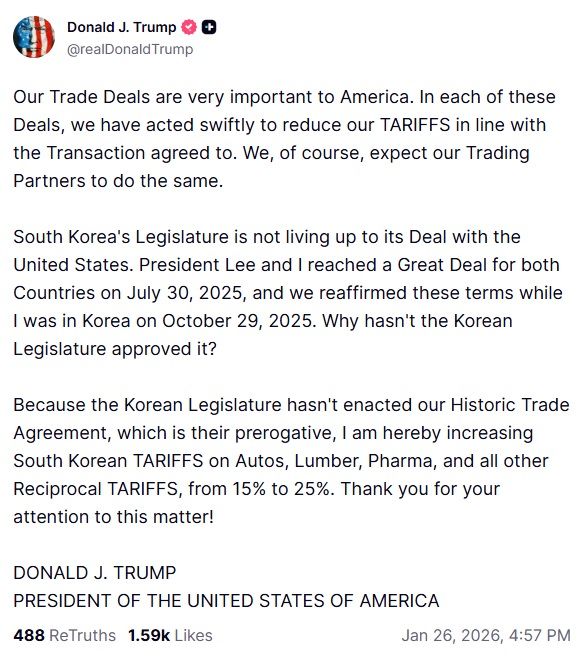
Trump then asked, "Why has the National Assembly of the Republic of Korea not approved this agreement?" and declared, "Because the National Assembly has failed to legislate our historic trade agreement, I am raising tariffs on automobiles, lumber, pharmaceuticals, and all other items subject to reciprocal tariffs from 15% to 25%."
However, he did not specify when the higher tariffs would take effect.
What is the 'great deal' Trump is talking about?
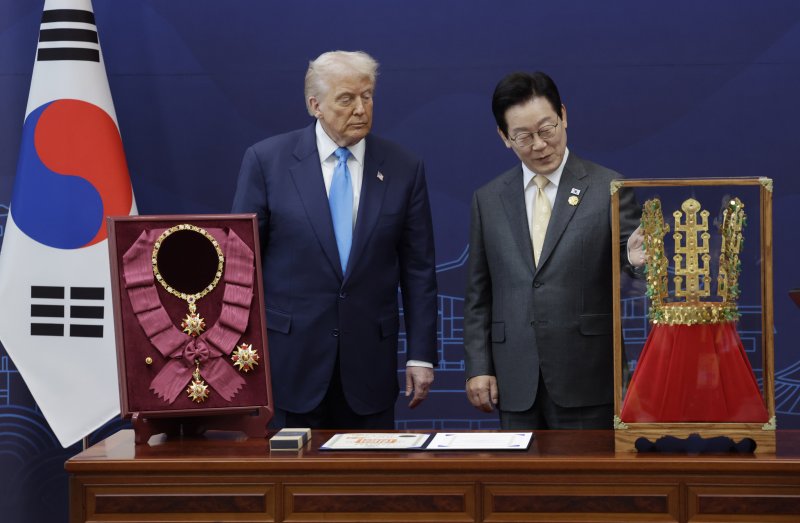
The ROK and the U.S. agreed last year, through negotiations on tariffs and security, to cut reciprocal tariffs and tariffs on items such as automobiles from 25% to 15%. The two leaders held a summit in Gyeongju on October 29 last year, and on November 13 they issued a joint fact sheet that included these points.
According to the fact sheet, in return for the ROK investing 350 billion dollars in the U.S., the U.S. would lower tariffs and reciprocal tariffs on ROK automobiles and other products, and would support or approve the ROK’s uranium enrichment, reprocessing of spent nuclear fuel, and introduction of nuclear-powered submarines.
Under the trade agreement, the ROK also committed to making investments in the U.S. of up to 20 billion dollars per year.
The two countries then signed the "Memorandum of Understanding on Strategic Investment between Korea and the United States (MOU)" on November 14, the day after the fact sheet was released. They agreed that the tariff cuts would be applied retroactively from the first day of the month in which the bill to implement the MOU was submitted to the National Assembly of the Republic of Korea.
On the 26th of the same month, the National Assembly introduced the Special Act on Investment in the United States, and the Trump administration retroactively cut tariffs on ROK automobiles and other products to 15% as of December 4 last year, when the measure was published in the Federal Register.
Why is Trump pinning the blame squarely on the National Assembly of the Republic of Korea?
The ROK–U.S. tariff talks had been proceeding smoothly.Trump’s sudden decision to slam on the brakes is being attributed not to the Lee Jae-myung administration, but to the National Assembly of the Republic of Korea.For the ROK to fulfill the investments it promised the U.S., the National Assembly must pass the "Special Act on Strategic Investment Management between Korea and the United States"—better known as the Special Act on Investment in the United States.
Observers believe Trump has seized on the fact that ratification of the agreement has been delayed in the National Assembly.
The bill, introduced by the Democratic Party of Korea (DPK) on November 26 last year, is currently under review by the Strategy and Finance Committee of the National Assembly, which has jurisdiction over it.
The delay in the National Assembly’s vote appears to stem from differing legal interpretations and conflicting interests between the ruling and opposition parties.The ruling DPK has questioned whether there is any need to elevate the U.S. investment arrangements, which are in the form of an MOU, to the level of a treaty like the United States–Korea Free Trade Agreement (KORUS FTA).Its argument is that the agreement should be implemented swiftly without a lengthy ratification process in order to minimize damage to businesses.By contrast, the opposition People Power Party (PPP) insists that the deal must go through formal ratification.The PPP maintains that the agreement contains an extraordinarily large volume of ROK investment in the U.S. that could be excessively unfavorable to the ROK side, and therefore the National Assembly must scrutinize the terms.
Although the DPK holds a majority in the National Assembly and could push the ratification through on its own, concerns have been raised that forcing it through on a purely numerical basis, over the opposition’s objections, could trigger a political backlash.
Is the National Assembly of the Republic of Korea really to blame?
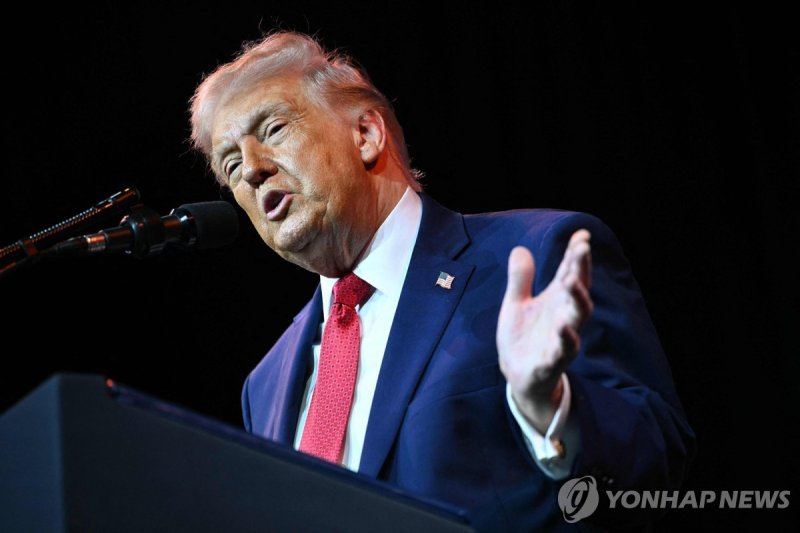
Trump’s abrupt move to raise tariffs has prompted a range of interpretations.
In response, the ROK government decided to dispatch Minister of Trade, Industry and Energy Kim Jung-kwan to the U.S. as soon as possible to grasp the Trump administration’s exact intentions and devise countermeasures.
A trade expert, speaking by phone, cautioned, "We should not take Trump’s talk of restoring tariffs at face value. He may have raised it for a variety of reasons," adding, "With the U.S.’s true intentions unclear, the ROK government finds itself in a highly uncomfortable position."
Many observers say it is hard to understand why Trump is singling out the National Assembly of the Republic of Korea as the culprit.
Japan, for example, moved quickly through its parliamentary procedures right after reaching a trade agreement with the U.S. last July and began implementing the deal in September. By contrast, the European Union (EU) has chosen to slow-walk the procedures needed to pass its own agreement.
Given that the U.S. has accepted that the EU’s legislative process will take some time, questions are being raised as to whether there is some other reason why Washington has pulled out such a hard-line card against the ROK alone, citing "parliamentary ratification."Some analysts suggest that the ROK government, while pursuing a trade agreement with the U.S., may have irked Trump by taking steps in other areas that run counter to U.S. interests.That view is also gaining traction.The proposed amendments to the Act on Promotion of Information and Communications Network Utilization and Information Protection and the online platform regulation bills introduced in the National Assembly are often cited as examples.On top of that,the U.S. government and the United States Congress have criticized the ROK government’s stance toward Coupang Inc., which has clashed with Seoul over a massive personal data leak, arguing that "the ROK government is excessively cracking down on U.S. companies."This has also become a sticking point.
Another factor often mentioned is a recent interview in which Minister of Economy and Finance Koo Yun-cheol told foreign media that it would be difficult to execute the planned investments in the first half of this year because selecting the investment projects is taking longer than expected.
From legacy media to YouTube and social media, the ways we consume content have diversified. At the same time, we live in an era flooded with fake news and disinformation.Fact, Check Check Checkis committed to fact-based journalism to the core. We investigate the truth behind controversial news and rumors, and we verify the facts. "Is this news really true?" We welcome tips and questions from our readers.
[email protected] Reporter Seo Yoon-kyung Reporter