President Lee: "Excessive expansion in real estate is inevitably a bubble... It can severely damage the economy"
- Input
- 2026-01-27 11:16:14
- Updated
- 2026-01-27 11:16:14
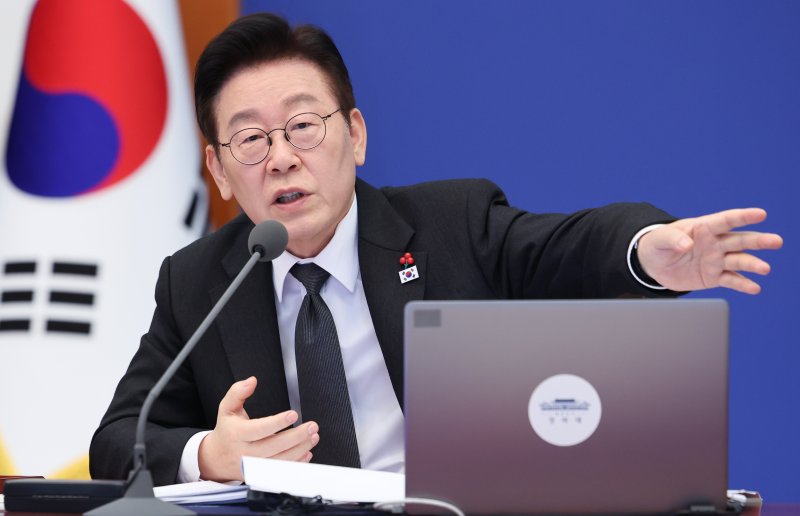
According to The Financial News, President Lee Jae-myung stated on the 27th, in relation to real estate issues, that "we must never leave unfair and abnormal practices unattended just because we fear the immediate pain and resistance in front of us." His remarks came after he recently signaled, through a social networking service (SNS), that the temporary suspension of heavier capital gains taxation on multiple-home owners will end as scheduled and that property holding taxes could be strengthened. The comments are being seen as a renewed emphasis on his determination to stabilize the housing market. Lee also called for the government to prepare proactive measures that the market is seeking.
Presiding over the State Council meeting at Cheong Wa Dae that day, President Lee said, "Real estate issues have recently become a matter of heated debate," adding, "To truly achieve growth for all through a major transformation of our economic structure, we must correct the distorted allocation of resources in our society, which are abnormally concentrated in real estate."
He particularly warned that "the excessive expansion of unproductive real estate inevitably inflates a bubble," and went on, "It not only undermines our growth potential, but could also inflict serious damage on the entire national economy. Furthermore, it can erode trust among members of society and even shake the very safety of our community."
Lee stressed that "we must firmly rein in wrongful expectations of pursuing unfair gains," and again underlined his plan to end the temporary easing of heavier capital gains taxation on multiple-home owners. He said, "When we extended the heavier capital gains tax relief for multiple-home owners last year, it was clearly for only one year. It ends on May 9 this year. That was already explicitly scheduled," adding, "Unless we revise the enforcement decree again, it simply expires." He continued, "Yet people are assuming, 'Of course it will be extended,' and based on that wrongful and unjustified expectation, they demand an extension. When I said it would not be extended and that it was already set to end, some attacked the policy as if we were newly imposing heavier capital gains tax on real estate."
Lee went on, "It may be a misunderstanding, but it could also be an unfair attack," and added, "We must not be swayed by this. At the same time, we should thoroughly address any resulting problems, and even if there is fierce debate, once a decision is made, it must be implemented as is. Only then can we have a predictable and rational society."
Lee again highlighted the need for policy consistency. He noted, "We say tax cuts and similar measures are temporary, but we keep extending them. Whenever we say a measure will sunset, there is resistance and criticism, and this has become routine," stressing, "If those with power can get things changed while those without power cannot, that is absolutely unacceptable."
He also reaffirmed his commitment to stabilizing the real estate market. Lee said, "We must take to heart the painful lesson of a nearby country that suffered a 'lost 20 years' or even a 'lost 30 years' and great turmoil because it failed to properly control a real estate bubble," adding, "To avoid such hardship, we must push ahead with effective policies consistently and in a stable manner, grounded in firm determination."
At the same time, Lee emphasized that "we must also pursue proactive measures that the market itself is calling for."
[email protected] Choi Jong-geun and Sung Seok-woo Reporter