Moon Hyung-bae, Newly Appointed at KAIST, Says, "Without Independence, It Is Not a Judiciary"
- Input
- 2026-01-27 08:03:24
- Updated
- 2026-01-27 08:03:24
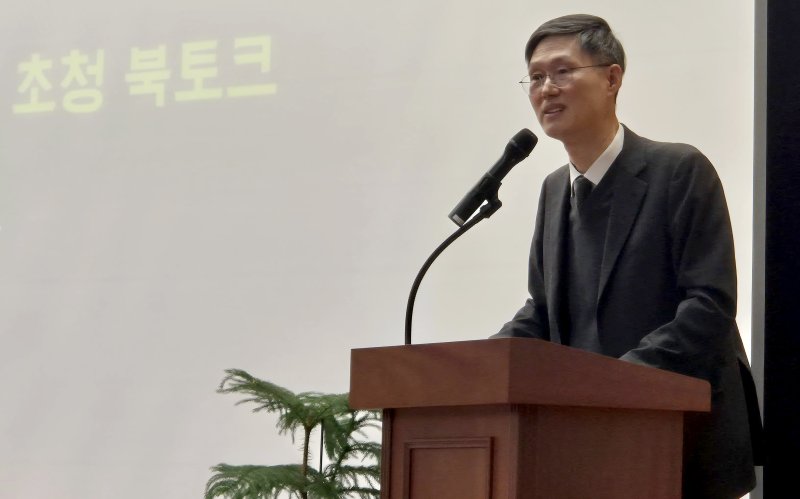
According to The Financial News, Moon Hyung-bae, former Acting President of the Constitutional Court of Korea, announced that he has taken up a position as a visiting distinguished professor at the Korea Advanced Institute of Science and Technology (KAIST), stating that he intends to "play a role as a legal expert in the artificial intelligence (AI) industry."
He expressed his intention to "serve as a legal expert for AI legislation."
Moon, speaking as a guest lecturer at the "2026 Gwangju High and District Courts New Year Book Talk with Distinguished Guests" held at the Gwangju courts on the 26th, revealed this fact and remarked, "I recently became a visiting distinguished professor at KAIST and am no longer unemployed," adding, "Many universities expressed interest in inviting me, but I did not want to go to a place with a law school."
He also shared his firm views on "AI legislation."
He explained, "The biggest issue with AI is the right to informational self-determination. Because AI collects personal information as data, it is bound to clash with the other party’s right to control their own personal information."
He went on to say, "Korea was the second country in the world, after Europe, to implement a basic AI law. The United States, by contrast, takes the position that companies should voluntarily draw up and apply their own guidelines," stressing, "They believe that legal regulation will stifle the AI industry."
Moon continued, "Europe is implementing regulations only in part, whereas Korea is enforcing AI legislation across the board. If you fail to indicate that content was created by AI, you can be fined," and added, "No one knows yet whether this will be effective."
He further noted his goals as a visiting professor, saying, "To resolve the challenges facing the AI industry, the involvement of legal experts is essential, and in my view, they must be engaged from the early stages."
He also voiced concern over the DPK’s judicial reform and delivered sharp criticism toward the courts.
During the lecture, he also expressed concern about the judicial reform drive of the ruling Democratic Party of Korea (DPK).
Moon said, "There is a major difference between the roles of politicians and legal professionals. Legal professionals must offer legal and academic criticism in their capacity as legal experts," as he brought up the DPK’s judicial reform agenda.
He stated, "I believed that some parts of the judicial reform proposed by the DPK could not be implemented, and I do not regret having expressed that view. Judicial independence is a fundamental condition for the Judiciary to exist," adding, "If it is not independent, it is not a Judiciary. If there is a problem, you should correct the people, so why try to tamper with the system?"
He did not spare criticism of the courts themselves, which became the starting point for calls for judicial reform.
Citing the detention case of former President Yoon Suk Yeol as an example, Moon criticized, "We have never once calculated a detention period in hours instead of days. There is such a firmly established practice, so why change it? If there was a need to change it, it should have been done in cases involving ordinary citizens, so why change it in a presidential case?"
Moon added, "It is truly difficult to be a good judge. It is far too easy to be a bad judge. The responsibility for narrowing that gap also lies with the courts, and that is their fate," and asked, "If the Judiciary, which is facing public criticism over its decision to cancel a detention order, demands 'independence of adjudication,' will anyone accept that?"
He concluded by advising, "You must earn the trust of the people. You should devote yourselves to securing confidence in the courts’ decisions."
[email protected] Reporter Seo Yoon-kyung Reporter