Yun Ho-jung: “For low birth rates and regional decline that budgets have failed to fix, the answer is the social and solidarity economy”
- Input
- 2026-01-27 05:00:00
- Updated
- 2026-01-27 05:00:00
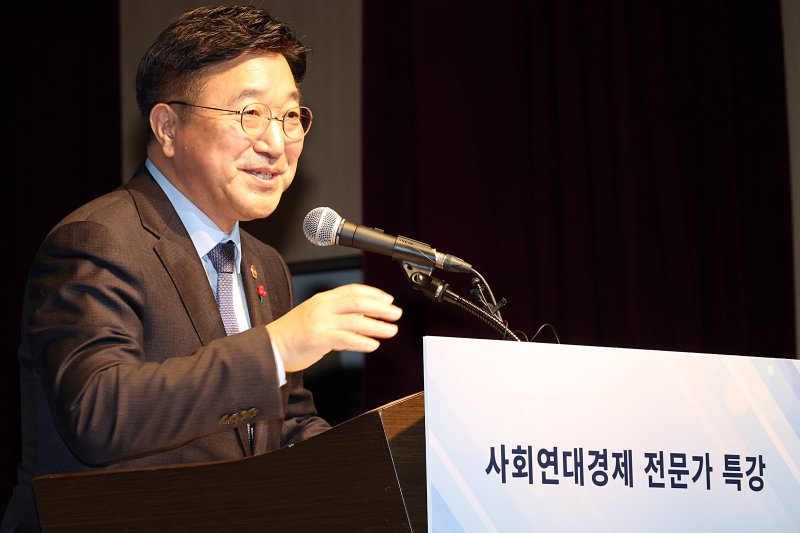
[The Financial News] Minister of the Interior and Safety Yun Ho-jung said on the 26th, “The answer to the question of what to do about issues that cannot be solved by government budgets and policies turned out to be the ‘social and solidarity economy.’”
In his remarks at a “special lecture on the social and solidarity economy” for all staff at Government Complex Sejong that day, Minister Yun recalled, “We poured enormous budgets and policy capacity into tackling low birth rates, population decline, and population concentration in the Seoul metropolitan area, but the problems have not been resolved.”
He went on, “I asked myself why we are failing on these issues, and what it is that we could do but have not done,” adding, “In the end, I came to recognize that there are clear limits to what the government can do with budgets and policies alone.”
Minister Yun said, “If citizens, acting as members of their communities, voluntarily step forward to tackle social problems, and if the market recognizes the value of those efforts so that communities can sustain themselves, that will become a powerful force.”
The social and solidarity economy (SSE) refers to economic activities that address social problems through the voluntary participation and cooperation of members of society. Representative examples include social enterprises, cooperatives, community enterprises, self-support enterprises, social ventures, and impact businesses. MOIS is the lead ministry for SSE policy and is pursuing related initiatives as a core national agenda of the current administration.
Kim Jonggul, professor at Hanyang University Graduate School of International Studies and Chairperson of the Policy Advisory Committee to the Minister of the Interior and Safety, who delivered the lecture, said, “The social and solidarity economy does not exist to maximize profit,” explaining, “Its strength lies in putting the problems of members and local communities front and center, and in adhering to people-centered democratic principles.”
Professor Kim noted, “Because profit is not the top priority, these organizations are not swayed by short-term results, and they build up trust and relationships,” adding, “Over the long term, this relational capital becomes the foundation for higher productivity and stability.”
He also introduced research by the Government of the United Kingdom, which analyzed cooperatives and found that they had lower absenteeism and turnover, and higher productivity and customer satisfaction, than ordinary companies.
As a domestic example, he pointed to a financial cooperative established by residents of the jjokbangchon in Dongja-dong, Seoul. The cooperative was run on capital voluntarily contributed by residents, and its loan repayment rate rose from 66.4% in 2012 to 93.7% in 2023. This is higher than the repayment rate at the Korea Inclusive Finance Agency, which offers similar financial products.
Professor Kim cited the “building of trust-based networks” as the driving force behind these results. He explained, “As residents became the agents of solving their own problems through a financial cooperative they created themselves, their social networks were restored and they regained a sense of pride in their lives.”
However, he drew a line against unconditional support for the SSE. “You do not receive support just because you are part of the social and solidarity economy, and an attitude of ‘we are a cooperative, so support us’ can undermine the purpose of public finances,” he stressed. “Any organization must first demonstrate its own problem-solving capacity and performance.”
He also addressed the role of the state, saying, “The government must be responsible for a basic safety net in areas such as housing, finance, healthcare, and livelihood, but if it tries to solve everything, the private sector’s capacity for self-reliance will weaken,” and added, “SSE can take root only if policies are designed to foster the people on the ground and the leaders who guide them.”
[email protected] Reporter Lee Bomi Reporter