Two New Nuclear Reactors to Proceed as Planned, Marking Official End to Nuclear Phase-Out Policy
- Input
- 2026-01-26 10:30:00
- Updated
- 2026-01-26 10:30:00
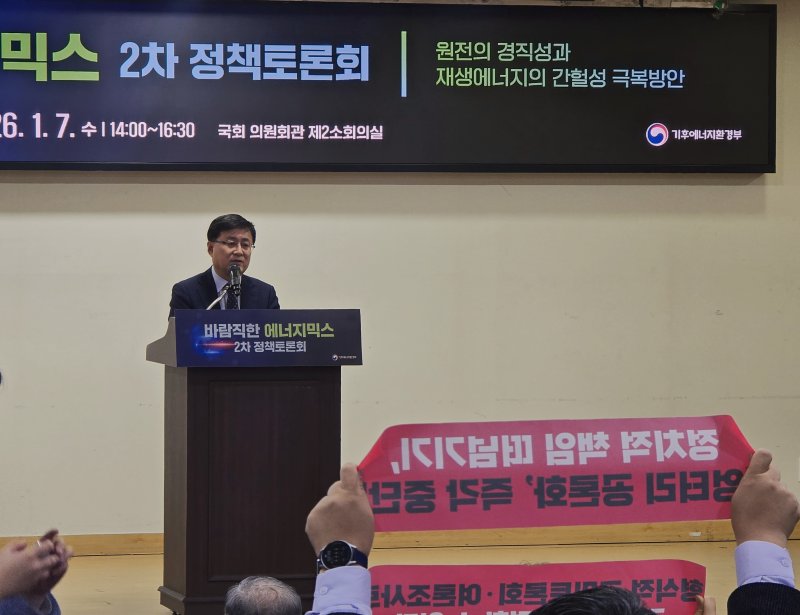
According to The Financial News, the Lee Jae-myung administration will move forward as planned with the construction of two new nuclear reactors included in the 11th Basic Plan for Electricity Supply and Demand. This effectively amounts to raising the white flag on the nuclear phase-out declared eight years and seven months ago under the previous Democratic Party-led Moon Jae-in administration. The decision is expected to signal that South Korea's energy policy is shifting away from ideology and back toward practical realities.
On the 26th, Minister of Climate, Energy and Environment Kim Sung-hwan announced at a briefing at Government Complex Sejong that the new nuclear power plants in the 11th Basic Plan for Electricity Supply and Demand will proceed as scheduled. Earlier, the Ministry of Climate, Energy and Environment (MCEE) held two policy debates on the new nuclear projects in the 11th Basic Plan for Electricity Supply and Demand and conducted public opinion surveys through two separate institutions. The surveys found that, among energy sources that should be expanded in the future, renewables ranked first and nuclear power second, with more than 80% saying nuclear power is necessary and over 60% responding that the new nuclear projects in the 11th Basic Plan for Electricity Supply and Demand should go ahead.
The government's latest decision is being interpreted as an abandonment of the Moon Jae-in administration's nuclear phase-out policy.
On June 19, 2017, at a ceremony declaring the permanent shutdown of Kori Nuclear Power Plant Unit 1, President Moon Jae-in declared, "We will scrap the nuclear-centered energy policy." That moment marked the first official shift in South Korea's energy policy under the banner of a "nuclear phase-out." Eight years later, on January 26, 2026—exactly 3,143 days on—the Lee Jae-myung administration has once again placed nuclear expansion at the forefront. In effect, it is a complete retreat from the nuclear phase-out.
The core rationale of the Moon Jae-in administration's nuclear phase-out policy was safety and decarbonization. In the wake of the Fukushima nuclear accident, public anxiety over the risks of nuclear power was high, and the government envisioned expanding renewable energy and gradually reducing nuclear power over the long term. Reality, however, unfolded differently. Cutting back on nuclear power did not automatically translate into a surge in renewables. The gap was filled not by solar power, but by Liquefied Natural Gas (LNG). Greenhouse gas emissions did not fall, and the cost of power generation actually rose.
Electricity prices emerged as the clearest aftereffect of the nuclear phase-out policy. From 2021, as global fuel prices soared, the cumulative deficit at Korea Electric Power Corporation (KEPCO) exceeded 40 trillion won. With nuclear utilization reduced and the share of LNG-fired generation increased, the structure pushed up power production costs, which were ultimately passed on to consumers through higher bills. The banner of a "safe energy transition" lost credibility in the face of rising electricity charges for households and businesses.
Minister Kim emphasized, "To respond to climate change, we must cut carbon emissions across all sectors, and in particular, we need to reduce coal and LNG power generation to lower emissions in the power sector. This requires operating the power system with a focus on renewable energy and nuclear power." To that end, MCEE plans to address the intermittency of renewables through Energy Storage Systems (ESS) and pumped-storage power generation, and to mitigate the inflexibility of nuclear power through more flexible operation.
In the 12th Basic Plan for Electricity Supply and Demand, the ministry also aims to scientifically and objectively reflect projected electrification demand driven by the expansion of Artificial Intelligence (AI) and electric vehicles, as well as the energy mix and decentralized power grid plans needed for carbon neutrality. MCEE plans to incorporate the contentious issues raised during the latest round of public consultations and continue gathering public input through various forms of engagement.
Under the 11th Basic Plan for Electricity Supply and Demand, the new nuclear reactors will move forward through a site selection process that will begin soon with a call for candidate sites by Korea Hydro & Nuclear Power (KHNP). Site evaluation and selection are expected to take about five to six months, with the goal of obtaining construction permits in the early 2030s and completing the plants around 2037–2038.
[email protected] Lee Yu-beom Reporter