Kang Hoon-sik Says Canadian Submarine Bid Now Between Korea and Germany... Hyundai Motor Joins Special Envoy Delegation
- Input
- 2026-01-26 10:00:07
- Updated
- 2026-01-26 10:00:07
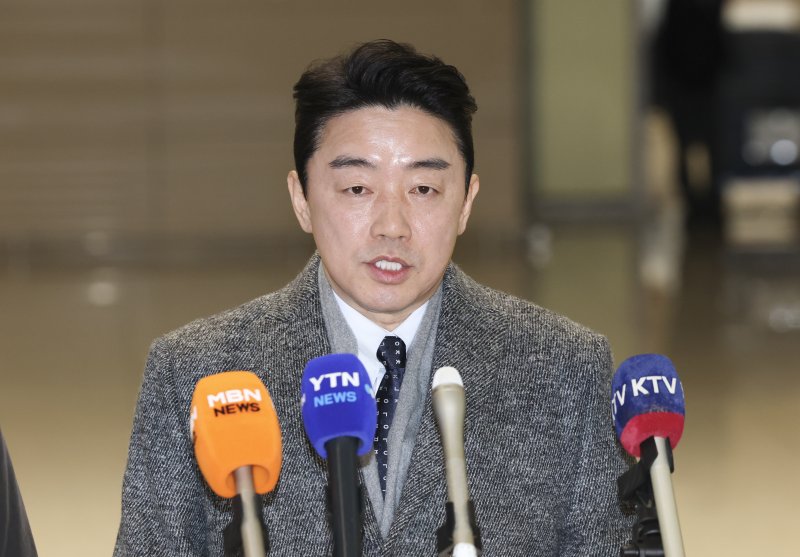
According to Financial News, Presidential Chief of Staff Kang Hoon-sik left for Canada on the 26th as the Presidential Special Envoy for Strategic Economic Cooperation. Kang and the special envoy delegation plan to discuss defense industry cooperation in Canada, including the submarine program. The delegation includes Minister of Trade, Industry and Energy Kim Jung-kwan, Defense Acquisition Program Administration (DAPA) Commissioner Lee Yong-cheol, and executives from Hanwha Group and HD Hyundai Heavy Industries, which are directly pursuing the submarine project. Hyundai Motor Group is also joining the trip in a supporting role. In particular, Hyundai Motor Group Chairman Chung Eui-sun and Kim Dong-kwan, vice chairman of Hanwha Group, are reported to be accompanying the delegation. After Canada, Kang is also scheduled to visit Norway.
Speaking to reporters just before departure at Incheon International Airport, Kang said, "As has been mentioned in media reports and on several occasions by the Canadian government, the submarine contract has effectively been narrowed down to the Republic of Korea and Germany," adding, "We will do our utmost to win this bid."
He noted, "Germany is a manufacturing powerhouse in automobiles and advanced chemicals, and considering that we received technology transfer from Germany in the early stages of our submarine development, we judge that the situation is by no means easy." However, he stressed, "This submarine contract is one of the largest ongoing defense projects. We estimate that the domestic production inducement effect alone will exceed at least 40 trillion won, and if we succeed in winning the bid, it will not only provide work for more than 300 partner companies but is also expected to create over 20,000 jobs."
In Canada, the special envoy will support the bid for the Canadian Patrol Submarine Project (CPSP), a 60 trillion won patrol submarine program for which Hanwha Ocean and HD Hyundai Heavy Industries have formed a consortium. Kang plans to meet Canada’s top government officials and convey Seoul’s intention to expand bilateral industrial and security cooperation.
Regarding the bidding strategy, Kang said, "The Canadian government has stated that for this submarine project, factors such as job creation and industrial cooperation will be important criteria, in addition to the performance and price of the submarines themselves." He continued, "We are preparing a meeting table that can serve as a symbol of industrial cooperation, and we intend to focus on building a framework where Canada and Korea can achieve a win-win industrial partnership."
He went on to explain, "This is not simply about proposing a defense project based only on security cooperation. Economic cooperation and a wide range of public–private partnerships must proceed in parallel, and it is an issue that requires the entire presidential office to pool its strength and coordinate its views."
Kang also remarked, "There is a Canadian saying that a true friend comes to visit in winter. I am told that this week Canada is suffering from a severe cold wave, with temperatures hovering around minus 30 degrees Celsius," adding, "If we can raise our chances of winning the contract even a little, and if we can convey Korea’s sincerity, our delegation believes its role is to do everything possible during this visit."
Asked about Hyundai Motor Group’s participation in the delegation, Kang replied that there would be an opportunity to explain in more detail if circumstances allow. He added, "We are going with many things prepared, but it is not appropriate for us to disclose all the specifics. Since we have a competitor, revealing everything here would not be very helpful to our national interest."
The CPSP is a major project to build up to 12 diesel-powered submarines. Including the construction cost of the submarines, estimated at up to 20 trillion won, and 30 years of maintenance, repair, and operations (MRO) after delivery, the total project value could reach as much as 60 trillion won. A joint "one-team" consortium of Hanwha Ocean and HD Hyundai Heavy Industries has been shortlisted alongside Thyssenkrupp Marine Systems (TKMS) of Germany, and the two sides are in final competition ahead of an announcement expected in June this year.
Canada is reported to have requested offset-style industrial cooperation from both Korea and Germany in connection with the submarine project. Offsets refer to arrangements in which, when importing foreign weapons or equipment, the buyer secures benefits such as technology transfer, export of locally manufactured parts, or logistics support from the contractor.
At present, Canada is said to be asking both shortlisted bidders, Korea and Germany, to build infrastructure along the Canadian coast for submarine maintenance and repair. In addition, Canada has reportedly proposed the construction of a local Hyundai Motor plant as a bidding condition for Korea, and additional Volkswagen facilities as a condition for Germany.
[email protected] Choi Jong-geun Reporter