International Gold Price Tops $5,000 for the First Time, Rewriting Financial Rules
- Input
- 2026-01-26 09:15:57
- Updated
- 2026-01-26 09:15:57
[The Financial News] Gold, the oldest safe-haven asset in human history, has opened a new chapter.
As of 8:40 a.m. on the 26th, Korea time, gold futures on the New York Mercantile Exchange (NYMEX) COMEX division hit $5,032.50 per ounce (about 7.28 million won during intraday trading. This is the first time in history that prices have broken through the $5,000 level, a major psychological and economic barrier. The price has nearly doubled in just over a year, after hovering around $2,700 at the end of 2024.
The latest surge in gold is seen as more than a simple imbalance between supply and demand; it is being interpreted as a tectonic shift in the global economic paradigm. The most decisive factors are eroding confidence in the US dollar and the normalization of geopolitical risk. As warnings grow that the United States of America (U.S.) is approaching a critical point in its massive fiscal deficits and the Federal Reserve System (Fed) loses some control over monetary policy, investors have been shifting en masse from fiat currencies into physical assets such as gold. Prolonged conflicts in the Middle East and Eastern Europe, which are spreading into broader resource wars, have further intensified the preference for safe-haven assets.
One key development is the behavior of central banks. Emerging economies such as China, India, and Brazil are buying tens of tons of gold every month as part of their "de-dollarization" strategies, sharply reducing the share of the US dollar in their foreign-exchange reserves. Private investors are also pouring record amounts of money into spot gold exchange-traded funds (spot gold ETF), creating a powerful floor under prices even as some warn that gold may already be overvalued. In the past, it was taken for granted that gold prices would fall during interest rate hikes, but a "new rule" has emerged in which gold continues to soar even in a high-rate environment.
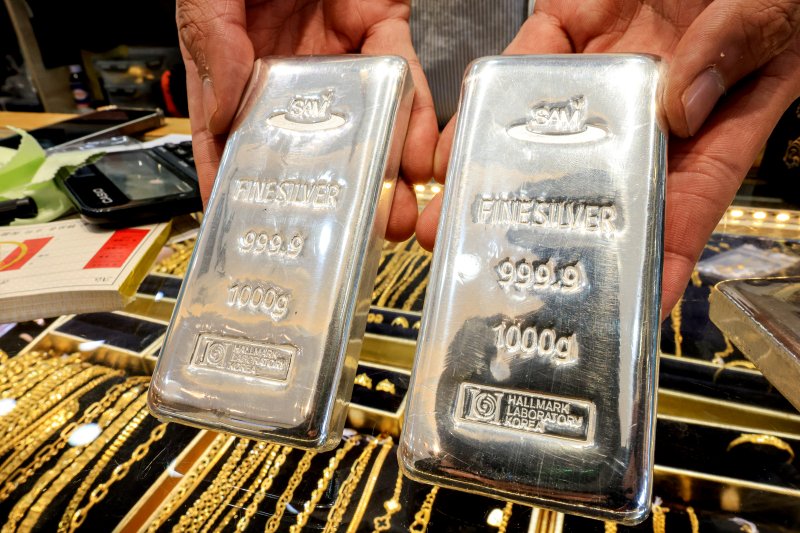
Markets are now focusing on the monetization of gold. Wealthy investors, exhausted by the volatility of the Virtual Asset market, are returning to tangible assets, and gold is increasingly seen not just as a precious metal but as the strongest alternative currency. On top of this, demand for industrial gold is rising due to power grid expansion and advanced device manufacturing driven by the rapid growth of Artificial Intelligence (AI) industries, further deepening the supply-demand imbalance. In this environment, silver prices have also entered the era of $100 per ounce, signaling that the broader commodities market has moved into a powerful bull phase.
Major investment banks, taking into account inflation-adjusted real values, are issuing bold forecasts that gold could climb to $6,000 per ounce within the year. Some analysts argue that the age of paper money is fading and that we are entering a "golden age" in which the value of physical assets is being reassessed.
At the same time, there are growing concerns that this gold frenzy may be an early warning sign of an impending collapse in the global credit system. For now, however, the market consensus is that there are no clear catalysts in sight that could bring the gold rally to a halt.
[email protected] Kim Kyung-min Reporter