[Editorial] Suspension of Tax Benefits for Owners of Multiple Homes: The Real Impact on Housing Prices Must Be Examined
- Input
- 2026-01-25 19:07:41
- Updated
- 2026-01-25 19:07:41
The President argued, "Unfair benefits arising from abnormal arrangements must be eliminated, even if it is difficult," and stressed, "Abnormal, speculative holding behavior must not be rewarded." He went on, "Even if there is pain and resistance in the process of escaping from a republic built on unearned real estate gains, racing toward a 'lost 30 years,' we must not shy away from it." Referring to the amendment to the Commercial Act, he recalled that "there were voices claiming that companies and the country would collapse" but asked rhetorically, "Once the amendment was passed, did companies, the nation and society not all improve?" The message is that, even at the cost of some backlash, he intends to push ahead as planned with the process of normalizing the housing market.
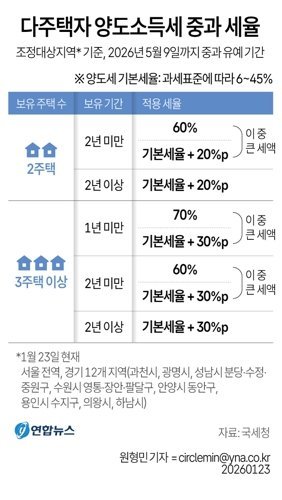
The heavy capital gains tax is a system that adds 20 percentage points to the basic tax rate of 6–45% for owners of two homes and 30 percentage points for those with three or more. Since its introduction in 2004, it has repeatedly been enforced and suspended depending on the administration. If the heavy tax, which has been suspended since May 2022, is reinstated, owners of multiple homes who sell properties in an Area Subject to Adjustment on or after May 10 will have to pay up to 82.5% of their capital gains in tax.
It is difficult to draw a definitive conclusion about the policy effectiveness of imposing a heavy capital gains tax on owners of multiple homes. In the short term, people trying to avoid the higher tax burden may rush to sell before May, which could temporarily increase the number of properties on the market. As these tax-saving sales grow, they may help put a brake on rising prices. The real problem, however, begins after the heavy tax is back in force. If more owners of multiple homes choose to hold rather than sell in order to avoid the increased tax, the market could face a shortage of listings and a collapse in transaction volume. In a situation where, under the October 15 Housing Market Stabilization Measures, all of Seoul has been designated a Land Transaction Permit Zone, even properties that do come onto the market may not find buyers, which would inevitably limit the impact of the policy.
During the presidential campaign, Lee Jae-myung pledged, "I will not try to control housing prices through taxes," and at a recent New Year press conference he also remarked, "We are not giving serious consideration to real estate policy through the tax system." Nevertheless, by deciding to let the heavy capital gains tax take effect as scheduled, the administration has already played its tax card. Kim Yong-beom, Chief Presidential Secretary for Policy of the Republic of Korea, has even raised the possibility of higher taxes on owners of a single high-priced home, leading many in the market to believe that an increase in property holding taxes is only a matter of time.
The core of housing policy is supply. That said, when speculative demand overheats, tax-based restraint can play a certain role. The challenge is precision. Because tax measures affect all potential buyers and owners, they require the same careful, targeted approach as a surgical operation. Past tax-centered policies fueled the "one smart home" strategy, concentrating demand on a few prime areas and widening regional disparities. The heavier tax burden was also passed on in the form of higher jeonse deposits, creating new side effects. Ignoring these lessons and trying to suppress demand solely through even stronger taxes risks repeating previous policy failures.
If the government clings to short-lived price effects, its policy could become the "fool in the shower," swinging between hot and cold. It must look beyond May 10 and adjust both the pace and intensity of tax measures in line with expected changes in supply and demand, while presenting a clear timetable for medium- to long-term housing supply and demand forecasts by region. Only a comprehensive, forward-looking approach that minimizes side effects will be able to stabilize the housing market around genuine end-users.